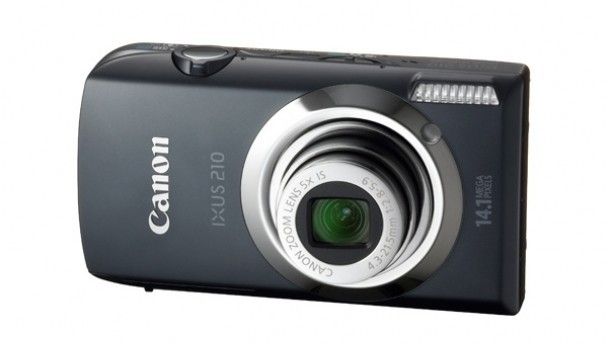
JOE got its hands on a shiny IXUS 210 for the past week and after much soon-to-be deleted shenanigans, we felt compelled to share our thoughts.
Released in February, the Canon IXUS 210 is another release from Canon’s much-vaunted 2010 IXUS range, and we at JOE have been lucky enough to play around with one in the office for the past week. Boasting one of the most advanced (not to mention giant, at 3.5â€) touchscreens on the market, the 210 is also boosted by an extended Smart Auto Mode – so does this IXUS live up to the hype?
The first impression anyone in the JOE office had from placing the 210 in their hands was one of ressaurance. Unlike a lot of dinky, lightweight digital compacts on the market, Canon’s camera carries a comforting heft and weight, coupled with lovingly-designed contours that slip right into the shape of your hands. It feels expensive, in a reassuring sense – already you feel the camera might be money well spent.
Of course, the devil is in the details, and luckily, here Canon pass with flying colours – the IXUS features a 14.1 Megapixels sensor, an ultra wide-angle 24mm lens, an advanced touch screen and HD movie recoreding. Indeed, the 210’s PureColor II touch screen is one of the first features that draws remarks time and time again – initially it feels unfeasibly large, especially considering the back of the camera features no physical buttons.

Yes, the gold version is actually made of real fake gold
While a button-free horizon seems to be our inevitable future (ask smart phone users), naturally it does take a little time to adjust to such a set-up when implemented within a camera. However, considering the IXUS is considered Canon’s ‘prestige’ range among digital compacts, consider it a glimpse of soon-to-be normalcy. Sure, we occasionally haphazardly touched the photo itself rather than the arrows while skimming through photos, but in all, the lack of physical buttons left a less daunting, more approachable impression upon us. If you’re someone that needs tactile feedback from your handheld gizmos, however, it may be time to admit defeat.
One of the most impressive features of the 210 is its ease of use – you can take stunning photos without really trying. The wide-angle lens ensures you catch a lot of detail with each shot, and this extra information is a huge advantage when you’re deciding whether to keep or crop your efforts – if anything, the surplus details ensure that unlike many of the less-advanced digital compacts, you have that option to really transform your creations effectively, rather than being resigned to your initial efforts.
Ease of use
If, like ourselves, you prefer to snap away without much post-analysis, the IXUS does everything it can to ensure your photos look great the first time around. The Smart Auto and Face Detection functions essentially ensure that beneath the hood of your 210, the camera is doing everything it can to maximise your photo as you peer through the lens.
Smart Auto automatically detects the optimal settings for your desired snap by analysing subject brightness, contrast, distance and overall hue, all in real-time. This function also enables i-Contrast, which reveals greater detail in dark or brightly-lit regions. Unlike many basic digital compact models, you won’t simply be switching between ‘Day’ and ‘Night’ modes, as the camera has an intimidating array of scenarios to capture any particular moment.
As for Face Detection, Canon’s system quickly and accurately detects faces in a scene and pulls everyone into focus – even eliminating red-eye for you in playback. The camera’s Smart Shutter mode goes even further, by remotely triggering the 210’s shutter when a smiling face is detected, or even triggering the shutter two seconds after a new face has entered the frame. In all, the camera can detect up to 35 faces in one frame. Think of it as a friendly Terminator, or maybe not.
Finally, when we’re talking about a 14.1 Megapixel camera, it goes without saying that the picture quality is uniformly excellent, though we must mention the ability to record HD movies. What is so often the case with digital compacts is that your recording looks fine until you attempt to view it on your TV or PC, when suddenly the video devolves into a pixely mess. Not the case with the 210, we’re happy to report – it’s easy to hook up to external devices and worth the minimal effort too.
In all, the IXUS 210 is a resassuringly complete camera, and absolutely earns its place at the higher-end of the competitive digital compact market, in feature implementation rather than just price. Though the 210 may not sit in the optimal price-range for some potential buyers, its accessibility and admirable stance in taking out the hard work of great photography means it’s certainly worth the upgrade.
The Canon IXUS 210 retails for around €350 and can be purchased from camera stockists nationwide.
LISTEN: You Must Be Jokin’ podcast – listen to the latest episode now!