Building mass in your leg muscles proves a tedious task for many. Stick with these three exercises, however, and the results will start to show.
Free-Weight Squats
Position yourself under the bar with the bar on the upper portion of the trapezius muscles (around the shoulder blade area). Make sure you squeeze your shoulder blades together slightly, and place your hands on the bar. For most people, a shoulder-width stance is fine.
The exercise: In a slow, controlled fashion, squat as low as you can, stopping right before your pelvis begins to curl under. Once you have reached the bottom, slowly press the weight upward while maintaining spinal alignment. Your knees and hips will move back in line with one another simultaneously as you move upward. It is important to keep the abdominals tight and chest high. Straighten the legs as much as possible without locking the knees.
This exercise is just one of many that works the legs, but it’s very challenging because you use free weights, and it requires good balance.
Tip: Keep your chest up, shoulders lightly back, and head up.
Dumbbell Lunges (Step-Ups)
Your feet should be pointing forward and positioned at least hip-width apart. Pick up a pair of dumbbells, being extremely cautious not to strain your back.
The exercise: Step one foot forward, about the same length as your quadriceps (from your hip to your knee) either on the floor or on a bench in front of you. (For example, if you step forward with your left leg, your left knee should be directly over your left ankle. Your right knee should be directly under your right hip, and your right thigh should be perpendicular to the floor.) When coming back to the starting position, focus on straightening the knee and the hip. The front leg is the primary mover, while the back leg is used only for balance.
Caution: Don’t let the knee travel over the toes because this can place extreme tension on the tendons of the knee.
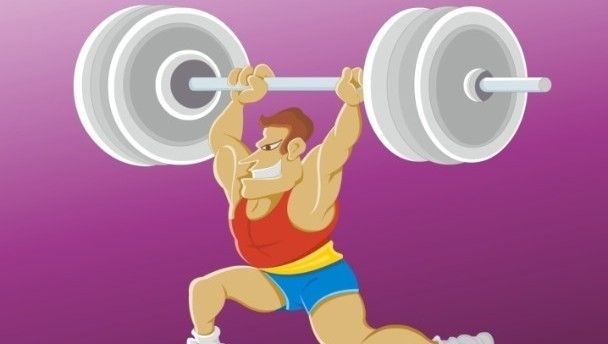
This guy knows what he’s talking about:
Stiff-Legged Deadlifts
Stand with your feet shoulder-width apart, balancing your weight on your heels. Grasp the bar with either a pronated grip (palms down) or a powerlifting grip (one palm up and one palm down) and place your hands about shoulder-width apart. Pull back your shoulder blades, and tighten your lats. You want to keep your back straight throughout the exercise. Tighten the abdominals, and maintain this throughout each and every cautious rep; this will help stabilize the pelvis and lessen the risk of lower back injury. Tighten the hamstrings and quads to stabilize the semi-locked knee.
The exercise: Bend at the hips, and as you lower the weight, move the hips backward slightly. Lower the weight until you get a good stretch of the hamstrings, but don’t start bending at the shoulders or lower back.
It’s imperative that the knee joints stay in a semi-locked position, held tight by the quads. This will allow you to fully stretch the hamstrings as you lower the weight. Practice keeping the neck in line with the rest of your spine as much as you can.
Once you have reached the bottom of the exercise, return to the starting vertical position by slowly and simultaneously moving the hips and bar toward each other while keeping perfect spinal alignment.
Caution: Don’t round the upper, middle, or lower back.
LISTEN: You Must Be Jokin’ podcast – listen to the latest episode now!