JOE caught up with Munster and Ireland legend Mick Galwey to talk about his rugby career, the plight of Munster rugby at present and stripping off if Ireland win the Rugby World Cup.
As far as rugby icons are concerned in this country, Mick Galwey would certainly be near the top of most people’s lists. An inspirational character that won an All-Ireland football medal with the great Kerry team of 1986, the man affectionately known as ‘Gaillimh’ went on to be a central figure for Munster and Ireland in both the amateur and professional eras right up to his retirement in 2002.
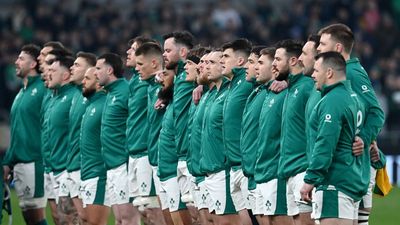
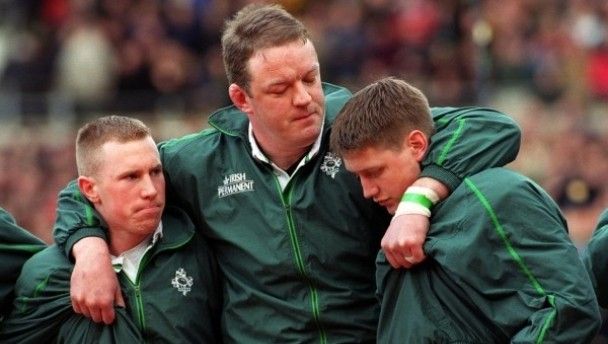
A veteran of 41 Ireland caps (four as captain), 130 appearances for Munster (85 as captain), two Heineken Cup finals and one Celtic League triumph, Galwey was the heartbeat of both Munster and Ireland and a leader of men, a trait that was probably best captured in the iconic photograph (see above) taken before Ireland’s Six Nations clash with Scotland in February 2000.
Galwey stood between fresh-faced debutants and Munster colleagues Ronan O’Gara and Peter Stringer and gripped them tightly by his side, sending out the message that if anyone was to mess with them, they’d have to deal with the big fella first.
These days, Galwey is enjoying his time as a squad advisor in the Munster set-up and also helping O2 out with their Be The Difference campaign. He was kind enough to take time out to talk to JOE this week about Ireland’s performances in the Six Nations so far, his rugby career, and being prepared to bare all if Ireland win the World Cup later this year.
JOE: Thanks for talking to us Mick, first of all, have you been impressed with Ireland’s performances in the Six Nations so far and do you think that Ireland still have a chance of winning the competition?
MG: Well obviously, the Italian match was scrappy, there’s no doubt about that. I was very impressed with the way we played against France, I suppose the disappointing thing was that, realistically, it was a game we should and could have won. I thought the atmosphere at the Aviva Stadium was fantastic and the players were honest and up front and gave it 100% and I think they were the first to put their hands up after the Italy game to say that they didn’t perform.
Unfortunately, this business is about winning matches and unfortunately we lost the game which is disappointing because having the big two – France and England – at home, it was the equivalent of our Grand Slam year two years ago. Unfortunately, the Grand Slam is gone now, but I still think there is a lot to play for, I think it could be a big year for Ireland, we just have to keep the head down and try and get something out of the six nations.
I know this might sound a bit like the olden days, but I’m a big believer in playing all the rugby in the opposition half.
It’s going to be hard to win the competition at this stage but I still think we can get a lot out of it. England are the team to beat, they’re playing France next weekend and although France haven’t played as well as they can do, you’d fancy them in Twickenham. England are a team that build their game around confidence and you’d have to say that their confidence is high at the moment. Personally, I’d like to see England win and see us win away to Scotland and Wales and have a massive game on the last day of the season when it’s all to play for at Lansdowne Road. Unfortunately, the last time it was a head to head like that in 2003, they beat us and went on to win but a Grand Slam and the World Cup.
If we were to win a triple crown on the last day against England and deny them a Grand Slam in the process, I would say that it would be a great season and I would say that it should be our goal for the moment. It’s quite a big goal, but it would be great for the confidence and it would be a great way to prepare for the World Cup as well.
JOE: Do you think that the style of rugby that Ireland are playing is the right way to go?
MG: What I would like to see them doing more, and I know this might sound a bit like the olden days, but I’m a big believer in playing all the rugby in the opposition half. If you look at the last game against France, we gave away penalties in our own half. I know we were trying to run out of our own half and that’s the expansive game that we’re trying to play, but I think we need to find a balance somewhere in between.

Mick celebrates with Keith Wood and Peter Clohessy back in the good old days
You saw that when we were in their 22’, we put them under pressure, we put 27 phases together for one of the tries we scored and if you can do that once, you can do it again. It’s a lot easier for teams to defend in the opposition half rather than in their own half, because they know they can give away penalties and they know that if something goes wrong in their own half, they’re going to be under pressure. Personally I’d like to see Ireland play more rugby in the opposition half, but overall, I think we’re playing a good expansive game and if we can keep scoring tries like the one I mentioned against France, we’re on the right track.
JOE: With all due respect to the Six Nations, it’s probably not the be all and end all this season, especially with the World Cup around the corner – do you think Ireland have what it takes to make a big impact on the occasion?
MG: Well, I suppose the World Cup is New Zealand’s to lose, but there’s never a certainty in sport. It’s funny enough with the teams in Ireland’s group. Australia, for example, are a team that could go to New Zealand and win it, but at the same time they could find it hard to beat Ireland.
With Australia and Italy in the group, the bottom line is that we have to get out of our group and get to the quarter-finals. If we get there, it’s a one-off match and you don’t know what will happen and I think to get to a semi-final would be a great achievement for Ireland. Personally, I thought we were in better shape going into the last World Cup, but look, we obviously came a cropper there, but you know, hopefully, we can go well in the rest of the Six Nations and we’ll be prepared for the World Cup.
The other thing that is a huge factor is injuries. If we have our all our top players injury-free that’s going to be a big factor because we don’t have the strength in depth of other countries. Look at the back three at the moment for example, Rob Kearney is out, Geordan Murphy is out, Tommy Bowe is only coming back and it’s hard to replace those guys. Stephen Ferris is another guy that’s been injured and is hard to replace as well. It’s tough when you’re missing top guys like that and hopefully they’ll all be fighting fit come the World Cup.
Mick on the end of an era for Ireland, Munster, and choosing rugby over GAA
JOE: Will this World Cup mark the end of an era for Irish rugby?
MG: Well, I suppose it certainly will be the end of an era, there’s no doubt about it. There’s a core bunch of players there that have given great service to Irish rugby, a lot of them have been around since the late 90s and certainly 2000s. For example, Peter Stringer and Ronan O’Gara came in around 2000, Paul O’Connell came in two years later, Brian O’Driscoll is there since ‘99 if I’m not mistaken and Gordon D’Arcy a little bit after that.
There is a core bunch that have been the backbone of this Irish team for years and it’s like everything, they’re not going to last forever, but it’s up to the young fellas to step up and fill their shoes. I would be positive about the future of Irish rugby; I think we’ve a lot of talent coming through. At Munster, we’ve a good ‘A’ squad at the moment playing the British and Irish Cup and it’s the same in Leinster, Connacht and Ulster, there are some fantastic players coming through. I think the future is bright and I suppose the big thing is hanging on to our best players, so hopefully they’ll hang around.
JOE: You’re currently squad advisor in the Munster set-up. Can you fill us in on exactly what the role entails and, are you enjoying it?
MG: I am certainly enjoying it; it’s good to be back. I suppose I’m a mentor to the younger players as such, I’d be around for match days and for training sessions during the week and it’s good to be back involved. I suppose I’m somebody that knows Munster Rugby, I’ve been around a long time and I’m enjoying working with Tony McGahan and all the coaches in the Munster set-up.

Mick, pictured with Operations Manager Bryan Murphy, is enjoying his role in the Munster set-up.
It’s not a coaching role that I would have as such, it’s more of an advisory role, but it’s great, I love it and let’s be honest it’s good to be involved, who wouldn’t want to be involved, particularly for someone who’s played with Munster. There’s always been great excitement around Munster matches and that hasn’t changed. I haven’t lost the appetite for it and hopefully we can get things back on track.
JOE: Speaking of getting back on track, Munster were being written off in many quarters following their Heineken Cup exit – did you think that was a bit harsh and can you see them competing at the top end of things again in the near future?
MG: Yes I think it was harsh, of course I do. First of all, we’ve been there (in the Heineken Cup quarter-finals) for 12 years and in those 12 years, we’ve had a bit of luck along the way, let’s be honest about it. I know the ‘miracle match’ (2002/03 v Gloucester) was fantastic, but there was a lot of luck along the way and there were times when we were lucky to make it to the knockout stages.
Realistically, to be successful in the Heineken Cup, you have to win your away matches, that’s the bottom line. It’s funny, the last time Munster won the Heineken Cup in 2008, we actually lost two of the away matches and people forget that, but we were lucky to get bonus points out of them, whereas this time around, unfortunately we got nothing out of the Toulon game and that’s the reason we’re out of the competition. If we had beaten Toulon, we could have been in a quarter final and anything could have happened. In two of our home games we won with try-scoring bonus points and against the Ospreys at home, we probably should have gone on and won with a bonus point, but we came up short in the end and let them back into the game.
There are a lot of good young players at Munster and I think the future is in good hands. The young players will come through eventually and will perform I can guarantee you.
In fairness to Toulon, they went to London Irish and won an away match where we didn’t succeed and they deserved to go through. It’s not the end of the world, we’re top of the Magners League and people might say that it doesn’t matter but it does to us, it’s huge. It’s all about building players for the future and playing competitive rugby; we’re unbeaten at home in competitive rugby this season and that’s something else we’re proud of. We beat Australia as well and although some people might say it was a second side Australia had out, beating a touring side is something special. It was a hard slog on the night, but it was a great effort with a lot of young players on the field.
We still have a lot to prove this season, we still have the Challenge Cup and hopefully we can do well in the Magners League as well. That’s the joy of competitive sport, you don’t have a divine right to win every year or to qualify every year and of course there’s going to be a changing of the guard in Munster, but I’d be very proud of the young players coming through. A lot of them haven’t hit their peak yet, but there are a lot of good young players there and I think the future of Munster is in good hands, the young players will come through eventually and will perform I can guarantee you.
JOE: Like the late Moss Keane before you, you tried your hand at GAA before turning to rugby – what was it that convinced you to change codes and if I had to push you on it, what sport do you think you were better at?
MG: Oh, that’s an easy question, definitely rugby! I suppose growing up in Kerry, everyone wants to play with Kerry and I was no different, my boyhood dream was to play football for Kerry when I was growing up in the seventies and I was lucky enough to play in a golden era of Kerry football and got to play with all my heroes. I was 19 when I won an All-Ireland medal with Kerry in ’86, playing with the likes of Páidi Ó Sé, Mikey Sheehy, Pat Spillane, Ogie Moran, ‘The Bomber’ Liston, Charlie Nelligan, Seanie Walsh, I could be here all day naming them all and I was blessed to have the opportunity to play with them.
At the same time, I was playing rugby with Shannon and I played under age for Munster as well. Obviously, the rugby started in Castleisland and I didn’t know at the time that rugby was going to be professional and I’d eventually make my livelihood out of it. I suppose there was a bigger goal for me there with rugby, I’m not saying that winning another All-Ireland with Kerry wouldn’t have been great, but put it this way, Kerry didn’t win another All-Ireland for 11 years and I doubt very much if had stayed that that would have changed!
To be honest, with you, rugby suited me, but I suppose anybody that has played Gaelic Football and switched over to rugby will have had a natural eye for the ball, they know how to attack the ball and run with the ball, which is particularly important in the modern game. The bottom line is that rugby definitely suited me more. I enjoyed my time with the Kerry footballers and playing with my club Currow and my divisional team St. Kieran’s but at the end of the day, I was certainly more of a rugby player than a GAA player.
Mick on changing from an amateur to a professional and his biggest achievement in rugby
JOE: Your career transcended the amateur and the professional era – how big was the difference between the two eras and did you find it to adapt?
MG: I didn’t really find it too hard to adapt. I was lucky enough I suppose, in that I had been playing about ten years for Munster when all of a sudden the game went professional. I was coming into my late twenties but at the same time I didn’t find it hard to adapt at all, it was my job.
OK, it took a while to get used to the training and that, but it was phenomenal. I mean, who wouldn’t want to be in full time training or to be a full time sportsman? Of course, it took us a while to get used to the pressures of the game and professional rugby, it was a learning curve but it was an enjoyable learning curve.

Mick in action for the British and Irish Lions in 1993
Looking back, it was probably a four-year process getting to be really professional. OK, we lost the Heineken Cup final in 2000, but at that stage, we turned a corner and we were competing against the best sides in Europe on a regular basis. When the Heineken Cup started, it was amateur and our biggest problem was we would win our home matches but not win our away matches.
At that time, our fitness wasn’t there and we weren’t strong enough or mentally strong enough and that took a while for us to get used to. Thankfully, we got on the right track and I think professionalism suited Irish rugby in particular. It was an ideal situation with the four provinces, which I think suited us perfectly.
JOE: Rugby in the amateur era was renowned for its social side, particularly when a team was on tour. Was there was a big change from a social point of view when the game turned professional?
MG: Yeah there certainly was, there were a lot more sacrifices, everything had to take a step backwards, including your family. Being a professional sports person, your whole life is built around it. You had to make sacrifices and one of those sacrifices was the social life.
I think being a part of bringing Munster from the amateur era to being successful in the professional era was probably my biggest achievement.
Look at the boys now, around Christmas time, they are playing on Stephen’s Day and on New Year’s Day and this is what professional rugby players have to do, they can’t be going out on New Year’s Eve and can’t be having a few pints on Stephen’s Day with their friends. Even on Christmas Day, you have to watch yourself. These are the sacrifices you have to make, but if you ask any player, they wouldn’t have it any other way.
JOE: Looking back over your career, what would you say was your biggest achievement in rugby?
MG: Well, it was a happy day leading Munster out in the 2000 Heineken Cup Final. I know we lost the match, but jeez, there was something like 50,000 or 60,000 Irish people over at that match and it was a huge occasion. We filled Twickenham and it was phenomenal. Ok, as I said, we lost the match, but I just felt at the time that we had made it.
If you ask any GAA player, even a club player, getting to Croke Park was the big thing and for us, that was our Croke Park in GAA terms. OK, we didn’t win, but look, we got a taste for it and we got back there again and we went on to win it and that was the most important thing. The building of Munster rugby, from the amateur to the professional era, which I was lucky enough to be around for, that was my biggest achievement in rugby.
I wasn’t lucky enough to win Triple Crowns or Grand Slams for Ireland, but I had some great days out for Ireland and for Munster and also with my club, Shannon. When I look back at my rugby career though, I think being a part of bringing Munster from the amateur era to being successful in the professional era was probably my biggest achievement.
JOE: Finally Mick, before the World Cup last year, Diego Maradona said that he’d run naked through the centre of Buenos Aires if Argentina won it. Would you be willing to do something similar if Ireland won the World Cup later this year?
MG: I’d certainly follow in his footsteps. I don’t think anyone would want to see me naked, but if it took that for Ireland to win the World Cup, I’d certainly do that no problem!
O2, official sponsor of the Irish rugby team, is calling on all supporters to get involved in their ‘Be the Difference’ campaign as the Irish rugby team compete in the 2011 6 Nations Championship. This year, O2 want the supporters to bring back the Roar to Aviva Stadium. So, whether your Roar is a ‘heave’ or ‘come on Ireland’, or something completely different, O2 are giving supporters the opportunity to show their passion, add to the magic of the atmosphere, and truly get behind the team.
Supporters will be able to upload their Roar at www.bethedifference.ie where it will be featured as part of a supporter’s sound wave. The best Roars as selected by the team will be featured on the big screen at Aviva Stadium before the France and England games.
LISTEN: You Must Be Jokin’ podcast – listen to the latest episode now!