In the latest of this month’s features on Brazil’s influence on MMA and UFC ahead of UFC 134 in Rio, we look back at UFC 17.5 – otherwise known as UFC Brazil – and find out why the triumphant return has taken so long.
By Fergus Ryan
With Brazil’s rich fighting history it seems strange that, having staged an event there in 1998 and seen so many successful Brazilian fighters in the promotion, the Ultimate Fighting Championship would wait 13 years to return. Especially when you consider the UFC was founded by Rorion Gracie, from Brazil’s first family of fighting. While the ramshackle event staged by the previous UFC owner, Semaphore Entertainment Group can be partly blamed, an unfortunate promotion in ’97 can take most of the blame.
As Brazilian Jiu Jitsu continued to grow in popularity in Brazil a rival sport was founded to take on the Gracie’s martial art head to head. BJJ was seen as a sport for the middle and upper classes as the uniform or gi was quite expensive and the classes at the academies had to be paid for. Luta Livre (Portuguese for free fighting) is a form of no-gi submission grappling that was created in Brazil in the 1940’s and adopted by the working class looking to learn how to fight. The founder of the sport, Euclydes “Tatu” Hatem, fought and defeated George Gracie in a vale tudo (literally “everything allowed”) match in the late 1940’s and the rivalry between BJJ and Luta Livre was born.
Through the decades important BJJ v Luta Livre vale tudo fights occurred featuring the kings in each sport. Usually whole events were staged to showcase BJJ versus Luta Livre fights. Some of the more noteworthy fights didn’t even occur at legitimate shows. Rickson Gracie, considered the Gracie family’s finest fighter, twice beat Hugo Duarte, protégé of vale tudo legend Marco Ruas, in significant fights – once on the beach and then in the street behind the Gracie Academy in Humaita. Royler Gracie fought a 50-minute draw with Eugenio Tadeu behind closed doors in a gym. All of which contributed to the rivalry reaching a peak in a tennis club in 1997.
The slapdash nature of the UFC in those days was highlighted by the fact that the Brazilian flag was wrong on the promotional poster
Pentagon Combat was established with the hope of becoming Brazil’s and then the world’s premier mixed martial arts promotion. The promotion was being bankrolled by a wealthy Sheik from the United Arab Emirates. Ironically the Sheik, who was a friend of the Gracie’s and a fan of BJJ, would go on to set up the Abu Dhabi Combat Club, which is now the ‘World Cup’ of no-gi submission grappling.
The promotion’s debut event was held in September 1997 in the Tijuca Tennis Club, Rio de Janeiro. The card boasted some of the biggest names of the day like future UFC middleweight champ Murilo Bustamante, Lions Den standout Jerry Bohlander, UFC 6 tournament winner Oleg Taktarov and a main event featuring Renzo Gracie fighting Eugenio Tadeu. With no private security at the event some Luta Livre fans positioned themselves right up at cageside by the time the fights had started. Gracie, having dominated the early parts of the bout, was gassing out when the crowd, now pressed up against the cage walls, began to riot. The fight was ruled a ‘No Contest’ but the repercussions would be lasting.
Final stages of the Gracie v Tadeau vale tudo fight with riot scenes
Not only did the Pentagon Combat promotion fold, the mayor of Rio de Janeiro banned vale tudo from the city, which led to Brazil’s leading television station, Globo TV banning it also. To compound the problems in Brazil, earlier in 1997 Senator John McCain had labelled UFC bouts “human cockfighting” and MMA found itself banned in 36 US states soon afterwards. A combination of the Pentagon Combat riot and a ground swell of negative opinion saw vale tudo/MMA loose popularity in Brazil and elsewhere – and a year later the UFC limped into Sao Paolo.
 With UFC 17 completed and UFC 18 already in the planning stages, UFC 17.5 – more commonly referred to as UFC Brazil – was booked. It was hoped that returning to the homeland of vale tudo/MMA would give the ailing promotion and sport a shot in the arm. The show almost never happened only for the intervention of current UFC referee Mario Yamasaki, himself a BJJ black belt, who mobilised his network of contacts in the Brazilian fight community. The slapdash nature of the UFC in those days is highlighted by the fact that the Brazilian flag is wrong on the promotional poster (right).
Despite the organisational chaos the card featured some of the finest fighting talent MMA had to offer and included two championship matches. In the Lightweight Championship (then 170lbs) Pat Miletich beat Mikey Burnett in what was considered a massive snoozer. Having gone the full 15 minutes without a victor, six minutes over-time was given in which Miletich would eventually triumph by decision. Frank Shamrock defended his Middleweight Championship (then 200lbs) in a rematch against John Lober. Having lost to Lober after a 30-minute bout in Hawaii, Shamrock credits this rematch as being the catalyst for beginning to cross train for MMA fights.
For the local fans the biggest performances of the night came from Pedro Rizzo and Vitor Belfort. Representing the new wave of Brazilian fighter, their performances on the night showed how strong Brazil was going to be in MMA in the coming years. The only downside was that it coincided with a period where the sport was fighting for survival.
Rizzo battered the portly brawler Tank Abbott for eight minutes to win by knock-out. Rizzo would go on fight 12 more times in the UFC and beat former heavyweight champions like Mark Coleman, Josh Barnett, Andrei Arlovski and Ricco Rodriguez, although he fell short against Kevin Randleman and Randy Couture (twice) in championship fights. Still active, Rizzo can be mainly found on smaller shows and has taken his record to 19 wins and 9 losses since he began fighting in 1996.
Pedro Rizzo highlight reel
Having debuted as a 19-year-old winning the single night heavyweight tournament at UFC 12, Vitor ‘The Phenom’ Belfort was the next big thing in MMA by the time he fought at UFC Brazil. A physical specimen with a Carlson Gracie BJJ black belt and lightning fast hands it was hard to see where the ceiling was for Belfort. Randy Couture was the first person to bring Belfort past 80 seconds in a fight on a way to grinding victory and Belfort’s first loss at UFC 15. Belfort would avenge this loss and win the UFC heavyweight strap at UFC 46 in January 2004. What was more remarkable about the championship win was it came just after his sister, Priscila had been kidnapped and held for ransom by a drugs gang.
Wanderlei Silva was a grissled veteran of the vale tudo scene by the time he fought Belfort at UFC Brazil. A product of the famed Chute Boxe academy his fighting style was fearless. The fight lasted 44 seconds with Silva backpeddling for the last 10 seconds under a hail of punches from Belfort. With this victory Belfort cemented his status and gave his pre-fight highlight reels the most explosive piece of action a fighter could ever hope for. In his recent victory against Akiyama, Belfort reignited the form and style that brought him victory against Silva.
Vitor Belfort highlight reel from the early days including the devastating KO of Silva
The UFC and MMA continued a downward spiral in the years after UFC Brazil. Unable to secure home-video releases, SEG ultimately sold the UFC to current owners Zuffa in 2001 and the rest, as they say, is history.
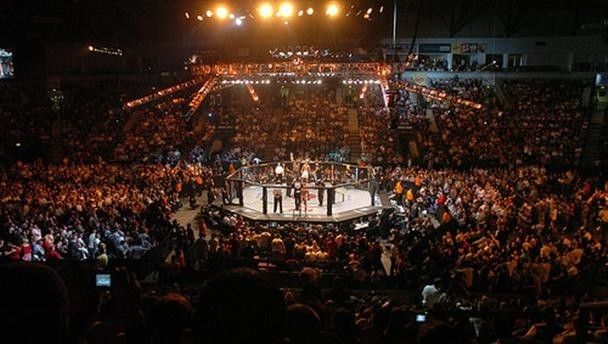
The UFC is now a global sport watched by two billion people in 120 countries, and UFC 134 in Rio de Janeiro on Saturday night will be a triumphant return after a long, hard road to success.
LISTEN: You Must Be Jokin’ podcast – listen to the latest episode now!