Anderson Silva and Chael Sonnen’s fight at UFC 148 will be one of the biggest in Mixed Martial Arts history, but what did the build-up to the event say about the young sport’s standing?
“When the time is right, I am going to break his face and every one of his teeth in his mouth. Playtime is over, the jokes are over. I am going to beat his ass out of the UFC. He is never going to want to fight again after I am done with him. It doesn’t matter if I am on bottom, side or top. Chael is going to get his ass kicked like never before. What I do inside the Octagon is going to change the image of the sport. I am going to make sure his legs are broke and arms are broke he will not be able to walk out by himself. I know he is listening; no more shit talking, it is on now. I’m going to make him pay and make him eat everything he said about myself and my country. I’m going to make sure he does not disrespect any other fighter. I’m going to beat him like his parents should have beat him to have manners. He can say whatever he wants, but I am not playing anymore. It will be the same like the first fight. He walked out the loser and this time he is going to walk out the loser. The only difference is that this time he is going to have to visit a plastic surgeon after the fight.”
The above comments were made by UFC middleweight champion and widely recognised best mixed martial artist in the world, Anderson Silva, to Chael Sonnen, whom he will fight this weekend in a rematch of their closely contested fight from UFC 117.
Trash-talking and intentionally punishing, or possibly ending an opponent’s careers aren’t things exclusive to the UFC and Mixed Martial Arts.
Ali talked.
Tyson punished.
Keane ended.
People criticised each of these things, but in the long term they weren’t detrimental or damaging to their sport’s overall image.
People criticised Muhammad Ali when he prolonged his punishment of Floyd Patterson and embarrassed the former champion because he continued to call Ali ‘Cassius’.
Tana Umaga shifted serious criticism when he, intentionally some have suggested, ended Brian O’Driscoll’s Lions tour with a spear tackle because of a perceived sign of disrespect towards the haka and because BOD was a vital player to the opposition.
The New Orleans Saints bounty system rewarded their players for putting dangerous opposing players out of commission.
Many in different sports have, through hyperbole, anger or cunning promotion, claimed they will end an opponent’s career.
People tut, tut and move on generally.
With the UFC, this time it’s different.
Anderson Silva, the posterboy for the UFC, is usually quite composed and an all-round great spokesperson, but he exploded at Sonnen because of the incessant and at times distasteful trash-talking that Sonnen had subjected to him, since their last fight.

UFC 148 is one of the biggest MMA events in history.
Silva has been promoted by former Brazilian striker Ronaldo’s new company and is a massive star in Brazil, South America and the world-wide MMA community.
With his excellence, charisma and looks, he has all the ingredients to be the transcendent figure MMA needs – the Michael Jordan, the Tiger Woods, the Pele.
When he says things like the above, the casual sports fan, the sceptics, and people in the media (many whom I’ve spoken to) are taken aback and reminded of Senator John McCain’s description of the UFC many years ago as “human cock-fighting”.
McCain has since become somewhat of a fan and said the sport has cleaned up its act. Zuffa, who bought the ailing UFC from SEG in the last decade, no longer promote it with blood-splattered graphics and this week the promotion’s exponential growth continued as it announced its first event to be held in the lucrative Chinese market.
Still MMA doesn’t get the free pass that other sports may do when their top sportsmen like Silva or former heavyweight champion Lesnar go off the rails in a similar fashion.
Despite the commercial success and burgeoning popularity, true mainstream coverage of the sport by sportswriters in Ireland and Europe isn’t forthcoming because of moments like this that see the sport compared to pro-wrestling. You only hear the coverage in relation to its success as a business entity or when a big scandal hits it, not when a major achievement, such as Conor McGregor’s title win at Cage Warriors a few months ago in Dublin, happens.
It all seems part of the legacy of the b-movie type of promotion of the UFC in the 1990s when it was advertised as “the rules are, there are no rules”. (Reputable MMA fights are now governed under multiple rules codified in the Unified Rules of Mixed Martial Arts.)
Or is it the fact that when Silva says he is going to break Sonnen’s legs, he is capable of doing so and, in this form of athletic pursuit, nearly encouraged to do so as a goal that makes the sport unpalatable to the mainstream, along with the utilisation of seemingly barbaric skills such as foot-stomping and rolling elbows?
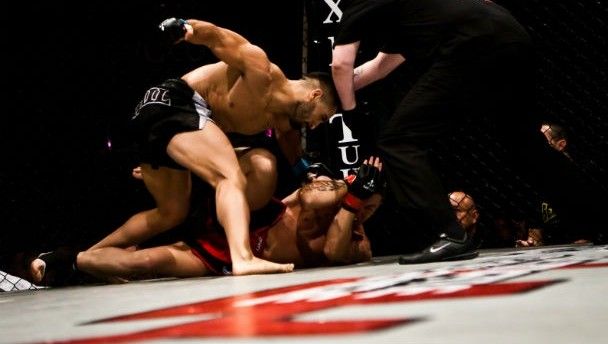
Khalid Ismail is a British Mixed Martial Artist who succeeded in breaking his opponent’s leg with eight seconds gone in a fight, albeit not in any premeditated fashion.
Khalid Ismail breaking his opponent’s leg.
We asked him about Silva’s comments and some of the remaining stumbling blocks to mainstream acceptance of MMA as he is a proponent of MMA as a sport and fitness pursuit and instructs people in the sport as well as practicing it professionally himself.
I asked him how he reacted after he broke Wayne Brown’s leg after seconds in their fight last year?
“Well we are sports men. We both don’t go out there to end peoples’ careers, we both go out there knowing the risks, but obviously without that malice of intentionally ending a career. I felt bad because it could have just as easily been my leg on the floor. The main thing is that you both know the inherent risks.”
Khalid was in touch with his opponent afterwards wishing him the best for his future. He was also quite concerned for his first ever opponent, Tom Kelly, who suffered blood-clots to his legs for a while after their fight. Khalid was conscious, he had a young family. “You don’t want to do anything to somebody that will prevent them from doing what they do for living,” he says.
You mention that is admirable but quite different from Silva’s comments, after Silva said he was intentionally looking to end Sonnen’s career.
Khalid reckons its mind-games from both fighters rather than a purposeful intention on either fighter’s part and should be treated similarly to Alex Ferguson’s winding up of Kevin Keegan in 1996.
“He’s never dealt with someone like Sonnen before in personality and I think he’s got under Anderson Silva’s skin. Is he actually going to do what he says? Or is it just fight talk? He’s just getting hyped for a fight which Anderson Silva hasn’t done for long time.”
Khalid says the fight will earn a lot of money with the extra hype and doesn’t think it should be treated differently than in boxing, where trash talking is routine and not taken seriousily.
“I was watching HBO 24/7 for Cotto versus Mayweather and Mayweather was saying ‘You’d best prepare for your funeral’ so I’m like ‘Okay he’s just said he’s going to kill him!’ and that’s in boxing. It’s all just hype! It could help generate more interest in MMA if anything.”
But would that frighten off the casual sports fan at the same time?
Khalid thinks for a moment. “Well because MMA isn’t mainstream yet in the UK people might not know the techniques so it might frighten them off. To hardcore fans it won’t because they know to break someone’s legs is quite hard to do, it’s not going to come very easily.”
What about those techniques that could be found crude and vicious, maybe even unskilled to people being introduced to the sport – the footstomps or the elbows to the face?
“It’s hard because anyone who watches a sport but never participates in it might find it difficult to penetrate the technique and go ‘well why has he done that?’ If you wrestle and you stamp on the foot it doesn’t do too much damage, but it hurts and positions someone’s leg and exposes the other one for a takedown.
In Muay Thai [Thai-boxing] they use elbows, so when you are doing ‘Ultimate Fighting’ a variety of skills are used. That’s what makes it so good, when someone who is at a disadvantage in one area might be able to make it up in another. Someone who as a disadvantage at a striking distance but good at wrestling might use the footstomps against someone who is a striker and a kicker.”

Khalid ready for action.
If the sport is so technical, one area where it must fall down in is the presentation of the sport in the UK where some of the MMA shows are presented by forty-year-old Danny Dyers and appeal to the lowest common denominator. Khalid agrees that the sport needs to be more understandable to casual fans in analysis of techniques and made more accessible to the television viewer, but not more stupid.
“I did a documentary, it was aimed at the normal Joe to watch and see what the sport is about and that it isn’t barbaric. I mean, I’m a business man, I own two gyms. I work, I train and I teach kids as well. We’re not these animals that we can be portrayed as.
I like showing people the Jiu-Jitsu and the wrestling skills and try to show them what they’re about and doing women’s self-defence classes, that’s the stuff that needs to be shown to average Joes so they can understand that it’s not just blood and elbows. So they can say ‘Oh I see that move and I understand that now.’”
The ground fighting aspect is one that people find most difficult to understand in the sport. The television analysis needs to be more technical to circumvent the dense techniques that are being applied on the floor. Khalid says: “The commentary needs to break it down for the layman, you can’t just say ‘Oh that fighter is doing a kimura’ when only people that study Jiu Jitsu understand what he means. You have to say for the layman that ‘he’s got his hand in a lock and is applying pressure that hurts when you apply it this way physiologically’.”
UFC 148 is a big deal and a great card. Unlike boxing cards at the moment there are at least four must-see fights on the under-card with well-known personalities in MMA such as hall-of-famer Tito Ortiz’s retirement bout and another fight with one of the best Brazilian Jiu Jitsu competitors in the world, Demien Maia.
If the main fight is a dud, no worries, you saw three good ones regardless.
You also know the belt on the line is prestigious because there is only one belt, unlike in boxing.
Sonnen and Silva’s verbal sparring has enticed current MMA fans even more and quite frankly, this event is a mouth-watering prospect with loads of fantastic narratives for sportswriters to cover in one of the biggest ever pay-per-views the sport has held, but a lot stay away.
Khalid is a decent spokesperson for the sport and people like him are quite capable of converting some followers to it.
However, as long as long as these discussions arise as a result of incidents that wouldn’t be as examined as critically in other sports, the inherent conclusion has to be that MMA has some fighting to do to be as accepted a sport by the mainstream all over the world such as boxing, rugby, NFL and soccer.
Let us know what you think, comment below or on Twitter @Joedotie
You can watch Khalid Ismail’s documentary ‘The Story So Far’ here.
LISTEN: You Must Be Jokin’ podcast – listen to the latest episode now!