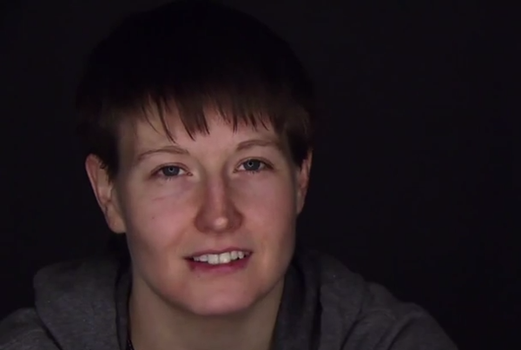
We caught up with women’s MMA star Aisling Daly to talk about her experience on The Ultimate Fighter, the claims from other that she is the Katie Taylor of the women’s MMA world and about her battle with depression.
Aisling Daly is the best known face for women’s MMA in Ireland adn she recently took part in the reality series the Ultimate Fighter where she was coached by UFC lightweight champion Anthony ‘Showtime’ Pettis. We spoke to her about her background in fighting, her time on TUF and how she used to beat up Conor McGregor…
JOE: Hi Aisling, we know you have a background in karate and BJJ but when did you start MMA?
Aisling: Basically, I guess I started around the age of 14. I was doing karate for a couple of years and my instructor at the time started bringing back bits and pieces of jiu-jitsu from John Kavanagh’s gym, because he was already training up there.
But at that age with SBG not being that close to my house, I just kept up with my karate and doing bits and pieces of BJJ on the side. Then when I was about 16 or 17 was able to get up to SBG myself, that’s when I decided to take MMA more seriously. I knew then that I wanted to compete and I started to I add some boxing, Thai boxing and some wrestling to go along with my BJJ and I tried to make myself well rounded and able to compete.
JOE: So what hold does fighting have on you, what drives you to be an MMA fighter for a living?
Aisling: I’ve always been really competitive; I was competitive in school, competitive in sport. If I was playing a board game I’d want to be the best at that, you know, I’ve always been like that. Not annoyingly competitive but healthy competition. But to my mind, MMA was like the ultimate form of competition, you have to be so physically and mentally tough, it is so demanding and that was perfect for me.
JOE: Did you find it intimidating at all starting off at SBG with all being the only girl?
Aisling: No, to be honest, it wasn’t really intimidating at the beginning. At the start, there were no girls there really training or anything but I always knew what I wanted to do so. The guys like Cathal [Pendred], Conor [McGregor] and Gunni [Nelson] started training after me; I’ve been training a lot longer in MMA than they have. If anything, when I started, I was intimidating to them because I’d a well-rounded skill-set when they started. When Conor [McGregor] joined, he didn’t have any BJJ and I’d be kicking his ass on the mat and he’d be beating me up standing. It definitely wasn’t intimidating to me.
JOE: We suppose you could make the comparison you’re kind of the Katie Taylor of Women’s MMA?
Aisling: I guess so, but I try and encourage the whole sport along with me and not just look after me. There is a lot of controversy with the women’s boxing team, Katie is the star and none of the other women get a look in.
JOE: How much of a help is it working with John Kavanagh and is he the biggest influence on your career?
Aisling: I wouldn’t be anywhere near where I am without John. Maybe he wasn’t initially so excited about the prospect of a woman fighter because he’d never had before and he didn’t know how it would work out. He quickly saw that I was willing to put in the hard work and not only was I a hard worker but I was getting good as well. So we’ve really good relationship and we’re close as a coach and athlete and I just need to thank him for everything he has done. At the beginning, I couldn’t get fights and he would hold events and make sure I always got a match-up, even if it meant him being out of pocket. If I hadn’t have gotten those fights starting off, I probably wouldn’t be here.
JOE: Moving on to the Ultimate Fighter, you’re currently a contestant on the show being aired now, what was your overall experience like on the show?
Aisling: I didn’t really enjoy the Ultimate Fighter experience, for me it was a means to an end. I wanted the UFC contract and that was really the only option available to me at the time.
But that kind of situation for me was very difficult, it was very high stress and constantly interacting with your opponents. There was a lot of hostility in the house towards different people and even if it wasn’t directed at you, it just became an uncomfortable environment.
The big thing for me was being away from my coach and my team, I don’t have any experience of training anywhere else. So to have this completely new coaching staff and regime, some of which I wouldn’t have enjoyed and some of it I wouldn’t have agreed with. I really do think that what we are doing at home in Ireland is really special, it’s really different to what anybody else is doing. It’s working for us as well when you see the kind of athletes coming out of the gym.
JOE: Anthony ‘Showtime’ Pettis was your coach in the Ultimate Fighter and he comes across very well on the TV, he seems very understanding and approachable. Is he the same in person and did you learn much off him?
Aisling: I think he probably comes across a little bit better from the way they’ve edited it and the way he carries himself in the interviews than he actually was. He has his title fight at the end so it’s different. When you’ve your own things to worry about, it’s hard to be thinking about other people.

Aisling pictured withUFC lightweight champion Anthony Pettis
At the end of the day, you have no relationship with this person, they don’t you, they don’t know anything about you and you turn up and they can’t tell if you’re happy, sad or indifferent. You don’t have any time to bond or that.
JOE: You were one of the most experienced fighters going over there but you were the last fighter picked by the judges, did that annoy you at all or did it matter at all?
Aisling: It didn’t really bother me all that much but it did flash through my mind a little bit, ‘I’ll show them’ kind of mentality. But at the end I think it came down to the American bias. They all think that what they are doing is better than any other country in the world. They will always rate the American fighter higher than the European and there’s the silly mentality that Europeans can’t wrestle.
You even see a lot of people saying it about Conor still, people saying ‘what if he gets a wrestler?’ Conor can wrestle; nobody needs to worry about Conor’s wrestling. He’s well able to wrestle.
JOE: You mentioned on the Ultimate Fighter that you took time off because you were diagnosed with depression, how much did training and SBG have in helping you to recover from that?
Aisling: I think the battle was much more of a personal battle than anything to do with the team. Members of the team knew about it but it was something that I had to sort out for myself. The guys would be good at the sports psychology aspect, you know getting you pumped for eights and that and have you in a good place and positive about your skills.
For me it was about not being positive about life in general and I never took any time away from training, I was still in the gym every day. I just had a loss of enjoyment in life, it was kind of like a problem that MMA had a part in creating but at the same time it had a part in fixing. it was kind of like a love/hate relationship of the sport at the time. Most of it was down to my way of thinking about things, you’re in control of your own thoughts and if you drag things into a negative place then that will definitely filter through to the everyday things in your life.
It was all to do with changing my attitude towards things and seeing things a lot more positively and appreciating what I had around and not to worry so much about things. I’d always get very anxious from the smallest things to the biggest things, so it was a matter of thinking whatever will be will be sometimes and if I can’t control it don’t worry about it. It is completely out of my hands, there’s no point in me being stressed about something I’ve no control over…
JOE: Aisling, it’s been great talking to you and best of luck in your upcoming fights.
Aisling: No problem at all JOE, talk to you again soon.
Images and video via The Ultimate Fighter.
LISTEN: You Must Be Jokin’ podcast – listen to the latest episode now!