For every iPod in someone’s hands, there’s a Zune sitting on the shelf. For every Sony Playstation still sitting proudly in a household, there’s a SEGA Saturn collecting dust in the attic.
Sometimes tech inventions work, become entrenched in pop culture and sell a bajillion copies, and sadly, sometimes they leave their own mark in tech history for all the wrong reasons. Here’s JOE’s top five most horrendous, eye-scratchingly ill-conceived tech disasters in recent memory. And no, sadly this doesn’t fit the “tech” criteria.
5. The Segway PT

Surprisingly, not many people wanted to be that guy
The Segway PT is best known in Europe as that awkward, niche, upright transport device, yet at the turn of the century, the hype surrounding the then-unknown invention was reaching fever pitch. Apple supremo Steve Jobs had been quoted saying that inventor Dean Kamen’s creation would be “as big a deal as the PC†and “change how cities are builtâ€, the latter quote being used in South Park’s pre-reveal satire of the machine, dubbed the “Itâ€.
What was actually revealed, however, was the biggest let-down since Mega Shark Vs Giant Octopus’ rubbish double-KO showdown. Consumers genuinely expecting a hydrogen-powered hovercraft were faced with the cold reality – the newly-dubbed Segway could only travel 12mph, required bicycle helmets, and made the user looks absolutely ridiculous.
Nearly ten years on, the Segway PT is used primarily by certain police forces or city tours, with the weak figure of just 50,000 Segways shipped since its inception. The company originally hoping to reach the 50,000 target within its first 13 months of sale – rather than nine years later.
4. Nokia N-Gage

Surely a phone with that many buttons couldn’t have problems?
Like the launch of Segway, Nokia became victims of their own hubris with their pre-release cavorting with the video games audience prior to the launch of the N-Gage mobile device. Hoping to eat into Nintendo’s dominant position in the handheld gaming market, Nokia positioned the N-Gage as a direct competitor to the industry-leading GameBoy Advance, with their device promising cellphone functionality and advanced graphical capabilities. Both statements were true, but that didn’t stop the system from begin a complete sales calamity when it hit the shelves.
Hitting game stores in time for Christmas 2004, Nokia initially announced sales of 400,000 N-Gage’s in its first two week on sale in the US. Independent market research firms were skeptical, and dug a little deeper, finding that the device had only sold 4,000 in the fortnight, with just a paltry 800 units in the UK.
Nokia eventually admitted to fabricating the initial sales data. A year later, the company sent out a press release announced that the one-millionth N-Gage had been sold – an impressive milestone, had Nokia not initially predicted six-million sales for the same year.
Two of the biggest drawbacks of the N-Gage were simple, avoidable design issues. Firstly, users had to remove the phone’s plastic cover and battery compartment before inserting a game. Secondly, the speaker and microphone were located on the side edge of the phone, meaning N-Gage owners had to hold the phone sideways, like a taco, to answer or make a call.
Despite the N-Gage’s disastrous performance, Nokia persevered with the 2004 N-Gage follow-up, N-Gage QD. As you can guess, it was also rubbish.
Vista, Virtual Boy’s and the C5
3. Microsoft Vista

We believe these fellows are quite excited about Vista
Microsoft’s Windows operating system (OS) was such a success that the company later had no choice but to release a slower, more confusing system in its place. Released on January 2007, Microsoft Vista was positioned as the next generation of the flagship product of the world’s largest software company.
What followed was a litany of complaints for the new operating system, with users claiming it was incompatible with their older PCs and running programs slower than its predecessor, XP. PC Magazine joined the fray, proclaiming Vista a “nice-to-have product rather than a must-have†– hardly a ringing endorsement for supposedly the next step in Microsoft’s forward march.
Microsoft fought back, however, with a web-based advertising campaign called “The Mojave Experiementâ€, asking people to evaluate a new Microsoft OS, dubbed “Microsoft Mojaveâ€, but secretly a Vista demo in disguise.
Despite the campaign’s moderate success, the damage was done – Vista was a poisoned brand, with British retail group DSG (owners of Currys and PC World) claiming the failure of Vista had cost them £40m in lost revenue. In the end however, the corporation rushed ahead with Windows 7 in July 2009, a less-revolutionary OS version – but one with instantly recognisable branding.
2. Nintendo Virtual Boy

Strangely enough, this didn’t catch on
With the launch of Sony’s Playstation and SEGA’s Saturn, the 32-bit console gaming war was heating up, leaving rivals Nintendo and its years-old 16-bit Super Nintendo effort feeling the heat. Their 64-bit Nintendo 64 console was still years away, and the company needed to think fast.
GameBoy inventor Gumpei Yokoi had an idea – a 32-bit virtual gaming device. Thus the Virtual Boy was born, released in 1995 and promptly smothered to death. The Virtual Boy (VB) suffered such a poor reception it was never even released in Europe, with just 14 games released during its entire North American lifespan. The main drawbacks? Try a colour scheme consisting purely of red, black, and reddy-black. Oh, and the fact long-term play carried the risk of seizures and temporary blindness – maybe that too.
After the disappointing VB reception, Yokoi quit his role in Nintendo, leaving his reputation in tatters. Sadly, the inventor was fatally struck by a vehicle in 1997, leaving behind an unfortunately, slightly-tainted legacy. To commemorate Yokoi’s achievements in the games industry, JOE presents you with this short, blurry video of the Waterworld Virtual Boy release – he would’ve wanted it this way.
1. Sinclair C5

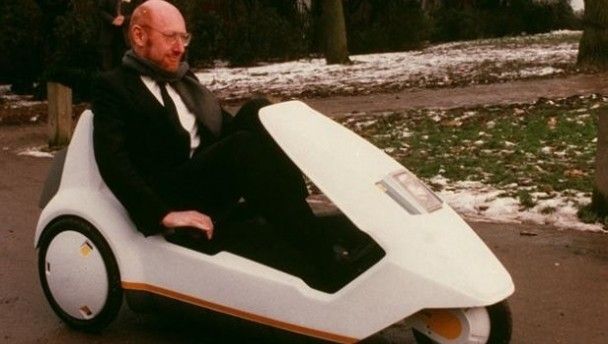
Even his face says “You’ve got to be sh*ting me?”
In the late 70s and early 80s Sir Clive Sinclair could do no wrong – having launched the ZX80, ZX81 and ZX Spectrum home computers to great success. With great success came great wealth, and with great wealth came batshit-insane ideas, such as the Sinclair C5.
Let’s be honest, if you’re going to throw your money away and destroy your legacy, do it with style, and quickly. The C5 did just that, a laughably odd, battery-assisted tricycle, with top speeds of 15mph, released in January 1985.
After months of public ridicule, manufacturers Hoover ceased production just six months into the C5’s release in August 1985. A month later, Sinclair Vehicles was put into receivership, with the vehicle selling less than 12,000 units, costing Sir Clive an estimated £8m of his personal fortune in the process.
Today, the C5 exists solely through kooky internet enthusiasts and occasional eBay auctions (we actually found one for our dear readers). That’s right, for the “Buy-It-Now” price of just $1,500, you too can have that look of self-satisfaction of the guy above with the space-age technology of the Sinclair C5. What are you waiting for?
LISTEN: You Must Be Jokin’ podcast – listen to the latest episode now!