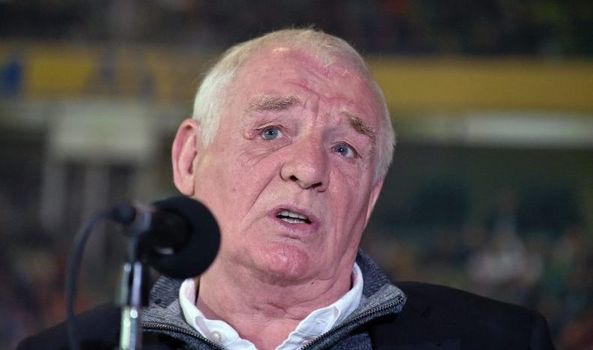
After 40 years, Eamon Dunphy has called time on his RTÉ career.
It makes sense.
The evolution of football punditry over the last 10 years has undeniably cast the self-styled panelism of Dunphy in a new light.
Gary Neville’s fluent mastery of touchscreen technology has ushered in a new age of analysis, preoccupied with statistics, and facts and what’s actually happening on the pitch.
But true analysis, for those of us who grew up watching The Premiership instead of Match of the Day, was something very different. It was about guesses and gut feelings. It was about Eamon Dunphy watching a brief glimpse of a player, going with his instincts and relying on whatever inscrutable algorithm was coursing through his mind.
G-Nev and Carra can split the pitch into quadrants and digitally demonstrate for us why a centre-half might be standing in the wrong place, highlight the range of a playmaker’s passing, and conduct a forensic post-mortem of any match.
But Dunphy’s process allowed him to break players down on a spiritual level. His third eye could glimpse player passing the ball about for 45 minutes and he could tell everyone sitting at home whether the man was a “clown” or a “fraud” or a “charlatan.”
This is why we’ll miss him so terribly.
“Ronaldo’s performance tonight was a disgrace to football,” Dunphy told us fearlessly in 2008. “A disgrace of petulance, temperament… A disgrace to professional football. This fella Ronaldo is a cod.”
While other pundits analysed what happened in the material world, Dunphy operated elsewhere, poring over charts and graphs that only existed only in his mind. An Olympian world of forms where players like Cristiano Ronaldo could not make the grade.
There was no adherence to the rules that bind today’s pundits and analysts. The moneyball-soccernomics that dictate today’s transfers, the relentless clocking up of forward passes and completed dribbles that now decide what makes a player a player. Dunphy was more concerned with character.
Encapsulating his entire attitude towards football or humanity, Dunphy specified that Ronaldo could go on to score 1000 league goals. But he’d still be a disgrace.
He once called Steven Gerrard a “nothing player.” He name-checked Sergio Aguero and Kevin de Bruyne in a rant where he referred to Man City’s players as “chancers.” These were all remixes of his first big hit in 1984: his claim that three-time Ballon d’Or winner Michel Platini was “not a great player.”
He would flip the tarot cards that he kept up his sleeve. “Spoofer,” it might say in old-timey writing above a sticker-book photo of a beloved player. His system was mystic rather than metric, and it worked for him.
Sometimes it seemed like he was just identifying most inaccurate possible thought and then verbalising it. It’s not something we’ll ever see from the thoughtful and thorough analysis of Richie Sadlier or Damien Duff.
And yet, we’ll be so much the poorer for it.
Dunphy is not the last of a dying breed. He is the whole breed. There has never been anybody like him. His longstanding contemporaries, Bill O’Herlihy, John Giles and Liam Brady, absolutely never approached the kind of territory Dunphy thrived in. Frankly, much of what made the late O’Herlihy so irreplaceable was his performance as a bemused, Corkonian voice of reason, trying in vain to sheepdog Eamon away from his wilder tendencies.
As far as his duties as a public servant, there can never be any question that Dunphy cared deeply about Irish football. The manner in which he cared for Irish football was confusing to the point of sheer chaos, but he definitely cared.
One time, he cared so much that he read out a lengthy broadside on air against prospective Ireland manager Terry Venables in the kind of move that would get you fired ten times over from Sky or the BBC — but for some reason, Irish media’s conservative streak was never brought to bear on Dunphy.
He accused the Irish media of grooming the public, normalising the idea of Venables as a manager, whom he tore strips off over his own personal financial affairs. It was the furthest thing from car crash TV. It was a space launch. It wasn’t that we couldn’t look away. It was “why on earth would we want to?”
Venables later confirmed that Dunphy’s attack was what cost him the Ireland job.
Many fans also appreciated Dunphy’s contribution during the Trapattoni years, harsh though it may have been on the players. Dunphy was unyielding in his criticism of the Italian veteran’s dire style of football, seeming ignorance of the players at his disposal and bullish attitude towards the Irish media. Even in spite of our qualification for Euro 2012.
Dunphy maintained those standards throughout the tenure of Martin O’Neill, and he has torn into the attitude of the manager and players at times when we may not have wanted to hear it.
When we lost 3-0 to Belgium at Euro 2016, Dunphy’s summation was succinct: “These guys are representing their country, you know? And you can’t bother to concentrate? Well, baby, get outta town.” Unashamedly wrong though he was on so much else, he could always be counted for the carnivorous catharsis of skewering whomever had let us down.
Still, it’s hardly unfair to say that this was the right time for Dunphy to go.
It has become a profound frustration over the last decade to watch him cover Champions League games — describing virtually all opponents as “unknown quantities” when what he actually meant was that despite his lucrative RTÉ contract, he appeared to have not bothered to watch Porto or Sevilla since the last time they played English opposition in the Champions League.
By the 2018 World Cup, fans were pleading with Dunphy to shut up. He didn’t even seem to know which players played in what leagues, suggesting that Roma’s goalkeeper Alisson, who had featured in the Champions League final, could use a move to Europe.
Even so, his contribution to Irish football from behind desks in Donnybrook and Lansdowne Road is more memorable than many of the moments we’ve actually witnessed on the field of play.
Eamon Dunphy never managed anywhere. He managed to stay alive for 63-and-a-half years, baby. And someday years from now, when we’re all old and we’re looking back on the glory days of “football analysis,” we’ll laugh and joke and talk about the time an Irish football pundit called out an English journalist on TV for running off and leaving his wife for “a young one.” And our children will ask who on earth this pundit was.
And we’ll put on our best Eamon Dunphy voice and say: I’ll tell you who said it… I can remember his name.
LISTEN: You Must Be Jokin’ podcast – listen to the latest episode now!