Author and professional designer Brian Garvey was invited to take a tour of the Pagani supercar factory to take a look at the cars and to meet the man behind the company. Here’s a look at how he got on.
Having been involved in design and automotives for many years I think the best place to learn how to do great work is to go see how the best designers do it. There are quite a few places you could go, but the problem with many of them is they are large organisations that lack face.
There is one place, however, where you can go to witness the finest automotive creations being designed and built all under one small roof, and also to meet the man behind them. That man being, Horacio Pagani.
I’m sure many if not all of you have heard of the name, ‘‘Pagani’’ the holy grail of supercars. Forget all the other names such as Ferrari, Lamborghini and Bugatti, these cars are very special, in that every part has been designed from scratch, handmade and hand assembled in very small numbers. Pagani only use the latest techniques and finest materials. To call the guys putting them together engineers, or technicians is almost an insult. After witnessing and talking with them first hand, I think they deserve to be called Master Tailors and Jewellers since most of the car is actually made from cloth and exotic metals, but more on that later.
I jumped into a taxi outside my hotel in Maranello, which was actually overlooking the Ferrari plant. It was pretty early still and what felt like -20 degrees outside. The Pagani plant is located about thirty minutes from Maranello, so enough time to get to grips after all these years of anticipation.
We pulled up to an industrial estate, the sort of place where you would normally go to pick up floor tiles after you had done the deal. The estate was clean, and like every other except this one had one very special building sitting on one corner.

‘’This is it’’, said the taxi driver in broken English, and sure enough, he was right. I told him I’d be back in a while and made my way to the front door of the building. The building looked very small from the outside to what I had been expecting, a narrow shrub walled path led up to the silver glass panelled door.
On opening the door I thought “this looks alright, looks like the Willy Wonka of automotive factories, with the cars looking good enough to eat”.

A lot of things hit you when you walk around inside. The fact that these are real Pagani supercars before you and not cad drawings or Images, that they are built here, and that the owner, Horacio Pagani, is coming down the stairs from the design office to shake your hand and talk about his passion.
I could talk about the design and details evident throughout the cars for weeks, but we don’t have that long, so I’ll pick some of the best bits for you.
Take for example his signature on the side of the Zonda, normally, this is injection moulded from plastic, and chrome plated, not the case here though, the badge below is CNC machined from solid aluminium and hand polished. That in itself is a long process for ‘just a badge’ so you can see he really cares, and even with the smallest details.

When we moved to the small factory area itself, he showed me another detail that he is very proud of, those being the mirrors. He is fascinated with women’s eyes, and has directly designed the mirror outline to try and capture that beauty. His English is limited, but one of his guys on the floor translates what he has to say about various parts. The mirror I was handed belongs to the new model called the Huayra, and is similar to the ones below found on the Zonda, and Zonda R

They happened to be building a Huayra at the time I called. It’s powered by a Mercedes AMG V12 Bi-Turbo M158, 5980cc power plant. A few people on hearing this for the first time think it is supercharged, but that’s not the case. The cars intake is engineered to sound that way, and more like a fighter plane. Horacio explains, Huayra means ‘’God of the winds’’. The car also features active aero, so depending on what speed you are doing, and if you’re on a corner, the cars rear profile changes automatically to correctly load suspension depending on what information the active aero controllers receive from various yaw, angle, pitch and speed sensors located throughout the car.
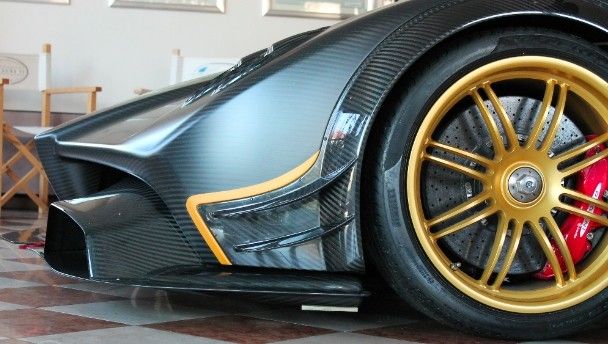
The Huayra also features carbotanium throughout its construction. First used on the Zonda R carbotanium is a blend of carbon fibre, and titanium strand. Whether or not the titanium strand actually does anything when you take into account the spec of both materials is debatable, but it sure does sound, and look cool glinting within the weave. Sadly, I couldn’t take pictures of the Huayra as it was still in the build phase, but I got plenty more of the Zonda RS composite construction below.

I mentioned earlier, that the guys building these cars should be called Master Tailors and Jewellers.
Here’s why; these cars are built from fibre and epoxy resin, and not pressed sheet metal, or aluminium like say your average road car. Composite construction involves mixing the carbon fibre with the resin and laying it into preformed body shapes in order to make the panels and monocoque parts.
Even in this case, the method is different to what you would commonly see on internet forums, or guys on YouTube doing it themselves where they buy rolls of fabric, soak in epoxy, and cover parts with that, or lay it into moulds. For better lighter parts, this method is no good. At Pagani and many other places including F1 a product called ‘prepreg’ is used. Prepreg is made of sheets or rolls of carbon or Kevlar with the correct amount of resin already applied, before it has time to go hard it is frozen, keeping it in its part cured state. Once removed from the freezer, it is meticulously tailored with a scissors using templates, and laid very carefully into the moulds – similar to making a suit. Once it’s all laid up to the moulds correctly it is placed inside a vacuum bag, and then baked in an autoclave, kind of like a big oven. The neatness with which the cloth is cut, and how well it is laid is reflected in the finished panels.

As for the mention of Jewellers, of course the metalwork is on par with the carbon work. Every part is flawless and there is as much detail put into each piece as there is with the entire car. Each part, down to the bolts carry the Pagani inscription and is custom made from either aluminium, or titanium.

So, the above is just a small glimpse at Pagani autos, and a little insight into the man himself. He’s extremely modest, kind, and willing to discuss design aspects with whoever is interested. I often get asked if the cars are worth the insane price tag. The simple answer after being through them all with a fine comb is, yes.
Horacio Pagani comes from a line of Argentinean bakers. He was born on Nov 10th 1955 and he lives in Italy. At the age of 20, Pagani had designed and built his first Formula 3 car. His childhood dream was to build supercars. His early work involved windbreakers for trucks, he has worked for Lamborghini, in the past and also owns Modena Design, a composites fabrication business.
Horacio is married to Cristina, they have two sons, Leonardo (designer) and Christopher (marketing), all four family members work at the family business.
LISTEN: You Must Be Jokin’ podcast – listen to the latest episode now!