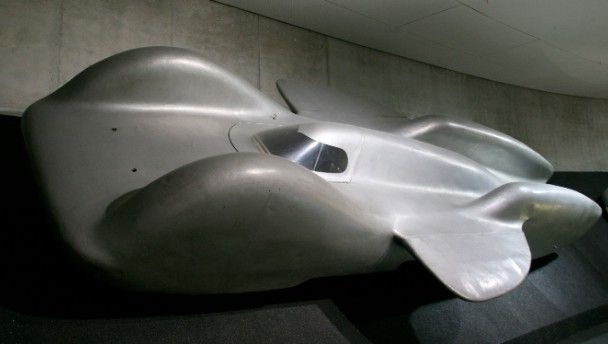
Not many people would know about the Mercedes-Benz T80, but in it’s day it was deemed the fastest car in the world. However, that was never actually proven.
The story of the Mercedes-Benz T80 starts way back in the 1930’s. Back then, Mercedes-Benz was locked in a sporting rivalry with a car manufacturer called Auto Union (the present day Audi). The two companies battled it out on racetracks all over the world before World War II and no other manufacturer could ever come close to their racing records.
It was in 1933 that the German government decided to help fund Mercedes-Benz in order to create some of the fastest cars ever to be built and to showcase the technological developments that the country was capable of at the time.
With a little extra money and a whole load of motoring knowledge, Mercedes-Benz decided they wanted a challenge (winning every other motor race must have been getting a little tiresome). It was only when the world-renown German auto racer Hans Stuck went to Mercedes-Benz telling them it was his dream to take the world land speed record that they agreed to make a car for the attempt.
The T80 itself was actually designed by Ferdinand Porsche (who would go on to start his own car company – no prizes for guessing which) and it was based off of the hugely successful Mercedes- Benz W125 Grand Prix car.
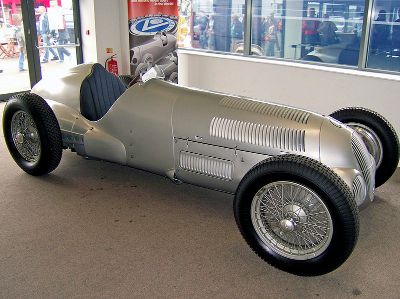
The Mercedes-Benz W125… gorgeous, isn’t it?
The T80 was fully completed in 1939 at a cost of 600,000 Reichsmark’s the equivalent of €1,992,000 back then. It was quipped with a giant 44.5L Daimler-Benz DB 603 inverted V12 which produced 3000 hp. It was basically an aeroplane engine on six wheels (that’s right, it had three axles!) and it even had small aeroplane-like wings to keep it pinned to the road.
In terms of size the T80 was over 8 meters long and weighed around 2.8 metric tons. Thanks to it’s superior aerodynamics it was projected that the car would reach a speed of 750km/h.
The record attempt was set for the January 1940 “Rekord Woche” (Record and Speed Week), and it was to be held on a special stretch of the Dessau Autobahn, which is now part of the current A9 Autobahn.
Before the record could be attempted World War II broke out and the Rekord Woche was scrapped and the T80 was rolled into a garage, never to see the light of day again.
The T80 is currently on display at the Mercedes-Benz Museum in Stuttgart and to this day, many people have pleaded (and begged) with Mercedes-Benz to restore the old T80 to see if it would be capable of the projected speeds.
If only…

LISTEN: You Must Be Jokin’ podcast – listen to the latest episode now!