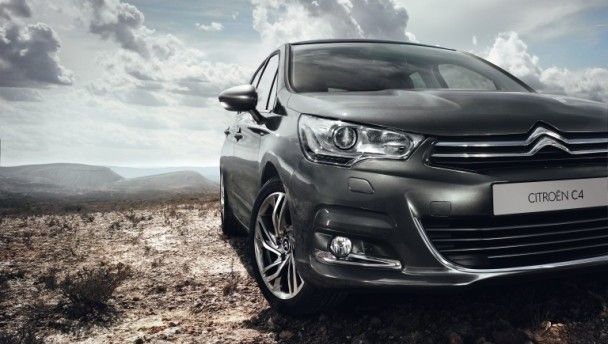
The Citroen C4 is a smart, accomplished compact family car that drives well. There’s very little not to like, but not too much to get excited about either.
Part of what gives the French their Gallic charm is the fact that they never seem to care if you’re charmed by them or not. They plough their own furrow while simultaneously shrugging and chomping on a baguette or chunks of unpasteurised cheese. Then they happily drive across that furrowed field in a Citroen 2CV, a car that is typically French – quirkily original and like nothing else on the road before or since.
Only the French could chose to produce a car like the 2CV. Alas, the days of the 2CV are long gone. The car that looked like an upturned old-fashioned pram got consigned to that section of history marked ‘cars that were designed to take Frenchmen carrying eggs across a ploughed field.’ For a good amount of time since the 2CV ceased production, Citroen concentrated on building more sensible stuff.
The automotive world was a lesser place without Citroens such as the 2CV and its weird, oddly curvaceous sibling the old DS. The industry needs to shift units that have mass appeal in order to make money and these were not cars to be driven by the average fella.
Over the years we’ve had the stereotypical Mondeo man and White Van Man, but the Citroen 2CV/DS man of old was anything but mainstream.
My physics teacher was just such a man. He had both these wonderfully odd cars and he was an odd man with one bulbous eye, mutton chops and an unnatural passion for Newton’s second law. He also absent-mindedly ran over my foot once in his DS. It was at low speed, I was wearing industrial-strength school shoes at the time and he gave me a lift home in the DS for the rest of that week, so I didn’t really mind.
Flair
So when the DS range was reinvigorated and turned out to be quite brilliant, I said a silent hurrah. The DS3 showed that Citroen hadn’t lost its flair and that car quite rightly won a great deal of admiration when it was launched last year. Bring on the DS4 and the DS5.
But if the DS3 (and the DS cars that follow), were to become design classics, Citroen still had to think about volume production. And to do volume production properly it’s best not to mess around too much with what a car should look like.
In 2008, the C5 showed that they could do big, proper grown-up cars well. In 2010, the C3 showed that they deserved a place in the small car market. But there was something missing, and that something was a car in the small, compact family sector. Something that could go up against the mighty Ford Focus. Something that began with a ‘C’ and ended not with a ‘3’. Or with a ‘5’… but with a ‘4’.
Which brings us to the car that brings together the letter ‘C’ and the number ‘4’ like no other: the Citroen C4.
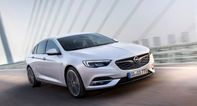
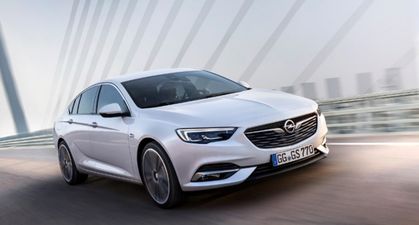
With the C4 you’ve got a car that is well proportioned, has a strong silhouette thanks to sharp creases down the side of the body and can confidently be relied on to get you, your friends/family and a fair bit of luggage (in the spacious 408-litre boot), from one place to another in comfort.
Just like all Citroens these days it has an attractive nose. Whoever first decided to incorporate the Citroen logo into the grille earned their Christmas bonus (a life’s supply of arrogance and two cloves of garlic, I believe) that year.
Inside, the dials on the dashboard light up in a way that reminds you that the designers are from the same stable responsible for the quirky stuff on the DS3, without running the risk of accusations that they’ve overdone it. In fact, you are offered a choice of illumination options, meaning that if you go for a Tron look than the more standard lighting option then you’ve only yourself to blame if your passengers think it’s a bit much.
Safely ensconced in the interior, you’re struck by the ‘bigger on the inside than on the outside’ nature of the vehicle. I know that’s not possible according to the laws of physics (and I paid attention to my school physics teacher – especially after he ran over my foot) but it certainly gives the sense that this is the case.
Technically, the numbers tick all the boxes that a grown-up car aspires to tick these days. There’s not a hint of jitteriness regardless of road type or condition – you point it and it does as its told. You always feel in control, and the fact that the steering wheel is always eager to bound back to the ‘straight on’ position means that it’ll be useful if we have another icy winter, when icy roads can make it hard for you to work out which direction your wheels are pointing in.

There’s a choice of three diesel and two petrol engines (the petrol ones co-developed with BMW). Citroen points out that a lot of effort has gone into making all models fuel and CO2 efficient – with up to 67.3mpg economy and emissions as low as 109g/km on e-HDi versions. This makes the C4 one of the most ecologically conscious models in the segment.
It’s a five-door that comfortably seats five and on the safety front, the C4 has a Euro-NCAP five-star rating (i.e. as good as it gets) – so high fives all round.
My biggest criticism – in fact my only real criticism – is that on a windy day the notoriously soft Citroen suspension can make you feel a bit like you’re piloting a gently rocking sea vessel rather than a car than a car.
While the C4 is never going to garner the fan base that the DS3 will undoubtedly attract, it deserves to get considered as a solid, tasteful alternative for buyers who don’t want to drive the same Focus or Golf as everyone else.
I’d have liked it to have been more tasteless and less predictable, but that’s why I’m only involved in writing about cars rather than manufacturing them.
Prices for the C4 start at €18,990 for the 1.4 VTi 95hp (ex dealer-related charges and optional metallic/pearlescent paint), rising to €25,740 for the range-topping 1.6 e-HDi 110hp EGS (Electronic Gearbox System) Exclusive. Thanks to the car’s low emissions, the diesel engines start from Band A of the Vehicle Road Tax (€104).
LISTEN: You Must Be Jokin’ podcast – listen to the latest episode now!