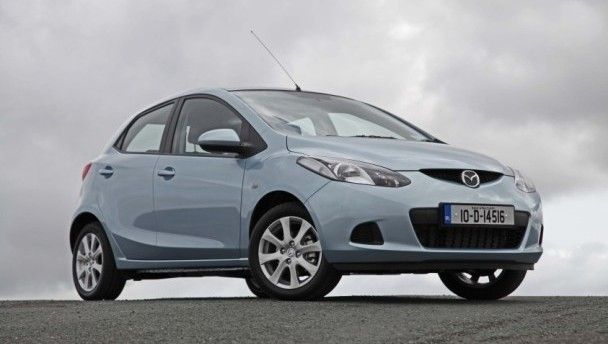
The baby of Mazda’s ever-improving fleet puts up a decidedly decent challenge to the Fiesta’s dominant position as the small car of choice on Irish roads.
I’ve spent the last few days nipping around town, being pleasured by an energetic little Japanese number. I’ve enjoyed throwing her around a bit and she’s responded well to my demands.
The number in question is the number 2 – the Mazda 2, to be precise (or the Mazda 2 1.3 litre 5-door Sensu to be even more precise).
Its size, specifications and price pitch the Mazda 2 squarely against the highly popular Ford Fiesta and the other sub-compacts out there. There’s a reason that, decade after decade, cars like the Ford Fiesta have continued to sell in such huge numbers – they are compact but not too tiny, they are practical and not too expensive. To this day Fiestas remain among the most bought cars in Ireland.
So what’s to like about the Mazda 2? Well quite a lot, as it happens. First off, there’s the Japanese engineering. We’ll ignore Toyota’s technical difficulties for a moment and focus on the strengths of the Mazda brand – a collection which, while never feeling heavy, always feel solidly put together.
And talking of heavy, the Mazda 2 bucked the trend when it was launched in September 2007. At a time when cars were getting bigger, chunkier and heavier, the Mazda 2 was lighter, more agile and quicker off the blocks than the car it replaced (all of the models available each weigh under 1,000kg). It’s also 15% more fuel efficient than the car it replaced.
The steering is satisfyingly responsive and the car gives the impression that it loves the chance to weave around urban streets. As the gear stick slots into each of its five forward (and one reverse) positions there’s no sense of small car flimsiness.
It’s incredibly quiet too. Inside the cabin there’s hardly a sound to be heard – so much so that the first time I got into the car, I stalled it. It was the only time I stalled the engine, thankfully, but predictably there were two or three men standing next to the car when it happened.
Before I turn this into a lovefest, I have to confess that I’m not overly enamoured by the exterior profile of the car. Don’t get me wrong, it’s fine and the wedge shape with the small back window looks quite sporty, but there isn’t that much of a wow factor. I find the profile of the 5-door version I’ve been testing underwhelming, with the back door looking out of proportion.
In fact, the five-door looks like a car that was designed as a three door, but that the designers were told late on a Friday evening that they needed to do a five door too, so just draw a quick outline of where the back doors should go and then headed off for a weekend doing whatever designers do. Buy funky outfits and designer specs, sharpen their pencils and look at books with lots of pictures in them probably.
Charms
But this is a small gripe. Each time I’ve stepped inside I’ve woken up to this car’s undoubted charms. I particularly like the dashboard, which is simple, stylish and, thanks to the minimalist white speedometer and rev counter, puts all the information you need right in front of you… and nothing else (something all cars should do but not necessarily something that they do always do).
This is a great car for running around the city, and it won’t make you feel like you’ve spent an hour with a bad-tempered chiropracter on longer journeys. Because I’d previously to do someone a favour before realising what size of car I’d be driving this week, I discovered that the Mazda 2 was able to accommodate a fold up garden table and two chairs in the boot alongside a load of shopping bags. Sure it was a snug fit, but a fit all the same.
The Mazda 2 comes in 1.3l Comfort, and 1.3l Sensu models. I’ve been driving the top-of-the-range 1.3 litre Sensu model, which comes with such details as 15″ alloy wheels, air con, a leather steering wheel, a socket for connecting up an MP3 player and a 86 bhp petrol engine (the Comfort model has a 75bhp engine). There’s also a sportier 1.5l model with 103 bhp and a 68bhp 1.4l turbo diesel.
It costs €15,735 (plus €450 for metallic paint) and falls into tax and VRT band B, so it qualifies for the government’s scrappage scheme. When this is combined with Mazda’s own scrappage incentive, the price drops to €12,235. If you’ve got a car you can trade in for scrappage, then the entry-level 1.3 Comfort 3-door model costs just €10,995 (€14,495 otherwise).
If you’re in the market for something like a Ford Fiesta, but don’t want to drive the same car as everyone else, then to my mind the Mazda 2 is seriously worth considering.
The lowdown
Car road tested: Mazda 2 1.3l Sensu
0-100km/h in 12.9 seconds
Top speed 172km/h (where permitted)
VRT tax band B (€156 per year)
List price: €15,735
LISTEN: You Must Be Jokin’ podcast – listen to the latest episode now!