Want to make the most of the few days of good weather we get here in Ireland? Clearly you need to buy an MX5.
It’s raining outside. The rain is lukewarm, so it must be summer.
OK, maybe I’m being unfair. Maybe, by the time you read this, Ireland is gripped in the midst of a shock heatwave – there are water shortages, the grass is parched, skirts are getting shorter.
But it’s probably raining.
Not that our perpetually dreadful weather should stop you from going for a convertible. Think convertibles and you no doubt think sun. Yet the residents of damp places like Scandinavia, Britain and Ireland are among the top purchasers of convertibles.
It makes sense. Buy a convertible in Saudi Arabia and you’ll burn to a crisp. Buy a convertible in Singapore and the humidity will kill you. Buy a convertible in Sligo or Sandyford and you’ll treasure every one of those scarce but brilliant days you get to drive around on our shiny new highways and our pothole-infested byways.
We don’t get many sunny days here, so when they do come around we really like to be able to appreciate them.
My first car was a convertible – a 1967 Triumph Herald 13/60 that I lovingly restored (it had been off the road for a fair few years) but which always smelt a little bit damp and funky. The smell had nothing to do with me being a soap-shy 18-year-old at the time and everything to do with the mould growing on the inside of the almost-but-not-quite fitting soft roof.
My, how things have changed. No longer does owning a rag-top mean in a city mean that you’ll have your roof slashed at least once a year and see your insurance spiral (personal experience talking here).
Convertibles these days nearly all come with folding metal roofs. No longer are the mechano-like metal frame on view – sit inside a modern convertible and the first you know that it’s possible to flip your lid is when you press a button on the dashboard.
So which convertible to buy? Most manufacturers have their topless models. The new BMW 6 series is gorgeous, smooth and powerful but out of reach for most. The barmy-looking Renault Wind has two seats, a big boot and is perfect for people who don’t mind looking a bit, eh, barmy.
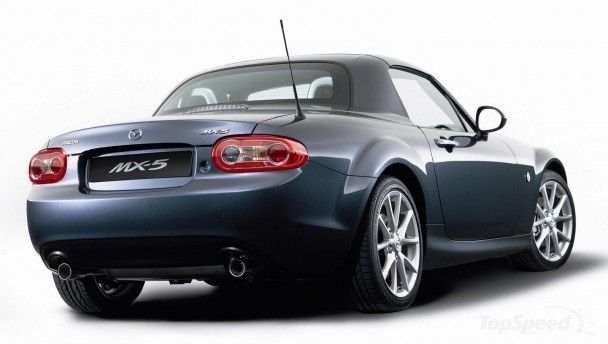
If you want a reasonably priced, responsive, good-looking, two-seater roadster, then you’re almost certainly going to have to consider the Mazda MX-5 – the car that pretty much created the current two-seater roadster market 21 years ago.
That the MX-5 is still selling well after 21 years speaks volumes. And talking of volume, this particular Japanese game-changer has now sold more than 900,000 units worldwide, making it the biggest-selling two-seater sports car of all time.
Satisfaction
Just last week, the MX-5 got the highest marks for any sports car in the UK’s annual JD Power survey of customer satisfaction.
For your money, it’s hard to think of more fun to be had in a car that doesn’t have a backseat for having fun on… and that’s why I’ve owned one for more than a decade.
So I’ve a vested interest in bigging up the MX5, but it’s not hard to be a fan.
My personal favourite is the Mark II MX-5, but then that is the one
I own. Unlike the Mark I, it doesn’t have the pop-up front headlights that were cool but took away from the sleekness and streamlining. Inside, it was paired down brilliantly so that you had exactly what you needed to point the car and go, and nothing else.

Removing the roof took about three seconds – just unclip and throw it back. There wasn’t even a light to tell you that you were low on fuel.
Moving through the gears was like taking a knife through hot butter – firm but smooth. Twelve years after I drove my Mark II off the forecourt the original gearbox is in great condition.
To my mind the Mark II wasn’t broken and didn’t need fixing, but where cars are concerned to not motor forward is to get seriously left behind. The Mark III MX-5 now comes with a folding hardtop, which adds a bit of weight and takes up room in the boot but doesn’t affect the balanced nature of the driving experience (and eradicates the chance of you getting your roof torn open).
The current MX-5 looks more Mazda than previous versions (which each bore more than a passing resemblance to the 1962 Lotus Elan). It’s more angular than its predecessor and the smart alloys have more attention drawn to them thanks to more prominent, muscular wheel arches.
Inside there’s a chunky central console that is a bit too chunky and plasticy for my liking. In the Mark II it was just about possible to slide over from the driver’s seat to the passenger seat. Not any more.
Like I’ve already said, I’m a biased Mark II MX-5 owner. But would I buy a current model? Absolutely.
Confidence
The engine now sounds better than ever (thanks to a tube that feeds just enough engine noise into the cabin to make you feel ‘at one’ with your car). The front suspension, which was a bit slooshy when the Mark III was first introduced, is now super sharp and gives you plenty of confidence when you corner (the pivot points have been changed to give the car a lower roll centre, if you were wondering).
The rear-wheel drive MX-5 has always felt like a car that’s eager to be driven and driven quite hard, and more than two decades on from launch that’s still the case. The fuel efficiency is slightly improved too – your five-speed manual MX-5 1.8i Roadster Coupé will use up 7.1 litres for every 100km driven (combined).
Top speed is 200 km/h, 0-100 km/h will take you 9.9 seconds. You’ll emit 167g/km of CO2 and you’ll pay €27,995, plus €475 if you want metallic paint (which you probably will).
Understandably, Mazda have no intention of stopping production anytime soon of a car that is undoubtedly a modern classic. In fact, they’re working on a Mark IV version that should be available in about four or five years’ time.
Why the long wait? When you’re dealing with a car that’s managed to stay pretty much on the money for this long, you’re hardly going to rush things and risk getting it wrong.
Follow Nick on Twitter: twitter.com/twitbradshaw
LISTEN: You Must Be Jokin’ podcast – listen to the latest episode now!