Mazda demonstrate that they believe we need to get traditional petrol and diesel engines right first before putting all of our focus on hybrid and electric vehicles.
Mazda have unveiled what they believe to be next step in the evolution of the car, and their SKYACTIV concept provides a cleaner, lighter and more responsive driving experience.
We’re in Mallorca and it’s raining. Not ideal if you’ve headed to the Med in order to catch a few rays, but not a problem if you’re here to do some test driving. After all, a car that only drives brilliantly in sunny, dry conditions is never going to be of any use on Irish roads.
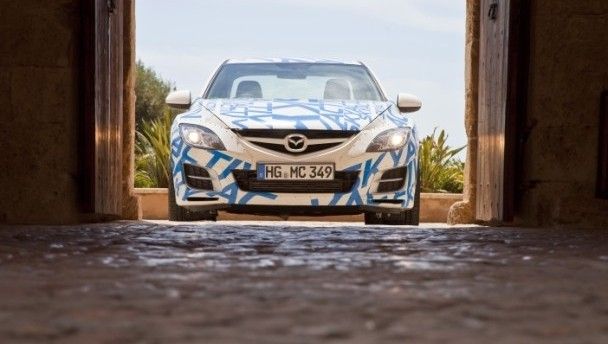
Mazda have shipped in their top engineers and development boffins to a track just outside Palma Mallorca in order showcase their latest automotive prototype. Four cars that each look like a Mazda6 that’s been bolted together on a Friday afternoon by workers keen to nip off early for the weekend have travelled with the Mazda crew.
But these oddly-riveted cars whose interiors are held together by black tape are not really Mazda6s at all, they’re Mazda6-shaped covers for some clever gadgetry going on underneath and that will be available to the public next year – a diesel manual, a diesel automatic, a petrol manual and a petrol automatic.

The new engines and chassis have been developed over the last few years under the watchful eye of Mazda’s Executive Vice President Seita Kanai. He and his team at Mazda have taken the approach that although hybrid and electric cars will form a part of the future of the automotive industry, for the next few years most people will still be driving a petrol- or diesel-powered car.
Mazda’s focus, then, is on getting these conventional internal combustion engine-powered cars to be as fuel effective and as fun to drive as possible. From this base, Mazda intend to grow their business and any future hybrid or electric cars will benefit from things like weight reductions and the introduction of clever grooves to improve rigidity in the frame of the car.
A lot of significant changes have gone on that will only be apparent when you drive the car or when you need to stop to refuel. There’s a lot more torque regardless of what gear you’re in – the cars feels as if they really want to be driven.
Nimble
The cars feel more nimble and responsive, the gear shifts are smoother and shorter (the change from second to third in the automatic version is super fast) and have been developed to have the swift precision of Mazda’s legendary MX-5 roadster .
There’s a more efficient gear system or developing a new exhaust system that sees benefits of having four pipes going into two before going into one tail pipe while keeping emissions low. This is better than having four pipes going into one, but the four-into-one set-up has become pretty ubiquitous because the amount of pipe used is less and emissions are lower. The Mazda boffins appear to have solved this somehow.

They’ve also done something pretty impressive with the compression ratio inside the engine. The petrol engine will have a 14:1 ratio – the highest ratio on the market for a petrol engine (this is a good thing). The diesel engine also has a ratio of 14:1 – the lowest diesel ratio on the market (also a good thing).
This means that future Mazdas will be cleaner, cheaper to run (by between 15 and 20 per cent) and more fun to drive, which means that will attract customers. All that and the fact that the technology has purposely been developed without using expensive materials, meaning that the advancements won’t lead to a price hike.
Ahead of finding out what potential future Mazda customers think of the cars, Mazda’s development guru Seita Kanai was on hand in Palma with his top engineers. All were keen to know what people thought of their quest to find the ideal internal combustion engine.
The general consensus of the assembled international journalists present was pretty positive, with the manual petrol car getting the biggest plaudits (not surprising given that manual automatics are pretty much always the most fun on a racetrack).
The new engines will be available first in the CX-5, a new compact SUV that will be launched in Ireland in April 2012. They will be then be rolled out in all subsequent Mazda models.
Follow Nick on Twitter: twitter.com/twitbradshaw
LISTEN: You Must Be Jokin’ podcast – listen to the latest episode now!