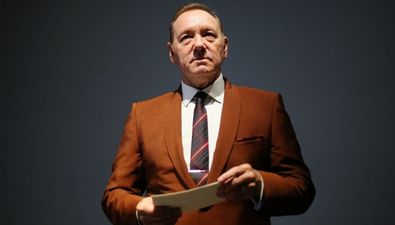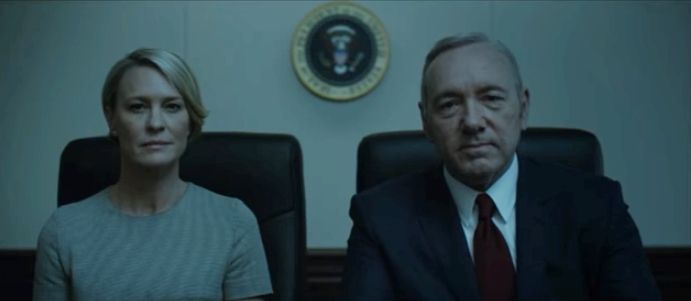
We look back at the fourth series of House of Cards, a significant improvement on a difficult third season.
**If you haven’t finished House of Cards: Season 4, it’s best to come back to this article at a later date.**

Lucas Goodwin. Tom Hammerschmidt. Raymond Tusk. Freddy Hayes.
If the greatest criticism of House of Cards’ lifeless third season is that it revolved around the absence of those characters who had established the show’s credentials in its first two years, the writers took notice and made amends with what was, mostly, a volcanic treat of a fourth series.
It was vicious fun, from start to finish.

The Washington Post, in a piece posted recently, described it as the ‘worst show about American politics. Ever.‘ as though we watch it for how accurately it reflects foreign policy, taxation, and healthcare under a Republican-led Congress.
On the contrary, we love House of Cards for its lack of realism, its chilly depiction of the homicidal President Underwood, his venomous harridan of a wife and the pursuit of power that drives them.
If we learned anything from this season, it’s that the show is a lot more compelling when the Underwoods are terrorising those around them, rather than each other.
The lessons of the third run of episodes, thankfully, heeded.
The Good
The start of the season lags a bit while Frank and Claire dance around the idea of separation but an assassination attempt on Frank galvanises the entire series, forcing the deathly duo to realise that one without the other is a massive waste of their collective talents.
Of the returning characters, Tusk is wasted and dispensed with early on, but Lucas looms over the show long after he’s taken out by a fatally wounded Meechum.
Hammerschmidt, too, is given his best moments to date as he chases down Frank with the relentless zeal shown by his younger staff in the first series.
His showdown with the President in the closing episode, in which Frank denies orchestrating the impeachment of President Walker, is dynamite television.

It’s a show that allows its female characters to be as deeply conniving, and cutthroat, as its men.
Jayne Atkinson as Secretary of State Cathy Durant plays Frank off against Republican nominee Will Conway superbly, and one Oval Office showdown between the former allies is as chilling as anything in the show’s history.
Frank recalls a fever dream of Zoe and Russo and admits their murders to a disbelieving Cathy, before an about-turn that’s as smooth as his Southern patter. She’s back in her box in a heartbeat. Done. It’s a horrible scene but, like much of the series, you can’t look away.
And then there’s Claire.
Robin Wright’s Claire owns Frank from the first moment of the series to its last refrain of, “We make the terror.”
The series is hers, entirely; she is now as murderously shrewd as her husband and we know she’s going to stoop lower and lower to make it to the highest office in the land.
She wants power, and the Presidency, for its own sake as much as Frank.
The Bad
The show doesn’t hit every mark.
Even within the show’s own twisted reality, Donald Blythe is far too easily manipulated and Claire’s ‘mother issues’ are too broadly painted; Heather Dunbar and Tusk don’t get enough to do, while Neve Campbell’s Leanne Harvey never gets in from the periphery.
We’d also love to have cared about whatever this chap was doing. But we didn’t.

The Verdict
Infinitely better, and more satisfying, than the third series. This time last year you could have been forgiven for abandoning House of Cards, but that chilling final scene during the final moments of the ICO crisis means that Storm Frank is just getting started.
Now it’s all about the carnage to come.
LISTEN: You Must Be Jokin’ podcast – listen to the latest episode now!