JOE caught up with sports psychologist David Mullins to find out if there’s more to fighting than punching a guy in the face.
By Fergus Ryan
Rich Franklin, a former UFC middleweight champion believes that “training for a fight is about 90 per cent physical and 10 per cent mental, yet when you enter the octagon it becomes about 90 per cent mental and 10 per cent physical.”
While most fighters train only for the physical, a handful of elite athletes in MMA have begun training the mental side of their game.
Conquer Mental Skills Training was founded by David Mullins to give Irish MMA fighters the opportunity to have the complete skill set going into a fight.
“The mental side of performance is something people always talk about when describing top athletes,” he tells JOE. “You hear things like self-belief, determination, motivation, focus, concentration and these are all mental skills. However, even though they are so important to performance these skills are often neglected in training. Sport psychology aims to train the mind and develop these skills so that the ideal performance can be achieved when it matters.”
Psychology
Competitive fighters, by the nature of their pursuit, need to be confident in their own abilities or else they get hurt. It would be easy to dismiss sports psychology as not really needed if you’re good enough. David disagrees and believes there are a number of myths that need to be dispelled:
“As sport psychology is a relatively new concept there are several myths associated. For example, People seem to think it is some kind of ‘magic’ by which you can turn people into machines that feel no pain. The truth is it is all very practical and just a part of training. In the same way athletes train physically to improve cardio and technique they train mental skills to improve their mental game.”
David continues, “It’s a step-by-step approach with the techniques used tailored individually to each athlete. There is no quick fix. There are a lot of ‘mental skills trainers’, shall we say, out there guaranteeing wins for guys but it’s not like that. I believe in improving everyday and that this week’s fighter should be better than last week’s fighter through working hard and smart in all facets of training.”
“The best fighter never wins, it’s always the guy who fights the best,” says applied sports psychologist Brian Cain who works with Georges St. Pierre. In other words, strategy can decide fights as much as talent.
Soon most fighters and athletes will work with a mental skills trainer and just see it as a regular part of training.
This, David believes, addresses another myth. He explains: “There is also the idea that it’s only for athletes with problems – if you need a mental skills trainer you are mentally weak. This is totally untrue. I believe that soon most fighters and athletes will work with a mental skills trainer and just see it as a regular part of training. It’s great to see elite level guys like GSP and Rich Franklin be such vocal advocates for sport psychology and how it has helped them develop.”
Since the subject of sports psychology has started become popular it has spawned a micro industry of self-help books, CDs and DVDs, which can lead to disappointment.
“There is a lot of nonsense online such as ‘give me two hours with you and you will be mentally tough’ or ‘buy this DVD to get the edge’ which is labelled sport psychology but definitely isn’t,” says David. “There is a market for taking short-cuts in everything but in reality progress is about gradual improvement and putting in the effort needed.”
Click here for the second part of brain training in MMA >>>
A keen sportsman himself, David played soccer at a high level but felt there was an element missing from his preparation. This, combined with the desire to enter coaching, led him to the field of sports psychology and a return to college. Having completed his Masters in Sport Psychology David now works with athletes fulltime.
“I have been able to work with several athletes and teams and all of these experiences were very useful in different ways,” he says. “While still in college I was lucky enough to be able to study Real Madrid FC while they trained in Ireland a few summers ago. This was a very beneficial experience for me and I learned a lot from it. I am grateful to the club for the opportunity.”
Real Benefits
With the popularity of MMA on the rise globally, David decided to combine an interest with an opportunity: “I do love a lot of sports but MMA is something I am fascinated by from a mental aspect. I was lucky enough to start working with Aisling Daly in 2009 thanks to John Kavanagh of SBG and Ais herself. This experience proved that working with fighters is what I wanted to do. It also showed me that sport psychology and MMA is a great blend and if the fighter is willing to put in the work like Ais was then there are real benefits. I am now exclusively working with MMA fighters and the response from the guys has been very positive.”
A fighter can have a great coach, training partners and support system but at the end of the day he alone climbs into the cage. The highs of winning are often shared but the lows of losing can be solitary and sometimes career ending. Training the mental side of a fighter’s game can lessen the distance or experience felt between the highs and lows.
If the fighter has an off day it can result in a KO or submission. It may be a cliché but there is no hiding place in the cage.
David continues, “The individual aspect of the sport is one of the reasons that attracted me to working with fighters. In team sports it is possible for a player to have an off day or even hide on the pitch but for the team to still win. However, in MMA, if the fighter has an off day it can result in a KO or submission. It may be a cliché but there is no hiding place in the cage.
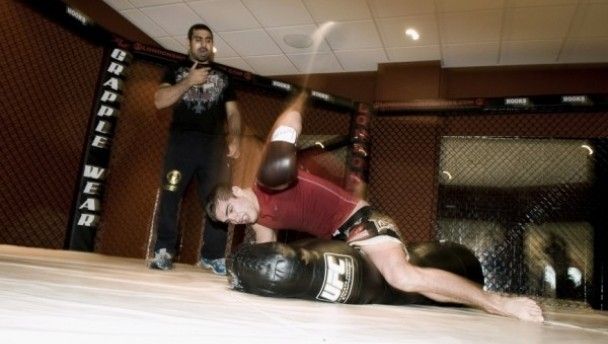
“These guys have to work on their stand up, BJJ, wrestling and strength and conditioning to become an all round fighter. On top of this they might have a big weight cut, and have to put it all together when it matters for 3×5 minute rounds. The use of sport psychology and mental skills can help in each of these phases and allow the fighters mental toughness to become a real strength.”
Elite MMA fighters now enlist the help of mental skills trainers and sport psychology. GSP, Rich Franklin, Randy Couture and Donald Cerrone are just some of those we know of. David is aware of many other fighters also using mental skills training but prefer to keep it quiet. So why do they choose to keep it private? “I think this is because of the stigma which still exists in some quarters, but this is changing. I am currently working with several pro-fighters here in Ireland and the guys have taken to it so well and we can see improvements already. It’s not my place to name them as confidentiality is an important aspect of the work I do,” explains David.
One example of mental positivity came during UFC 100 when GSP told his head trainer Greg Jackson his groin was blown between rounds three and four. Jackson told GSP to, “Hit him with it.”
Focus
Reflecting on the incident, David believes “Greg Jackson was trying to shift focus for GSP from worry about the injury to going out and finishing Alves”.
He continues, “GSP is open about the work he has done on his mental game, especially since the loss to Matt Serra. He believes he has found a new level of focus and has a different mindset and approach since that shock loss. He has amazing ability and is psychically and technically gifted, but he knew he could still improve and that the mental aspect of his preparation needed work.”
Just like training in any other discipline, mental training is a process rather than a magic bullet. It takes years of training to receive a black belt in any martial art and likewise becoming a zen warrior in the cage will take reasonable levels of time and commitment. David feels can help fighters achieve the next level in performance.
He continues, “The first session I have with a fighter is to get to know what they think and what issues and goals they had in mind when they contacted me. It is crucial for the fighter to be open and honest so we can talk about things and improve. Together we build a profile of the fighter and learn what skills need improvement and how to improve them.
“Once I start to find areas that need attention, there are several techniques I use depending on what issues are being addressed and the individual themselves, there is no ‘one for all’ cure and it really depends on the individual which approach and techniques are used. For example, some fighters respond better to visualisation while some respond better to self talk exercises it really depends on the individual.”
Commitment
Just like a striking coach would expect a fighter to spend time hitting the pads, David requires a level of commitment to his work from clients. He points out: “If I begin working with a fighter I am totally dedicated to helping them achieve their goals and I expect total dedication from them also. I might see a fighter daily, weekly, fortnightly or monthly that’s up to them but there are always tasks for them to be working on between sessions and I expect them to be completed.
“If you neglect your strength and conditioning training then you can’t expect your cardio to be as good as it could for a fight. Likewise, if a fighter neglects the work I am giving them they can’t expect their mental skills to develop. I only work one-to-one with fighters and the details of what we work on are private.”
Given the rising standard of fighters, training facilities and shows Mullins believes its only a matter of time before Ireland can boast a number of high profile fighters active on the international circus. “I believe the success of fighters like Aisling Daly on an international level has shown it is possible for Irish fighters to make it to the big time once they are willing to put in the work. Also the amount of UK fighters in the UFC should act as an inspiration to the Irish guys. I am sure that when the UFC returns to Dublin there will be several Irish fighters on the card.”
Click here to visit the Conquer Mental Skills Training website. Alternatively, phone David on 0862441068, email davidmullins10@yahoo.ie or check out Conquer Mental Skills on Facebook.
LISTEN: You Must Be Jokin’ podcast – listen to the latest episode now!