 JOE’s rugby columnist Malcolm O’Kelly on Ireland’s performance against Argentina, the positives and negatives from the November internationals and why rugby is waiting anxiously on next week’s Budget.
Â
The conditions at the Aviva Stadium on Sunday were absolutely freezing and you have to hand it to the 30,000 brave souls who took on the elements to get out and support the team.
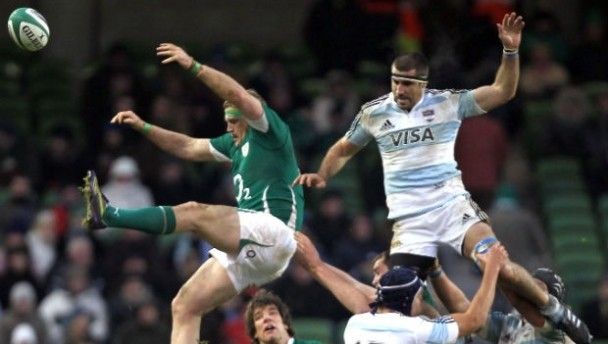
It was a real tale of two halves. Ireland put in a very good performance in the first half. They had learnt a lot of valuable lessons against New Zealand and they really brought that into the game from the start. The physicality was high, and that was embodied by an outstanding performance from the back-row. With their physical intensity and ball-carrying ability Ireland were able to dominate that area, and they also helped us to get good quick ball at ruck time. That in turn meant there was plenty of continuity and the back-line got the chance to show their stuff.
After half-time, though, it was very frustrating. The setpiece didn’t function, especially the line-out and the restarts, which were a real cause for concern again. It was very stop-start and we didn’t get a chance to see the backs in full flow until the last five minutes or so.
It was good to see Peter Stringer back in the starting XV again and playing well. His delivery is pretty much second to none but there’s no doubt he was helped, in the first half at least, by the fact that the forwards were clearing out the breakdown quickly and presenting him with good ball. With ammunition like that, it was always likely that Stringer would be able to get things going on the outside, and that’s exactly how it turned out.
On a day that his old Leinster rival Felipe Contepomi struggled a bit with the boot, Johnny Sexton was 100 per cent with his goal kicks again. Sexton and Contepomi are both incredible athletes and brilliant with ball in hand. Sexto is very much his own man, and he’s more about game control than Philly is, but I don’t think there’s much doubt that Johnny learned a lot when he was understudy for a couple of years with Leinster. Philly has always been fantastic in terms of picking the right moment to attack the line, and I’m sure watching and learning from the master mean those skills have rubbed off on Sexto.
Pros and cons
Looking back over the November internationals as a whole, it hasn’t been a brilliant month for Ireland but I think Declan Kidney will look upon the scrum as a real positive. Over the last four weeks it has proved that it’s up to the job, and players like Cian Healy, Sean Cronin, Tony Buckley and Tom Court have received invaluable Test match game-time against some of the best opposition in world rugby. That will certainly be a benefit in the long run for those players and the team in general.
The team also showed that it still has so many top-class strike runners. Even with Luke Fitzgerald and Rob Kearney injured, we have plenty of strength in depth with people like Geordan Murphy, Keith Earls and Andrew Trimble ready to come in, and Brian O’Driscoll, Gordon D’Arcy and Tommy Bowe are three of the best in the business..
There are plenty of things to work on, however. The priority will be on the line-out and the restarts. There’s a possibility that both problems will be solved as soon as Paul O’Connell returns to full fitness but you never know. I’m sure Paulie has had an input on the lineout work over the last while and his replacement Mick O’Driscoll is very adept in any case at the line-out and in claiming restarts. Micko and Donnacha O’Callaghan have been performing well for Munster so I would certainly have expected a better return against Argentina. But it didn’t happen there, and the whole thing just hasn’t worked over the last month.
It’s hard to say looking at it from afar but I’m sure there must be more to it than hookers just missing their throws. What I do know is that in Donnacha, Micko, Paulie, Leo Cullen and Dev Toner, they have real strength in that department, so I’m banking on that problem being sorted out in time for the start of the Six Nations in February. It has to happen, because Ireland have no chance of winning another Championship if the line-out continues in the same vein it’s been in for the last few weeks.
Another element that I’d be looking for improvement in by the time the Six Nations comes around is in counter-attacking. The game against New Zealand last week demonstrated the importance of possession. When New Zealand have the ball, they think ‘Why give it back?’, and they can score from anywhere. I’d love if Ireland showed a greater tendency to counter. We have players who can attack from every area of the field, so we need to cut down on aimless kicking which just gifts possession back to the opposition. One of Ireland’s main strengths is in running rugby and I’ll be hoping to see more of that in the spring.
Bail-out Ireland
With the way the country is at the moment, nobody can be certain about the future, and professional rugby is far from untouchable. Everyone is going to be impacted when the Budget is announced in a couple of weeks’ time, and rugby at all levels is going to feel the pinch in everything from attracting spectators to sponsorship.
The provinces will have to get creative when it comes to marketing their games to make sure that the crowds keep coming through the turnstiles. The IRFU have been burnt by their ticket pricing policy this month and I’m sure they’ll be rethinking that strategy in a big way in the future.
Tax hikes are going to hit everyone but I would hope that the Government decides to leave the status quo intact when it comes to the exemption scheme for athletes’ career earnings. I don’t think anything can be changed retrospectively but if it was a case that athletes entering the system in the future could not benefit from it, then you’ll have a situation where the best players will be looking abroad for contracts more and more.
For a young player breaking through at the moment, their ambition will still be to become a regular for their province, but if they establish themselves over a few years, they would certainly be looking at offers in England or France. The scheme is one that has worked well for Irish rugby in keeping the vast majority of the country’s best players at home. Altering it now would be a major blow to the professional rugby in this country in the country.
LISTEN: You Must Be Jokin’ podcast – listen to the latest episode now!