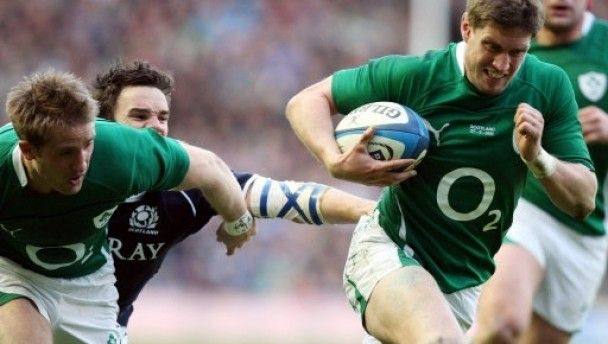

In this week’s column, Malcolm O’Kelly considers the positives of Ireland’s game, but feels the team need to stop making the same mistakes and get the lineout right.
All games are important and you always go into them aiming to win, and this was definitely the case with the game on Sunday that saw Ireland travel to Murrayfield to face Scotland in the Six Nations.
With Ireland having lost to France and Scotland having lost to Wales, both teams were looking for a kick start to their tournament and to resurrect their season.
Scotland had a really bad performance against Wales and they will have been looking to come back strong. Ireland at the moment are prone to produce a mixed bag, where they seem to perform well in attack, but in defence they can be too indisciplined.
Unfortunately for Ireland, Sunday’s game was again a case of a mixed performance. With Ronan O’Gara at ten they showed good control and played some good territory. When they actually did get ball in hand they were quite dangerous.
The Irish attack is a real positive, and something Ireland fans can take heart from. I’d go as far as to say that I think Ireland are looking like the most dangerous team of all the Six Nations teams when it comes to their ability to attack. Their forward runners all looked lively on the ball and made it difficult for Scotland to defend against them – there was a lot of offloading.
Skill
The skill in attack was rewarded with three tries, and there were parts of the game when I found myself standing up and applauding – especially in the case of Ronan O’Gara’s try, which was exceptional.
The first try came from a lovely well-timed little kick from Ronan O’Gara that was subsequently well chased. We got a good strong lineout mauled and then attacked around the fringes and created enough fast ball that most of the Scottish pack were still on the ground to give a good soft try and a strong early start.
The second try came from a very strong scrum, despite Nigel Owen’s reffing, that proved that Ireland have the ability to take their scrum to the next stage. Jamie Heaslip picked as Scotland were still caught in the scrum, then Eoin Reddan nipped in very sweetly for the try.
Which brings us to the last try, which was a piece of exquisite rugby – a great piece of interplay between backs and forwards. Forwards offloading in and around contact great support play players running onto the ball at pace. Cian Healy’s drive in the facet was inspirational as he barreled his way down the pitch, leaving the path clearer for the man of the match to convert. Unfortunately this was the last we saw of Irish attacking rugby in the game.
The last 20 minutes we could not dominate the game as we had been doing we coughed up a lot of possession and offered Scotland easy points with the boot. At 21 – 9 the game that had seemed practically rapped up became a hearth stopper going down to the wire.
Ronan was certainly a stand out player – precise from the ground and from hand he consistently pinned the Scots back and dominated territory. A style Ireland have probably moved away from since New Zealand but against Scotland it was a good call to opt to play that kind of game.
We can score tries, and good ones, but that’s not enough. One big concern I have is that the Irish lineout simply isn’t functioning.
The controlled play by O’Gara and the way he managed his play with precision shows his experience. He just tipped away any opportunity he saw to make yards and as a result it kept Scotland penned down. Scotland on the other hand felt a compulsion to run the ball out of defense they took a lot of risks and played a lot of the rugby in their own half.
If we’re looking at the positives, I felt that Seanie O’Brien had a couple of runs that were indicative of his performances for Leinster. When you see Seanie getting back at it and getting some freedom, you know things are going well. I think it’s really important for him as well as the team to show at an International level what he’s capable of doing .
We can score tries, and good ones, but that’s not enough. One big concern I have is that the Irish lineout simply isn’t functioning. Although Ireland didn’t get a huge amount of lineouts, because of the kicking, when they did get their lineouts they really didn’t get any platform from which to get an advantage.
They lost the ball in the front, and the only reason you play the ball to the front is because you’re guaranteed to win it. There’s no real advantage beyond winning it – it’s not the best ball, so you can’t really use it – but we couldn’t even do that.
It was frustrating to watch and an area of concern going forward. Every other Six Nations side is winnig their lineout ball, but we really seem to be struggling. For years Ireland boasted a fantastic lineout that you could depend on delivering the goods, and there’s no reason why they shouldn’t be able to put together a functioning lineout now.
Exceptional
The personnel is there – Paul O’Connell is an exceptional lineout player. Leo Cullen is there, Donncha O’Callaghan is there. Rory Best is a strong thrower. They’ve all got their styles and idiocycracies, but what that gives you is options. With the Wales match so close, they need to address things quickly. They need to work out what’s going wrong and where they can improve it.
I believe that the scrum is strong, despite the fact that Nigel Owens, the referee at Murrayfield, was at fault at scrum time he insisted the teams close the gap so much so that neither team could set effectively. The front rows were forced into the scrum unbalanced resulting in a shifting unstable outcome which Owens penalised throughout.
This is the third Six Nations match they’ve played and this is the third match where Ireland have consistently given away penalties for the same infringements. They seem determined to steal ball on the ground in order to slow things up. It’s one thing to slow up the opposition’s ball – clearly that’s well worth doing – but going that little bit too far, falling off your feet, holding on and not playing within the rules.
Obviously the new rules of the game are being enforced to the highest degree, which means that player are not getting away with infringing in a ruck, yet we continue to infringe.
It’s the front five who are infringing and what they’re doing is costing us games. It definitely cost us the French match and it nearly cost us the Scotland match. Scotland aren’t as good a team as France, and they’re a team that we should be beating. Fortunately we did win the game at Murrayfield, but by giving away so many unnecessary penalties Ireland could have lost that match too.
The terrible thing – the frustrating thing – is that the Ireland defence is coping with different attacks quite well and the players are getting themselves in a position where they think they’ve dominated the tackle and where they think they can poach the ball, and each time the penalty is given away in a situation where, until the penalty has gone against them, they’ve been in the dominant position.
When Ireland gave away the first penalty, which was in Scotland’s 22, Gordon D’Arcy had read a play well, he’d come through and made a big hit. Ireland tried to pile through and turnover the ball, in their desperation to make a play someone goes off their feet and give away. Whereas if they’d done nothing other than making the tackle and then stopping, Scotland would have been forced to kick the ball out into touch and Ireland would have had the ball at the 10 metre line.
Referees will now be looking to ping Ireland at ruck time so going forward we will have to be whiter than white to even get the benefit of the doubt.
Instead they had a penalty given against them and were forced to defend a lineout in their own half. It’s understandable this happening in the first game but it would have been addressed post match to see it in so much evidence in the third game is unforgivable. O’Callaghan paid the price for his ill- discipline by being taken off directly after giving away a penalty to bring Scotland within 3 points, a sign of Kidneys frustration.
At international level you’re dealing with top refs who will not let you away with marginal play. Clearly, Ireland are infringing and being penalised accordingly. Going forward however referees will now be looking to ping Ireland at ruck time so going forward we will have to be whiter than white to even get the benefit of the doubt. The lads need to show patience and trust in their defensive system by all means fight to slow the ball down but quit with the desire to make a big turnover as its not working.
The ill discipline has cost us dearly France, and nearly Scotland, if it is not addressed then we will go down in the Millennium Stadium against an inferior side.
LISTEN: You Must Be Jokin’ podcast – listen to the latest episode now!