 In his latest rugby column for JOE, Malcolm O’Kelly discusses the ongoing dominance of Leinster and Munster and gives an insider’s look into the world of the lineout.
Â
It was a great weekend for Leinster and Munster, winning big Magners League matches with sub-strength sides because the Player Welfare scheme meant so many players were unavailable to them. Munster had to go to Ulster, who may have been without a few of their Ireland internationals too but had all their high-profile South Africans playing and are always formidable at Ravenhill. Leinster, on the other hand, met a full-strength Edinburgh, because Scotland don’t play their first November international for two weeks and, in any case, don’t have the same Player Welfare system in place.
Starting with Munster, they’ll be very happy to have gone to Belfast and taken four points, and denied Ulster a losing bonus point with their last minute intercept try. The game was in the melting pot until the last minute or so but Ruan Pienaar, one of Ulster’s big-name Springbok internationals, will be having nightmares.
While Peter Stringer was lively at the base of the scrum and was spot on with his delivery all night, Pienaar was slow and inaccurate for the most part. He also missed two kickable penalties at crucial stages, and was then at the centre of the desperate late bid to go through the back line which led to Ivan Dineen’s interception and simple try.
Munster had a very young team on the field, particularly after Alan Quinlan went off, but there was no lack of seniority or leadership
Overall, with the side they had out, the players Munster were missing and home advantage, it was a great opportunity for Ulster to get a win, but I would have to question some of their tactics. It had rained in Belfast all day so conditions were always going to be tricky. An aerial bombardment of Munster, especially with someone as young and inexperienced as Scott Deasy at full back, would have been a good ploy but they barely asked a question of him all night.
Ulster probably won’t look at it too critically. When two sub-strength sides meet it can often be a bit of a lottery. The game was very close until the very end and could easily have gone their way on another day. They’re traditionally very strong at home but until they can take a few scalps away they’re not going to overhaul Munster and Leinster. Those two teams have showed that they can go away from home, put in big performances and come away with the spoils.
Ulster have to prove they can do that. It’s a mental thing. You need that deep-rooted confidence to put in a big performance away from home, and I suppose that only comes from performing and winning. It’s a chicken and egg scenario but it’s something Ulster have to work on if they’re to become a real force again.

Niall Ronan … immense against Ulster
Munster, on the other hand, will be very happy with the win and the performance. There’s a lot for them to be satisfied about. They had a very young team on the field, particularly after Alan Quinlan went off, but there was no lack of seniority or leadership. They did what Ulster struggle to do – go away from home and take a win in a big game, even with an under-strength team. Among their most impressive players was Niall Ronan, who was immense in the back row. I’m also a big fan of Ian Nagle in the second row, and he had another very good game.
On Saturday Leinster eked out a good win against Edinburgh at the RDS. It was only their second home match of the season and despite the fact that a lot of the star players were missing and it was a miserable evening there was still a massive crowd of well over 16,000 in attendance. Leinster are putting in great strides in extending the game to all areas of the province. At half-time there was an U10 game involving teams from Longford and North Kildare, so they’re really putting in a lot of work to grow the game outside its traditional strongholds and it’s paying dividends.
I like the look of Andrew Conway, the 21-year-old Blackrock College winger. He’s a very elusive runner, electric with ball in hand
While a lot of the main men in the backs, like Brian O’Driscoll, Gordon D’Arcy and Rob Kearney, were missing, the forward unit which took the field was very powerful. It was good to see Leo Cullen back in action after his shoulder injury and I thought he put in a very solid shift. He contributed well around the pitch, taking on hard ball and never showed any weakness to the shoulder.
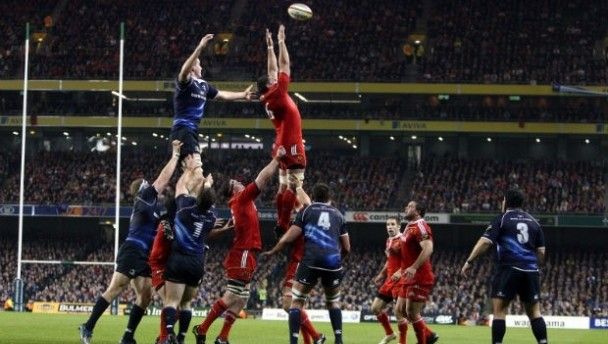
I’m sure he’ll be disappointed with the way the lineouts went on the day. When a lineout goes awry, it usually boils down to one of two things: a technical mistake by someone, a poor lift or throw, or if no one gets off the ground a misunderstanding of the call by the someone in the unit; or it can be an awareness issue, and by that I mean a call that isn’t on when made by the caller. To make a good call the lineout caller needs to have an understanding of all the options available to him in that lineout, a flexible calling system that is simplistic and quick and a calmness under pressure to make the right call. Knowing Leo, he will be working hard to get it right but the good thing about the lineout is that it’s something that can be analysed the mistakes flagged and worked out in training.
In the game, Leinster showed good continuity and created a few good opportunities that they just didn’t finish of. They enjoyed the bulk of the possession but they failed to command the territory. A lot of that was down to the lineout not functioning properly. That Edinburgh were able to hang on in the game was mainly down to Leinster’s mistakes, but on the balance of play you’d have to say Leinster deserved the win.
There were a few performances that were very encouraging for the future. I like the look of Andrew Conway, the 21-year-old Blackrock College winger. He came into the squad last season and definitely looks to have a bit about him. He’s a very elusive runner, electric with ball in hand, and caused a lot of problems for Edinburgh. He took his try very well.
Another encouraging aspect of the game was the interaction between Leinster’s backs and forwards. Usually, you see the back-line moves and the forwards coming to clear out the rucks and make the hard yards. But what Leinster are trying to do, and what they did successfully against Edinburgh, is to mix that up a bit. So you had the back three and the two centres getting involved at ruck time and someone like Isa Nacewa picking and going off the side of the ruck. All in all, with more improvement to come, the performance bore well for the rest of Leinster’s season.
Ireland begin their November Internationals programme against world champions South Africa at the Aviva Stadium next weekend. Check back here next Monday for Malcolm O’Kelly’s verdict on the big game.
LISTEN: You Must Be Jokin’ podcast – listen to the latest episode now!