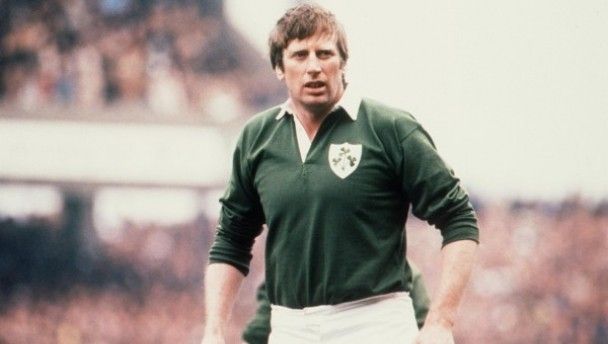
JOE pays tribute to Moss Keane, who passed away this morning at the age of 62.
The world of rugby was thrown into shock this morning with news of the death of the great Moss Keane aged 62, following a long battle with bowel cancer.
Keane was one of the most popular characters in the game and had a distinguished career for Munster and for his country, winning 51 caps from his debut in Paris in 1974 to his final game against Scotland ten years later. Unfortunately for Keane, Ireland lost on both occasions. He did enjoy some success with his country, however, as a member of the Triple Crown winning side of 1982.
Keane was a giant of a man – he was once described by the great Bill McLaren as 18 and a half stone of Prime Irish Beef – and a serious presence in the Ireland lineout before lifting became the norm.
A native of Currow county Kerry, Keane was an accomplished Gaelic Footballer before taking to the oval ball. He played at full-back for the Kerry under-21s and won a handful of Sigerson Cup medals while attending University College Cork (UCC).
In his acclaimed autobiography, Rucks, Mauls and Gaelic Football, which he wrote with journalist Billy Keane, Moss revealed that a conversation with a friend, Johnny Brosnan, encouraged him to turn his back on a potential career with the Kingdom’s footballers.
“Johnny told me I might make a decent enough Gaelic player, but I would never be a Kerry senior, I was too big for it,†Keane wrote.
“I knew he was right. There were times when I was in tight situations when I felt like a man trying to turn an articulated lorry in a bathroom. He said that rugby might be an option.”
Despite his late conversion to the game, Keane took quickly to rugby and three years after making his debut for Ireland, he was selected on the British and Irish Lions squad that toured New Zealand in 1977.
Unfortunately for Keane, like Brian O’Driscoll 28 years later, his tour was over after he was injured during the first test.
Asked to recall his highlight of the tour, Keane memorably replied: “Hearing that Kerry had beaten Cork in the Munster final.”
Keane would have his chance to get revenge on New Zealand, however, when the All-Blacks toured Ireland in 1978, as Keane was a part of the side that so famously defeated the All-Blacks in Musgrave Park. Keane’s memories of the game are outlined vividly in his book, not least an encounter with Munster coach Noel Murphy at a team meeting prior to the game.

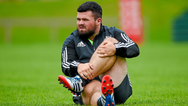
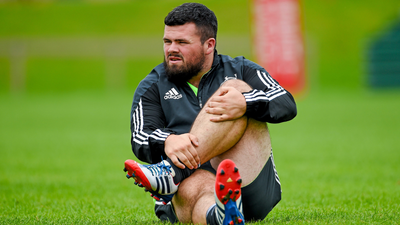
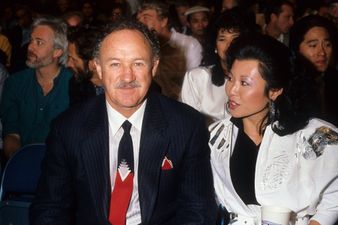
Keane pictured in 2008
“Moss, you are no longer an experiment, you are a Munster man picked to play against the All Blacks,†said Murphy.  “Just go out and cause mayhem. Disrupt their lineout. Stop them getting quick ball. Stand up for yourself and your team. Kerrymen have more All-Irelands than anyone else — you’re afraid of no one. Kerry are the All Blacks of Ireland. That’s why we picked you.â€
Keane took Murphy’s words to heart and went out of his way to disrupt the influence of New Zealand’s Andy Haden, a tactic that worked but earned himself and his colleagues some punishment in the process.
“They had me in the middle of the lineout against him — sure, I couldn’t out-jump Andy Haden to save my life,†he said.
“In front of the old stand in Musgrave Park you couldn’t allow a fella to clean you out so I elbowed and shouldered him out of it and he didn’t like it and there were a couple of bust-ups. We were in a tangle and Jerry Leahy, who’s gone now, God rest him, came in to try and stop it. He got three or four blows for himself. It was slightly more than handbags stuff.â€
Memorable anecdotes litter Keane’s career, such as the time when he got into a fit of laughter on his debut against France because of the amount of blood pouring from a head wound. Keane explained his laughter, saying: “I thought it would be handy if someone had a bucket so we could make a few black puddings.â€
The great England captain, Bill Beaumont, meanwhile, often recalled an incident when meeting Keane in the tunnel prior to an Ireland v England game. Beaumont approached Keane and said ‘May the best team win.’ Keane, recognising the calibre of his opponents replied: “I hope they don’tâ€.
Outside of the game, Keane earned a masters in dairy science and worked in the Department of Agriculture throughout his playing career and up until his retirement in July of this year.
Although he fought a long battle with bowel cancer, his death has still rocked the rugby community and he will rightfully be the subject of some fitting tributes over the next few days. Colleagues and opponents always spoke of Keane in glowing terms and the phrase ‘gentle giant’ never seemed more appropriate.
Keane is survived by his wife Anne and daughters Sarah and Anne Marie. He will be sadly missed.
LISTEN: You Must Be Jokin’ podcast – listen to the latest episode now!