 The performance of referee Christophe Berdos in Leinster’s Heineken Cup clash with Saracens on Saturday left me mystified, writes JOE’s rugby analyst Malcolm O’Kelly.
Â
Leinster have made the Magners League difficult for themselves but they’ve turned that form around in the Heineken Cup and now look well placed to book a place in the quarter-finals. After losing three of their first four games in the league, if someone told a Leinster supporter a couple of weeks ago that they’d be sitting on top of their Heineken Cup pool with nine points from their first two games, they’d have been very satisfied with that.
They have two big games coming up against Clermont-Auvergne, the first being the away leg, and these games could decide the outcome of the pool. If Leinster could gather five or six points they would be in pole position. With Racing Metro away and Saracens at home in January, a quarter-final would be in sight.
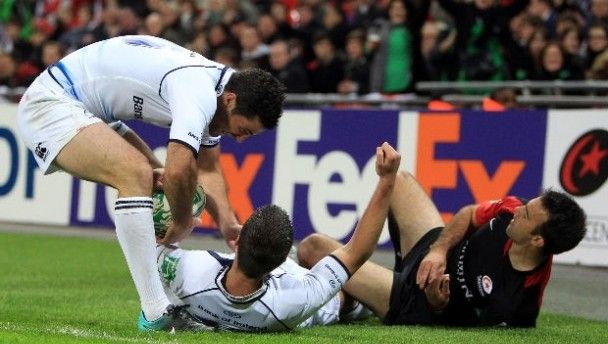
Winning any away game in the Heineken Cup is a good achievement and Saturday’s game against Saracens in Wembley was a great result. It was a very tense finish, with Saracens going through 30 phases in the last passage of play in an attempt to get the field position for a penalty or drop goal. Both sides deserve credit for that – Saracens for avoiding any handling error for so long, and Leinster for their defence and discipline. They had given away seven or eight penalties in the second half, so they knew that any slip would result in a penalty and probable defeat. They did very well to hold their line, keep making the tackles and keep their discipline. Obviously their game leaders decided that no-one should attempt to rob the ball on the ground, even if they saw it as an opportunity to turn the ball over, because that’s what they were being pinged for.
Different strokes for different refs
The breakdown was a real key area during the game. The interpretation of referee Christophe Berdos was very different from Dave Pearson, the English referee who took charge of Leinster’s first game against Racing Metro last week. The ball was much slower, which meant there wasn’t as much rugby being played, but Leinster adapted well to that.
Players are shown a lot of footage of referees in the build-up to games so they’re watching closely for certain things, but it can still be very difficult to adapt when you get two referees with completely different interpretations of the rules.
The tweak to the breakdown law this season is that after a tackle, the tackler has to release the tackled player by making a gesture that you’ve done so and then they can proceed to attack the ball. Last week Dave Pearson was very insistent on what way he wanted it, especially in the first ten minutes. That set the tone, and the match almost became a non-contest. Neither Leinster nor Racing Metro had to commit lots of players to the ruck, so there was lots of fast ball and it was a more open game, which has been the methodology that we’ve been seeing in Super 14 in the southern hemisphere.
Whereas Pearson was very decisive, that wasn’t being insisted upon by Christophe Berdos against Saracens, particularly in the first half. In effect, he wasn’t reffing the new ruling as strictly. The tackler was then more able to slow down and steal ball after the tackle.
Leinster were dominant in the air. There was one kick-off where Shane Horgan outjumped a second row who was being lifted by props. Unbelievable stuff.
In the second half the referee appeared to change his tune on this and started blowing Leinster up for a lot of penalties at the breakdown. Richardt Strauss was penalised and sinbinned for something that in the first half he would have got away with. Berdos often gave the benefit of the doubt to the defensive side, forcing more players from each side to commit to the ruck, all of which meant that the ball was slower. His interpretation was more in line with last year’s rulings – the stop-start pattern of the game, with lots of messing for the ball on the ground, more typical of last season’s Heineken Cup.
So much of it is down to interpretation. I can’t understand why Berdos reffed it the way he did – maybe he was acting on a directive. It was obvious that he wasn’t being tough on the defensive side, but I don’t know why that was. He also ended up compromising, sort of changing horses in mid-stream, which is why Leinster were pinged so much in the second half.
All in all, it’s very difficult for players to know where they stand. It’s a small but vital rule that we’ve seen refereed differently over the past two weekends, and as a direct result of that we’ve had two hugely different games.
White men can jump
Back to the rugby. Leinster had lots of good performers, but one of the key areas – apart from the breakdown! – was the aerial battle. Rob Kearney and Shane Horgan were incredibly dominant. Rob was exceptional in defensive areas and Shane was brilliant attacking the restarts and the box-kicks from Eoin Reddan. There was one kick-off where he managed to outjump a second row who was being lifted by props. Unbelievable stuff.
Rob was criticised a bit last season but I suppose that’s always possible when you set such high standards for yourself. You were astonished when he dropped a ball. If his form dipped a bit last season, he’s back to his best this time around. He was incredible against Saracens. Almost faultless. He’s also doing something that I haven’t seen in many full backs around the world. Not only is he rising to catch these up-and-unders, but he’s landing running, spinning off into space. When he’s going up for a ball it’s already in his head to make some opportunities in attack, which makes him such a dangerous player.
I have to say a word about Johnny Sexton’s performance. He had seven out of seven kicks, a drop goal hit the post and he had a well finished try. He’s an incredibly focused guy, very committed, very dedicated and has all the skill and the talent to take it on this season.
His kicking and running is top-notch, he’s a real leader and his game control is excellent. He’s also very physical as well. He’ll stand his ground and make big hits. I can only think of one error he made against Saracens, when he gave the full back an easy catch from a Garryowen. And he’ll probably spend the next day or two banging Garryowens up in the air until he gets them right.
Toulon’s money men
Munster had a great win at the weekend as well. Up front was the key, and Toulon weren’t very effective in that regard. If you give away your gain-line easily against Munster you have no chance, and guys like Tony Buckley and Denis Leamy were making good inroads with ball in hand.
Toulon have been making waves in France because of all the money they’ve been throwing at it. There’s no doubt they have some really good players but you’d have to think, if Munster or Leinster had a sugar-daddy, I wonder how many players they would buy in? Maybe one or two.
In top level rugby, success can be down to the top two inches. Â The best teams have an ethos of hard work and the most successful teams are grassroot-based and developed over time, they have a synergy and a passion to work for each other.
Organisation and hard graft can often outdo individual talent and flare. You can bring in top players from around the world, and Toulon have some of the best, but it’s very difficult to bring it all together for a new team. You can’t buy the major trophies. They have to be earned.
Â
LISTEN: You Must Be Jokin’ podcast – listen to the latest episode now!