Tying in with the “Take one for the team” campaign from our sponsors Champion, we salute an un-Brazilian Brazilian – decidedly unattractive in more ways than one, but the ultimate team player.
Ah, Brazil.
Bring Brazil to mind, briefly, and what do you see, right there in your mind’s eye? No, we don’t necessarily mean the Copacabana or the Samba, though that’s all good.
Pele, certainly. Ronaldinho, definitely. Ronaldo – the fat, gap-toothed one, way back when his knees flexed in the precise direction he wished, before he turned corpulent and sluggish and so fond of the good life – he’s typical of all that Brazil stands for.
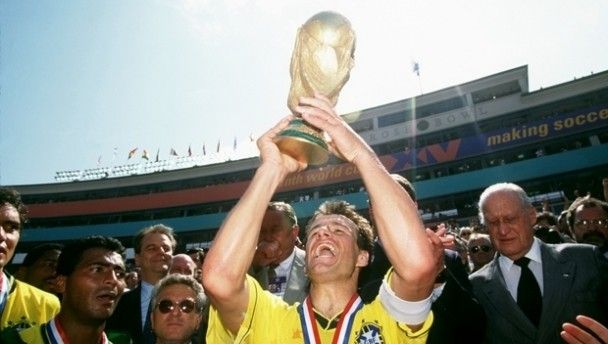
Now, shove all that aside. We’re not talking about the attractive stuff. No, we’re talking team player. The donkey-work. The water-carrier. Didier Deschamps, the World Cup-winning former France captain, was nicknamed “le porteur d’eau” – the water-carrier – during his playing days, but he was following a prototype created four years earlier by the previous man to lift the World Cup.
And appropriately perhaps, for someone unattractive both metaphorically (in that his role in the team was steady and unspectacular) and physically (all Army spike-cut, gnarled nose, unsmiling lips), that man’s name came with connotations of manure: Dunga.
The Brazil class of 1994 travelled to the World Cup in the United States on the back of well over two decades of underachievement. Although last year’s 2010 edition, personified by the petulance and flailing elbows of Felipe Melo, did plenty to erase any romance from the Brazil shirt, it’s unthinkable now for a Brazil side to have gone so long without a hint of a World Cup triumph.
In the 1970s, after Pele’s crowning glory in Mexico, they were overshadowed by their neighbours Argentina, by the Germany of Muller and Beckenbauer, and by the great but trophy-less Dutch side of Cruyff and Neeskens.
In 1982, Brazil were fanciful, they were free-flowing, they were often fantastic. And they returned home with their tail between their legs, having come up short on the biggest stage. Four years later, an ageing team played their part in the best game of that World Cup, possibly the best game of that decade, against France, but exited after a penalty shoot-out defeat. In 1990, they were reduced to mindless thuggery in a bid to halt Argentina and Diego Maradona in Italy.
By ’94, then, Brazil’s stock was possibly as low as it had ever been. Romario was their star man, the provider of the skill and the goals and the individuality, but was he any better than his predecessors in that role, Socrates and Zico? Probably not.
No, the key difference that summer was the presence of Dunga, and fittingly, the final was won in his image – a dour 0-0 draw for 120 minutes, in which our man helped to starve Roberto Baggio of the space and possession needed to wreak his mastery, followed by a penalty shoot-out win – in which our man stepped forward manfully to take the kick which ultimately won the Cup for Brazil; it piled the pressure on Baggio, the Great Ponytail, who fluffed his lines moments later to send his penalty high, wide and not very handsome.
Say nothing about Dunga’s subsequent record as a manager. Compared to the place in the trenches, the dugout can be inconsequential – just ask Roy Keane.
We hail Dunga, unsmiling, unattractive but indispensable. A World Cup winning team’s spiritual leader, protector, water-carrier and general. The ultimate team player.
LISTEN: You Must Be Jokin’ podcast – listen to the latest episode now!