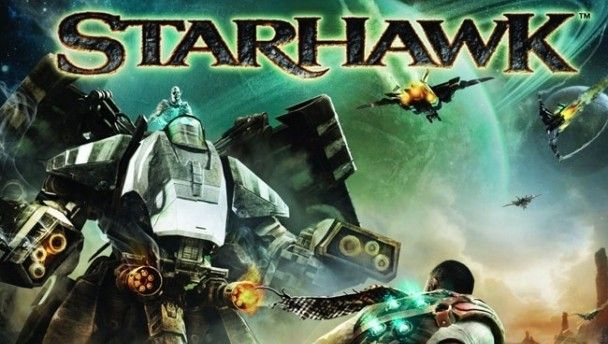
The spiritual successor to Warhawk, Starhawk promises to provide something a little different to gamers weaned on Call of Duty or Battlefield multiplayer bouts, yet does it succeed?
By Leo Stiles
Starhawk is the spiritual successor to Warhawk, one of the best early titles for the Playstation 3. Warhawk was ignored, largely because few could afford the fledgling PS3 (it cost over €600 at the time in 2007) and because the console did not have the online infrastructure or bundled headsets essential for online multiplayer games.
Starhawk is unlikely to find a bigger audience; not because of pricing factors or the state of the PSN, but because online shooters have gone from gaming curios to the dominant genre in gaming today and even the glorious Battlefield 3 can fail to dislodge the blight that is Call of Duty from its position of absolute dominance.
This is a real shame because Starhawk has some truly wonderful ideas wrapped up in a fairly bare boned package that have the potential to shake up the traditional death match.
Potential is the word to remember here because Lightbox, the developer, hasn’t managed to leverage some of its innovations into a more unusual set of game types or come up with anything resembling a compelling single player campaign.
So, what does Starhawk bring to the genre? Transforming jets for a start and a quite brilliant resource management and unit deployment system seem like game breaking additions to a genre but the execution here is so well done that suddenly, everything seems fresh.
The game is based on the Battlefield model with infantry augmented with an array of vehicles with which to tear holes in the enemy.
Jet bikes, tanks and a Halo-esque buggy are all present and correct but these are mere toys compared to the Hawks; agile and effortlessly easy to control, they dominate matches both in the air and on the ground which they do so as a transformed mech, complete with chain gun and shockwave inducing ground stomp.
Controls and vehicle balance is pitch perfect and is a pleasant surprise that you can be as assured a competitor in a cockpit as you are on foot, regardless of your experience or game rank.
As good as the Hawks are, the addition of RTS elements such as real time deployment of structures and the management of rift energy brings a layer of depth and strategy to the game that is absent from so much of its competitors.
Rift energy is the currency that allows you to deploy these structures that thump down onto the battlefield from orbit. Each structure gives you further options like to ability to build vehicles and weapons. These structures are easily chosen and placed via a smart wheel based interface that suits the rapid pace of the game.
Wall, bunkers, dome-like force fields and gun turrets can all be placed to defend your turf and for the happy snipers out there, watchtowers can be called forth to give your troops a ridiculously powerful rail gun that is so unbalanced, it is almost a game breaker.
Before you go nuts though, the rift energy that you depend on for deployment can only be harnessed at you base camp so the placement of multiple turrets inside enemy territory won’t work.
Admittedly, this all sounds like a lot of work but it all flows so seamlessly that you get into the swing of things very quickly. The game is technically assured as well with no slowdown and some truly epic draw distances making for some breathtaking conflicts with all manner of lighting and particle effects dazzling the eyes.
All of this would seem to suggest a winner here but Lightbox fails to capitalise on its biggest innovations by conforming to genre game types. Deathmatch, Team Deathmatch and Capture the Flag are all present and do little to take advantage of the strategy elements on offer. Capture the Flag is particularly unsuited to the game as bases become impossible to attack through sheer fortification and a single score wins many matches.
Zones – which tasks you with controlling multiple points on the map – fares a little better, however. As you secure each location, your resources become more finite and difficult to manage.
The single player campaign is as you might expect, redundant and useful only as a glorified tutorial. It’s dressed up with some sub-Firefly western motifs but is paper thin and unlikely to satisfy when you have the likes of Max Payne 3 on the shelves.
As I have said before, Starhawk has bags of potential and crucially, the game has ideas that are a cut above the staid genre norms. This potential has yet to be realised as it stands now but with future patches and expansions on the near horizon, a unique and fulfilling game could easily evolve. For now, Starhawk is a missed opportunity.

Format: Playstation 3
Developer: Lightbox Interactive; Publisher: Sony Computer Entertainment
LISTEN: You Must Be Jokin’ podcast – listen to the latest episode now!