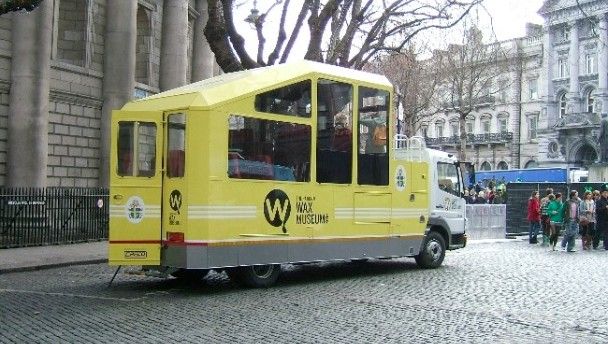
According to reports today the Irish Popemobile has been turned into a ‘party bus’, which is now available to rent… We didn’t even know there was an ‘Irish’ Popemobile.
Hang on, so before we start, what’s this about an ‘Irish’ Popemobile?
Well, it may be a tad surprising to those of you who were nothing more than a dirty thought when the Pope came over to visit Ireland back in 1979, but the pontiff actually had a holy carriage built specially for the event. It was a 1979 Ford D-Series converted flatbed – pictured below for the Popemobile aficionados out there – and it was constructed down in Cork.

Oh right, so what’s this about renting it out for a stag party? Surely it’s in a museum at this stage?
Well it was in a museum, sort of… The Irish Popemobile is currently owned by Paddy Dunning, who first came into ownership of the Popemobile back when he acquired the Wax Museum. Basically, it was ‘buy the museum get the Popemobile for free’. In fairness to Paddy, he might as well get some practical use out of the Popemobile instead of letting it rot in a room, especially as there’s a market out there for weird and wonderful limos.
So why stag parties?
It won’t just be used just for stag parties. Mr Dunning hopes to use his newly renovated Popemobile for stags, hen parties, debs’ nights and other private functions. At least it offers a bit more class than a giant pink stretch Hummer.
Okay, so how much for a spin?
Mr Dunning plans to charge around €300 per hour (plus VAT) for use of the Ford D-Series, which has been upgraded with a brand new Mercedes-Benz chassis. The truck has 15 seats, including the very seat used by the man himself when he came over to Ireland back in the late 70’s.
So is it only going to be used as a fancy taxi?
Not quite. Mr. Dunning said he’s going to be careful with who he rents the Popemobile out to. It is a piece of Irish history after all. As well as renting the truck out for private events, Mr. Dunning hopes to use the truck for good causes.
“I’d like to get a sponsor on board and take it around the country as a ‘hopemobile’,” he told The Irish Times.
“We’d like to go around the 32 counties and build a collection of stories of local heroes, either business people or local community achievers.”