Life jackets not fit for purpose and maps that were “blurred and unreadable.”
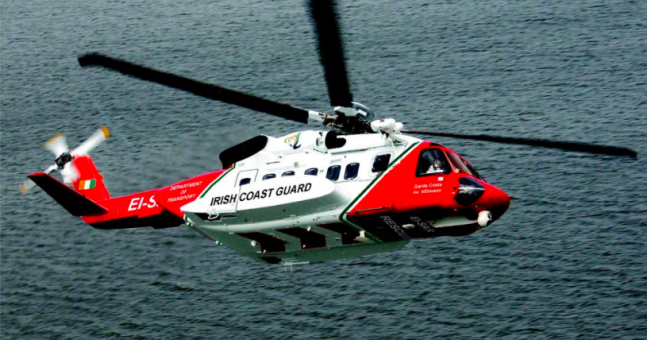
On Thursday night, RTÉ Prime Time reporter, Katie Hannon, revealed continuing safety concerns for Ireland’s Search and Rescue Helicopters services, some of which were raised as far back as five years ago.
The programme details information about pilot life jackets, navigation equipment, aeronautical maps and unclear safety regulation responsibility.
The company that runs the search and rescue helicopter service, CHC Ireland, received repeated warnings that the life jackets worn by Rescue 116 pilots Dara Fitzpatrick and Mark Duffy were not fit for purpose.
In the five years before Rescue 116 was lost, crew members logged several hazard reports about the life jackets’ personal locator beacons – a key safety system that ensures that pilots will be located quickly if they end up in the sea.
When Rescue 116 crashed, none of the personal locator beacons worn by the four crew members activated.
The programme also revealed new information about the data that the crew of Rescue 116 had available to them on the night of the crash.
Dara Fitzpatrick planned her final flight at the Dublin Base office using the Skydeamon flight planning tool. It shows Black Rock island as a dot – with no information to indicate that it is also an island of significant height.
Black Rock Island is included in this moving map system at the correct height. However, the map is blurred at some settings and when zoomed in to a close range, the actual height of the island is hidden behind the location code.
It also emerged that a few weeks before the accident, coast guard pilots began testing a new electronic mapping system which was uploaded on to a mini iPad and strapped to the pilots’ kneeboards.
Prime Time established that both pilots on Rescue 116 took these iPads on board on the night of the crash. This map was not approved for use as a navigation tool as it was still on trial. It showed Black Rock island at 46 feet when in reality, it is 282 feet at its highest point.
A CHC Ireland employee told Prime Time that CHC Coast Guard pilots are still flying with blurred maps.
It also revealed that the official aeronautical maps produced by the Irish Aviation Authority (IAA) contain a number of significant errors.
Nine days after Rescue 116 crashed into Blackrock Island, the IAA was informed that Skellig Michael was depicted incorrectly on their maps.
Achill Island is depicted in the official aeronautical quarter-inch map with no contours or tinting to indicate high ground. In fact, Achill Island has two peaks that are over 2,200 feet high.
Since then, new maps have been published but they still contain errors.
For example, the most westerly of the Blasket Islands off the coast of Kerry, Inishtarraght, appears on the chart to have the highest point of 276 feet when in fact 660 feet is its highest point.
Furthermore, there is confusion over who is ultimately responsible for safety oversight of Search and Rescue helicopter operations.
The Department of Transport initially told Prime Time that the Irish Aviation Authority was responsible, however, the Irish Aviation Authority’s own State Safety Plan states that “Search and Rescue is ….outside the remit of the IAA.”
The full programme will be uploaded to the RTÉ Player in due course.
LISTEN: You Must Be Jokin’ podcast – listen to the latest episode now!