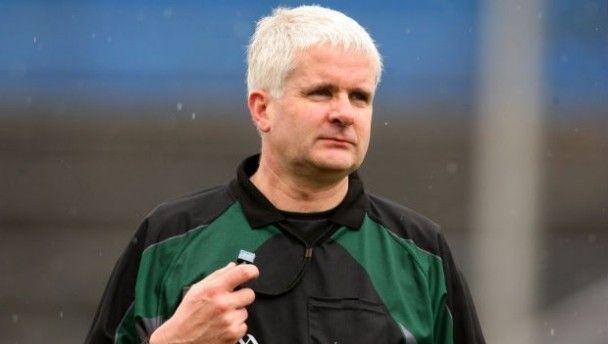
Former All-Ireland final referee John Bannon talks to JOE about the difficulties presented to players and officials alike by the hand-pass debacle.
The first couple of weekends of the Gaelic football championship have been beset by controversies surrounding the new hand-pass ruling.
Decisions during the Derry-Antrim, Kerry-Tipperary and Offaly-Meath games have all sparked consternation from players and fans alike.
There was a need to clear it up. The game had become like rugby league.
What we often fail to take into account is the difficult situation in which the official finds himself. After all, he’s the one charged with the responsibility of implementing a new ruling which has been introduced at short notice.
John Bannon retired from inter-county football last year but remains active on the club scene, which has also experienced its problems – albeit on a more low-key basis – as a result of the recent hand-pass rule change.
In contrast with some analysts, including JOE’s Gaelic football columnist Ciaran Whelan, Bannon feels that there was a definite need to address the hand-pass situation – but that the GAA botched the attempts to do so.
“There was a need to clear it up,†he says. “For the last year or two the throw ball had become so prevalent that the game had become like rugby league.
“I felt that what was tried in the National League this year, with the fist-pass only, had worked pretty well and most teams had adapted to it.
“But it didn’t get through Congress and then, unnoticed by most people in the media and everywhere else, this motion from Connacht, which stated that there had to be an underhand striking action, goes through. Now, if you’re to get technical about it, with players falling to the ground or whatever, it’s almost impossible to make an underhand striking action. If that’s the case the player in possession won’t be able to get rid of the ball at all.
“A lot was made of the Owen Mulligan pass for Kevin Hughes’s goal [in the Tyrone-Antrim game] but I think it was probably legitimate – to me there was a striking action from underneath. If it’s going to be a case that a pass like that is not okay in Gaelic football, it’s going to be nearly impossible for referees to ref games. That game was important last Sunday but imagine two minutes to go in an All-Ireland semi-final and a fella gives a pass like and it’s blown? The consequences would be unreal.â€
Implementation without experimentation
“One of the main problems with the new rule it is that it wasn’t experimented with. It’s only when rules are experimented with that you can really judge it. I saw this rule a month ago and thought it wouldn’t be a problem but I went to a meeting of 20 other referees and we started debating and discussing it, and we unearthed lots of problems.
“That’s where I’d blame the GAA. They did an experiment in the National League with 12 extra rules and threw most of them out, and then they come along and introduce one they haven’t experimented.”
Open to interpretation
Bannon believes the depth of the rule-book, and the fact that so much of it depends on the interpretation of individual referees, is a ripe source of discontent.
“There has been a problem for referees in the GAA for the last 125 years,†he says. “There are so many rules in the GAA that if you referee to the book, the game is stop-start, and if you use common sense and let the game flow, there are people saying that you’re missing certain things. It’s a no-win situation.
“Hurling is played under the same rules and I would say it’s a more physical game and on average there are 15 frees a game. On average we have about 55 a game in football and some would say there should be more.â€
The thorny issue of the referees’ assessor is another area which has had officials running for cover. Last Sunday, when Derek Fahy and Pat McEnaney offered two contrasting interpretations of the rules in Portlaoise and Belfast, one of the reasons offered by pundits was that while the esteem and experience of McEnaney shielded him from the views of the assessor, someone like Fahy may have been anxious of the potential pitfalls of failing to apply the new ruling rigorously.
Diverging views
Bannon points out that the views of the referees’ assessor and the paying public are often at odds with each other, something which highlights the difficulties facing officials.
“I said last year in an article with Martin Breheny that there are days when you’ll get a very good assessment but you could get booed off the field, you’ll get slated by the Sunday Game and you’ll get criticised in the papers. Now there’s something wrong when those two things are at such extremes.â€
When it comes to rule changes, Bannon feels that more stock should be placed in the views of the main protagonists, from players to managers to referees.
“One of the problems with regard to rules in the GAA is that we’re still dealing with committees,†he says. “The County Board goes to Congress and passes motions, whereas the players and manager are down at the training-field. They put one referee and one footballer on the committee, but that’s not enough, it’s just a camouflage job.â€
On a positive note, however, Bannon feels that the hand-pass problems will lessen as the weeks go by. “I believe it will sort itself out. The inter-county referees have a meeting again tonight (Wednesday) and I’ve a feeling that clearer guidelines will be given.â€
Â