Pitching is usually the art of the grizzled old pro. So how does a 21-year-old rookie suddenly become the hottest ticket in baseball?
By Sean Nolan
Traditionally, thanks to their college system, very young players rarely make it into the major leagues in any sport in the United States.
That trend is changing, especially in basketball as players skip college or go for a one year ‘one and done’ deal before joining the NBA. Neither Kobe Bryant or LeBron James played college hoops and the top draft pick this year, John Wall, spent just one year at Kentucky.
But in baseball it is really an older man’s game. Especially for pitchers. Some, injury permitting, go into their forties and often have their best years later in their career when they have full control of the ball. It’s a shock if a pitcher makes a name for himself before he’s 25 and most young pitchers drafted from college will spend three or four years in Double-A and Triple-A, finessing their game and building up their strength and control for the rigours of being a Major League starter.
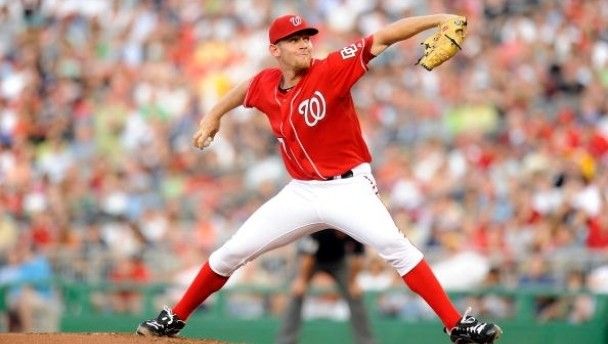
All of which makes the arrival of Stephen Strasburg into the league all the more remarkable. Number one pick in last year’s draft following a stellar career at San Diego State University, he has been fast-tracked unlike any other pitcher and after just three games, he is the hottest sports star in America.
The 21-year-old signed a four-year deal worth $15.1million in June 2009 with the Washington Nationals, breaking the record paid for a rookie by almost $5million dollars.
He would play his first game of Double-A in April this year for the Harrisburg Senators, an event attended by 70 accredited media as the hype machine went into overdrive. Strasburg’s ability was immediately apparent and he was easily too powerful for this level.
In May he was promoted to Triple-A, to the Syracuse Chiefs, where he once again dominated the lower-level batters. In total, Strasburg would play nine minor league games, winning seven, achieving 65 strikeouts in 55 and a half innings.
The clamour to bring him into the big league was now a cacophony and on 8 June, Strasburg made his debut against the Pittsburgh Pirates. The day was declared “Strasmus” in Washington, and the TV audience was enormous.
He pitched seven innings, striking out 14 batters, with no walks. It was one short of the rookie debut record for strikeouts and it was a stunning debut. He allowed two runs but got the win, and it was his control that was the most stunning.
Strasburg has a 100mph fastball – not a unique ability these days – but he can hit the corner of the strike zone with alarming regularity. But even more impressive is his breaking ball, a pitch that just dies as it approaches the plate. Apart from a very rare poor pitch, he is almost impossible to hit.
He followed up his 14 strikeouts against the Pirates with eight more against the Cleveland Indians, earning him the Player of the Week award and the cover slot on Sports Illustrated.
His third game was against the Chicago White Sox and in front of President Obama, a Sox fan, Strasburg struck out another ten, with no walks. His total of 32 strikeouts in his first three games was a Major League record, beating the previous record held set by J.R. Richard in 1971, who struck out 29.
His games are now “must-see TV”, and while the Nationals are still bottom of the National League East, the attendances and merchandise sales are through the roof.
Trouble ahead
The only spectre hanging over Strasburg, as hangs over all young pitchers, is injury. The nature of the pitching action, and the pressure it puts on the body, has wrecked many careers. The last pitcher to arrive with similar hype was the holder of the previous rookie signing record, Mark Prior.
Prior signed for the Chicago Cubs in 2001 and had an excellent first season in 2003, making the All-Star game and dragging the moribund Cubs onto the play-offs. But the Cubs left him in games too long – he averaged over 113 pitches per game that season – and injuries began to mount.
He never really recovered from various shoulder and elbow injuries and effectively retired from the game in 2009, with just 106 games played over seven seasons.
As for J.R. Richard, the man whose blazing start Strasburg has just beaten, well he had an even worse time. After his 1971 start, Richard was put back into the minor league to develop further and it was 1975 before he became an established starter.
From 1976 to 1980 Richard was one of the best in the game but he suffered a stroke before a game in 1980, ending his career instantly. He attempted a comeback but could not play at even close to his previous level and after retirement in 1984, his life went into a downward spiral.
He invested in some disastrous ventures, went through two divorces and ended up homeless by 1994. He has since found God and is now a minister but his tale is a warning to any young player about how quickly things can turn in professional sports.
The tales of Prior and Richard are the only shadow over the wonderful Strasburg story. Washington have handled him well and look to be prepared to use him sparingly for the foreseeable future. Some have questioned his mechanics but he seems to generate his extraordinary control and power with a minimum of effort.
The temptation, and the pressure from the public, to use him more is already relentless, but if we want to see Strasburg dominate the game for years rather than months, we are all going to have to be patient.
Â