From now until the end of the World Cup, JOE’s team of know-it-alls will be giving you a daily mish-mash of opinions. If you like what we’re saying, or think we’re talking a load of crap, have your say via the comment box at the bottom.
1. The Jabulani ball is actually quite good
The Adidas Jabulani ball had become something of a scapegoat in this World Cup. Every time a pass was misplaced, “it was the Jabulani’s fault,†every time a goalkeeper made an error, “it was the Jabulani’s fault.†Rob Green blamed the ball for his error, and gave it a horrible review on Amazon.
A case can be made for the players not being accustomed to it at the start of the World Cup, and clearly it would have been preferable if it had been used in other competitions in the build-up to the tournament (although just as clearly, that was never going to happen for marketing reasons.)
In the last few days, however, as even limited players have finally become accustomed to its foibles, we have seen some terrific shots and long range goals. Carlos Salcido hit the bar from 30 yards against Argentina, Frank Lampard hit the bar from outside the box twice (although one will be remembered more fondly than the other), and Carlos Tevez scored a cracking second half goal against Mexico.
The Jabulani has been criticised for killing the art of goalkeeping. But we have seen some excellent performances by keepers, none more so than Nigeria’s Vincent Enyeama (staple error apart, his coming against Greece). Was goalkeeping really any better back in the day? Was it a Jabulani that coaxed errors from people like Packie Bonner and David Seaman in past World Cups?
The Jabulani has been criticised for making long passes difficult. Great, that means we’ll have more short passing.
The best players in the world do not seem to have had any difficulties with it. Cristiano Ronaldo’s thumping effort against the Ivory Coast would have broken the keeper’s wrist if he had somehow managed to get close to it. Lionel Messi has dazzled in this tournament. David Villa’s strike against Honduras was one of the best goals we’ve seen. Brazil and Germany have scored some exceptional team goals, zipping the ball from width to width and end to end with ease.
2. The problem for England’s players is that they’re surrounded by English players
Every major tournament (or every tournament they qualify for), the English nation is somehow gripped by the conviction that this is going to be their year. Remember, this is the England team which, give or take a few underachieving millionaires, failed to qualify for the last European Championships two years ago, so what made them so special this time around?

Well, it’s a few things but mostly, it’s the fact that they’re not very good. Frank Lampard and Steven Gerrard play in focal midfield positions for their clubs. That’s focal, not pivotal – there’s a crucial difference. For Chelsea, Lampard is given the freedom to play as an auxiliary centre forward by the presence of such midfield enforcers as Michael Essien and Jon Obi Mikel. Take those two out of the Chelsea team and the dynamic is very different.
Lampard is a similar player to Michael Ballack, who has struggled at Chelsea primarily because the Englishman has held a stranglehold on that attacking central midfield spot. One of the main reasons that Ballack was so effective for Germany in the past was that he had people such as Torsten Frings behind him.
The Lampard/Ballack roles are virtually a carbon-copy of Gerrard’s situation at Liverpool. Gerrard’s best performances at club level have all been built on a solid midfield hub, there to do the defensive shielding and link play which is so crucial yet which Gerrard finds impossible. Remember that Champions League final in 2005 when Gerrard was put forward as the sword-carrying, scalp-brandishing hero for a Scouse generation? Liverpool were 3-0 down at the break, when Didi Hamann was introduced to shore things up. And voilà , suddenly Gerrard had the giant on whose shoulders he could stand. In Liverpool’s best season, 2008/09, Gerrard had the aid of both Javier Mascherano and Xabi Alonso, who filled the roles of destructor and link-man respectively. Is it any coincidence that Liverpool dropped from second to seventh when Alonso headed off to Real Madrid?
Everywhere in the England team, this situation is replicated. John Terry is better because of the nous of Ricardo Carvalho or Alex. Gareth Barry’s deficiencies, painfully obvious against Germany, are masked by the presence of Nigel de Jong or Vincent Kompany, two good defensive midfielders. Perhaps the only English player in this squad who deserves a place among the world’s elite is Wayne Rooney, who was a shadow of himself at this tournament. Perhaps we’ll never know whether the principal reason for that was his lack of fitness or his lack of Paul Scholes, England’s only real midfielder and a player whose courtship by Fabio Capello on the eve of the tournament spoke volumes about the team’s shortcomings.
3. Germany aren’t Germany any more
They’re not exactly solid, they’re not exactly efficient, they’re certainly not automatons. In bygone times, you could rest assured that Germany would impose the strength of their will on proceedings by strangling the life out of the opposition.
Almost always, they were joyless and ruthless, and us Irish only ever cheered for them when they were playing England. But even when they won, we revelled more in the schadenfraude of the England’s failings (Paul Gascoigne, Stuart Pearce, Chris Waddle, Gareth Southgate) rather than the qualities of the Germans. Did anyone outside the Rhineland really enjoy watching Olivier Bierhoff? Jurgen Kohler? Lothar Matthaus was brilliant, but in a typically German sort of way, which made him much less heroic than contemporaries such as Marco van Basten or Roberto Baggio.
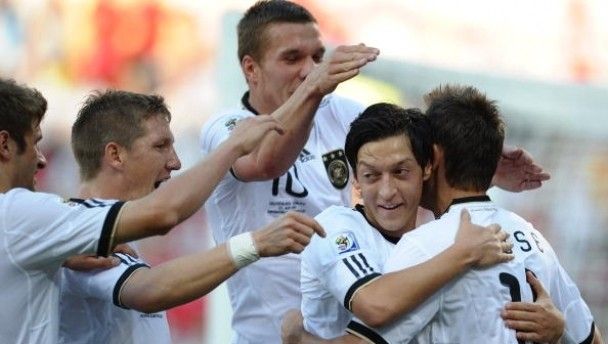
But this Germany, the one which first raised its head above the parapet in the World Cup on home soil four years ago, is different. Miroslav Klose was playing and scoring as far back as 2002, but he is now emblematic of a new Germany. A multicultural one. Klose, Lukas Podolski and the substitute Piotr Trochowski were all born in Poland. The families of Mesut Ozil, the rising star of this tournament, Sami Khedira and Jerome Boateng are Turkish, Tunisian and Ghanaian respectively. Cacau, the striker who scored in Germany’s first game against Australia, is a naturalised Brazilian.
It’s no wonder, then, that this Germany team is so resolutely un-German. They play with a flair which was never part of the German make-up. Had German teams of the past found themselves 2-0 up in a knock-out World Cup match they would have stifled the life out of the game, but this team would have been pegged back to 2-2 in the space of about 90 seconds but for a glaring oversight from the officials.
Even those who are so thoroughly German, like Bastian Schweinsteiger and Thomas Muller, are liberated by the players around them. The upshot of it all is that we actually look forward to Germany games. They’re rivalling Argentina as the most entertaining side in the tournament, which makes next Saturday’s quarter-final so enticing.
– Shane Breslin & Conor Hogan