By Sean Nolan
On Tuesday night the National League won the All-Star game for the first time in 13 years, ensuring that their side would have home field advantage in this year’s World Series.
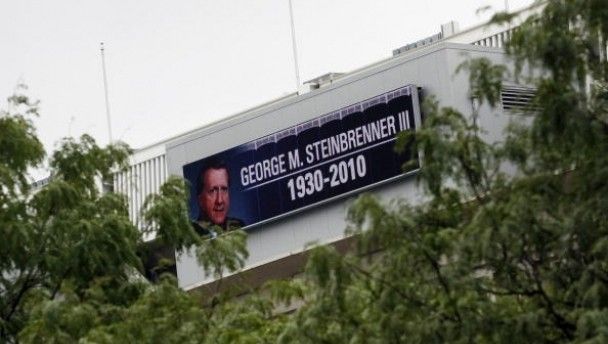
But the “Midseason Classic” was overshadowed by the death of George Steinbrenner, the former owner of the New York Yankees.
For most of the last 40 years, Steinbrenner was the Yankees. He embodied everything about the city, the team and their style and made them loved in the Big Apple and reviled almost everywhere else in America.
As an owner he was a cross between Roman Abramovich and Jesus Gil. He spent fortunes on the team, demanding excellence, and if he didn’t get it, the wrath of “The Boss” was legendary.
Born on 4 July 1930, Steinbrenner was a true independent man. Making his fortune in shipping in Ohio, he bought the Yankees in 1973 for $8.8million (they are now valued at $1.6billion). The Yankees were trading on the glories of the great teams of the past but Babe Ruth and Lou Gehrig were long gone and the team were no longer contenders.
Steinbrenner brought his incredible force of will to the team, demanding success instantly. And he did it the old-fashioned way: with money and tyranny.
During his 33 years at the helm – he retired in 2006 – Steinbrenner fired over 20 managers and 11 general managers. His tolerance for anything less than his own, sometimes insanely high, standards meant everyone in the Yankee organisation lived in fear of encountering him in the halls of Yankee Stadium.
Billy Martin, who managed the Yankees to their first World Series under Steinbrenner in 1977, was fired by Steinbrenner on five different occasions (1978, 1980, 1983, 1985 and 1988).
Yogi Berra, one of the greatest ever Yankees, was fired after just three weeks as manager in 1985, leading to Berra not setting foot in the stadium for 14 years.
The players were not immune to his whims either. Steinbrenner enforced a strict policy on his players’ appearance, with no player allowed to have hair that reached his collar or to have any facial hair apart from a moustache.
When star first baseman Don Mattingly grew a mullet in 1991, he was benched by Steinbrenner against the wishes of coaching staff and fines were issued to countless players over the years for growing goatees or other minor breaches of code.
Fans of Seinfeld will also remember Steinbrenner as a character in the episode where George Costanza worked for the Yankees. Voiced by Larry David, the Steinbrenner of the show was a constantly jabbering leader with bizarre flights of fancy, but his inclusion in that most New York of programmes, confirmed his place in the hearts of most New Yorkers.
The portrayal was largely affectionate and the man himself was reported to be a fan of the show, not surprising as he knew the power of the media better than, and long before, almost anyone in American sports.
He was one of the first to take advantage of cable television, selling the rights to games, ensuring a solid revenue stream into the club to fund his project.
He had a dark side too. Convicted of paying illegal contributions to Richard Nixon’s re-election fund in 1974 before he took over in the Bronx, he would be suspended from baseball for three years in 1990 for paying a small time crook $40,000 for “dirt” on a former player, Dave Winfield, who was suing him at the time.
But behind all of his decisions, good and bad, was a will to win. Under his tenure, he won seven World Series and 16 divisional titles.
Off the field he made the Yankees arguably the most famous sports franchise in the world, and the brand new Yankee Stadium, opened in 2009, is a fitting memorial to the scope of his vision and beliefs.
Before the All-Star game began on Tuesday night, an impeccable minute’s silence was held for Steinbrenner, and all the Yankee players and management involved in the game wore a black armband.
Then, as each player was introduced to the crowd, every player in the famous New York pinstripe uniform was loudly booed by the California crowd.
Respected and hated, loved and loathed, it summed up his legacy perfectly. George Steinbrenner would have loved being the centre of attention and dividing the baseball fraternity.
Â