The way you watch sport could be about to change, forever. And no, we’re not talking about 3D TV. 3D TV is sooo last year compared to the work in progress at a joint Disney Research/CLARITY project in Dublin. JOE.ie had a look.
It might be more famous as the home of Mickey Mouse but Disney is not just about cartoons or theme parks. As the parent company of ESPN, a major player in the hugely lucrative American sports television market which took its first steps towards breaking the Sky monopoly on this side of the ocean last year, it knows a thing or two about sports coverage too.
Committed to developing technologies of the future through its Disney Research arm, a university-based association of research labs aimed at coming up with ground-breaking new media and entertainment technologies, Disney has been working alongside CLARITY – a Centre for Science, Engineering & Technology between University College Dublin, Dublin City University and Tyndall National Institute Cork and funded by Science Foundation Ireland – with the aim of coming up with the technology to revolutionise television coverage of sporting events.
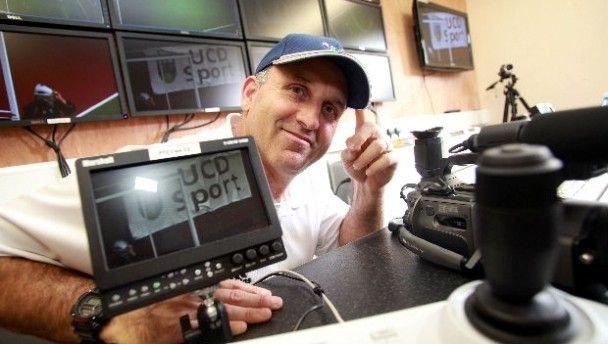
The technology is currently at the most embryonic stage, with hockey acting as its guinea pig. A ladies international between Ireland and Germany at the National Hockey Stadium in UCD earlier this year was the first major game to be subjected to its brand of remote-controlled cameras, with a film crew, under the direction of Emmy Award-winning director Artie Kempner (pictured top), attempting to find a way of producing broadcast-quality footage without the constant need for specialist manpower.
As a research technology it’s still some way from realisation in a commercial sense, but when it does come to fruition, it will help to streamline production costs for major networks requiring substantial outside broadcast units to cover the big events, thus making it more cost-effective to cover more and more of the major sports.
But it’s not just the elite sports which will benefit. Far from it, minority games will also receive a major shot in the arm when the technology is delivered. An achievable goal, then, is that even the smallest clubs within niche sports, or the governing bodies of juvenile and underage competitions, could stream coverage online through a low-cost camera network and highly automated controls.
Sensor Web
Professor Noel O’Connor is CLARITY’s Principal Investigator, is firmly of the opinion that the new technology will benefit all sports – at all levels. CLARITY is a research institute specialising in the ‘Sensor Web’, but what exactly is that?
Prof O’Connor explains: “We’re all familiar with the World Wide Web, as well as the Social Web including blogging, Facebook, Flickr and more recently Twitter. We believe the next evolution of that is the ‘Sensor Web’, with new forms of information. That could be video cameras or CCTV to monitor traffic data, or air and water quality sensors. When you ally images, video and text to those new forms of information, you have a fantastic leap forward but you also have a potentially huge problem. How do you separate all the rubbish from all the really useful information? So what we have to find is a way of getting the right information to the right people at the right time.

CLARITY’s Principal Investigator Noel O’Connor (right) with director Barry Smyth
“We want to try to put in place a hardware platform which would serve as the infrastructure to gather that raw data, analyse the content and extract the useful information from it, and then store and index that information to present to the right people. We have two demonstrators, one which deals with environmental monitoring and the other relating to personal health and sports. From the sports end of things, we want to develop the technology to enable athletes to perform better, and not just for elite athletes either, we want to do it so that everyone has access to it, for training or competitive use.â€
And that’s where this project with Disney Research comes in.
“You need state of the art computer vision and image processing technology, but it’s a research project – it’s very new ground and it’s not possible currently,†says Prof O’Connor. “Disney and the Irish Hockey Association agreed to take part in the research, in which up to 21 cameras are installed around the National Hockey Stadium. The aim is to make it available to everyone from local club to international level.
“ESPN is a key affiliate of Disney and they’re always interested in finding new technology to capture sports. Previously, when television networks are planning on broadcasting a live sporting event they need an Outside Broadcast Unit with a full production team of very specialist people capturing the event in real time.
“That’s not feasible in every town or every clubhouse in the country, but the CLARITY project can conceivably work on any sport – every club in the country can install a low-cost camera network to capture every game or training session. Say you’re a parent and you can’t make it to your child’s game, you could watch it online. It’s possible.â€
Director aids
But if a large team of specialists are required for high-end sports broadcasting, surely there must be some rebellion against the implementation of technology which reduces the need for human input?
“It’s not about replacing the director,†insists O’Connor. “It’s about creating the tools to make the director’s life easier. With something like the Super Bowl or All-Ireland final, you’ll always need a team of directors and cameramen, but this will allow them to do their job better. The initial feedback has been great.â€
Virginia Perry-Smith is here on the side of Disney Research as the project’s Producer and Research & Development Manager. Having worked with Disney for the past 20 years, Perry-Smith had a strong background in television and film before moving across to the research body two years ago.
Technology is moving so fast – while we’re some way short of delivering this now, it may not take five or ten years to come to fruition, it may happen in one to two
Like O’Connor, she is excited by the range of possibilities presented by the new technology: “We hope it will serve many purposes on many different tiers. It’s a long-term, multi-year investment but the ultimate goal, in order to serve lower level sports, the kind of one-off sports you might only see at the Olympics, is to find a fiscally responsible way of capturing those sports and broadcasting them to a wider audience, while we also believe it would supplement big-league options for the major broadcasters covering sports from NFL or Nascar.
“I’m an American and I’m here [in Ireland] for 18 months. My nine-year-old son plays soccer here and it could be possible to capture his games and stream them on the internet – what would my parents say if they were able to watch him online?
“There’s the possibility of creating new fanbases for minority sports by making them more accessible to a wider audience. It’s also a way of opening up new revenue streams and it could happen sooner than you think – technology is moving so fast so while we’re some way short of delivering this now, it may not take five or ten years to come to fruition, it may happen in one to two years.â€
Nevertheless, even with the ever-increasing speed of technological advancement, Ms Perry-Smith concedes that the technology is still some way short of completion.
“As far as the footage goes, there’s a ways to go. The ladies hockey international was just the second time the film crew got to shoot with the joystick- and remote-controlled cameras, which is very different from your usual handheld camera. But they’re very pleased with the results they’re getting so the aim is to get that up to broadcast quality as quickly as possible.â€
Watch this space. Soon every match, at every level, could be available at the click of a button.
Â