Around 1.5 million people visit Cambodia annually, most of whom discover still visable scars of war. JOE visits the country’s war museum.
By Robert Carry
The dusty, out-of-the-way Cambodian town of Siem Reap is one of the most well-visited places in Southeast Asia . It’s ugly, over-priced by regional standards and has little by way of attractions to recommend it. What it does have in its favour, however, are the fabled Angorian ruins which sit right on its doorstep.
Nearly one million people pour into this part of Cambodia to witness what are widely regarded as one of the greatest accomplishments of human construction. The sprawling, ornate ruined complex hacked out of the jungle once served as the administrative and religious centre of the Khmer empire that controlled most of Southeast Asia, and for sheer visual impact is said to only be rivalled by India’s Taj Mahal or Peru’s Machu Picchu.
While most of the visitors to Siem Reap were climbing onto motorbikes and tuk tuks and heading for the ruins, JOE opted for a lesser-known destination – the War Museum.
One of the bloodiest conflicts since World War II ripped across Cambodia from the early 70s and the upheaval ultimately led to the rise of infamous Khmer Rouge. The bloody-minded, ultra-communist group gathered support from among the Khmer rural poor amid the fury generated by the USA’s bombing the county as part of its war in neighbouring Vietnam.
The Americans backed the corrupt, ineffectual Lon Nol regime that was in power at the time but the Khmer Rouge, buoyed by swelled ranks and weapons from Vietnam, Russia and China, toppled Lon Nol’s forces and captured the capital Phnom Penh in 1975.

The KR idealised national self-reliance and a simplistic, classless rural lifestyle. They set about realising their agrarian utopia by forcing all city and town dwellers into the country where they were pressed into labour camps.
What followed was one of the most horrific genocidal massacres in recorded history as the KR began to see enemies everywhere. They murdered around one million people with many more succumbing to overwork and lack of food. They were eventually ran out of power by the Vietnamese, but the Khmer people are still struggling to recover from the incredible damage done to the country and its people during this terrible period in their recent history.
Moto driving duties were taken on by Jay – a heavily tattooed teenager who fancied himself as a playboy. His tales of seducing various lonely foreign women before seeing them off with instructions to send him money every month made the journey fly by.

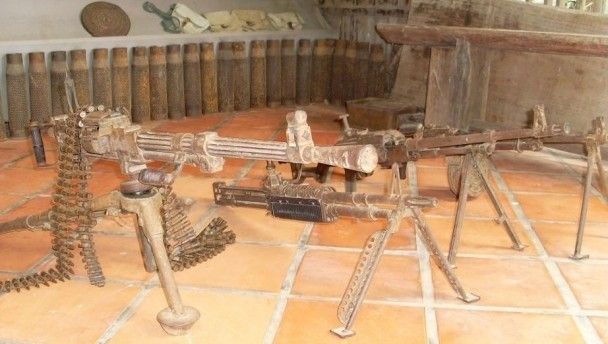
What we found at our destination was less a museum, and more a battered collection of munitions, arms, tanks and artillery left over from the conflict. A suddenly solemn Jay waited outside with the moped while Sam, a 30-something Khmer Rouge survivor, took on the role of tour guide.
Practically every member of Sam’s family had been killed by the Khmer Rouge in one way or another while he was a small child, and he had, on several occasions, witnessed their deaths.
“I was too small to pick them up or hug them so I just watched while they died,” he said. Sam’s uncle was the only other survivor in his family and he was determined to spend his life fighting the regime.

Sam, still little more than a child, would tag along after his uncle from one battlefield to another. He held up a mutilated right hand and explained that when he was 13 he picked up a fuse from a land mine. He also had a deep scar along the side of his eye from the shrapnel burst. He was lucky to be alive, he said.
The stacks of muddy rocket launchers, stricken artillery pieces and piles of AK47s were interesting, but what Sam had to say added humanity to the normal, detached curiosity that comes with hearing about a distant, nasty event. He encouraged visitors to pose with various guns that had killed God knows how many people, and seemed surprised that people who had come to stare at the tools of a genocide were unwilling to hold them.
Sam’s job was to retell his horrific story and relive his childhood experiences for everyone who walked through the museum gates. The weapons were rusting away as the country outside attempted to move on from its nightmarish past, but Sam was stuck there among the skeletons with the war still raging and his family still dying around him.