It was from the director of the Back to the Future trilogy and Forrest Gump.
Contact was released in cinemas on 11 July, 1997 and starred Jodie Foster as a scientist who discovers evidence of extraterrestrial life and then fights to be the person chosen to make first contact with the aliens.
Helmed by special effects wiz Robert Zemeckis (the Back to the Future trilogy, Forrest Gump, Who Framed Roger Rabbit), it begins with a scene panning out from Earth, before taking viewers through the solar system and the Milky Way all the way into deep space.
Its climax is even more spectacular, showing – spoilers – its lead character Dr Ellie Arroway being transported through an alien-made transit system comprising of wormholes. This is before she lands on a beach constructed from her literal dreams by kindly extraterrestrials in an effort to make her feel comfortable.
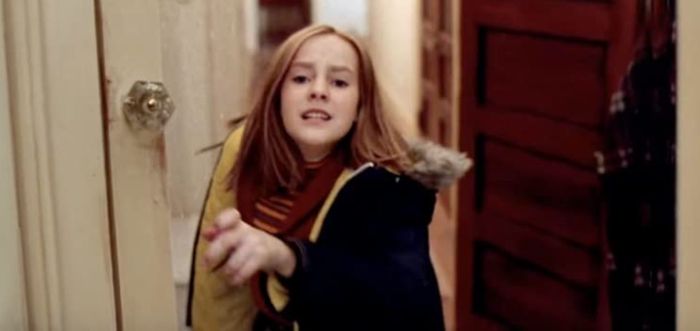
All that said, arguably the most jaw-dropping moment of visual wonder in Contact occurs in the middle of a more everyday, albeit tragic, scenario. During a flashback to Ellie as a child (where she is played by Jena Malone), we are shown the moment her character discovered her father (David Morse) dying.
In an apparent unbroken tracking shot, we see the young girl frantically running up the stairs to the bathroom to retrieve her dad’s medicine in a bid to save him.
However – as seen in the clip below – as she reaches the bathroom, it appears what we’ve witnessed throughout the scene already was actually a reflection in a cabinet mirror.
Yet, that cannot be the case as you would not have been able to see her in the mirror running up the stairs.
Clip via Velhasili Kelam
So, how did the team working on Contact pull off the trick? Well, on the Contact DVD, there is a commentary with Ken Ralston, the movie’s senior visual effects supervisor, in which he talks through the sequence.
Ralston explains that there was no mirror in the mirror shot, with the whole scene being constructed through inventive compositing.
“Bob [Robert Zemeckis] was trying to come up with a creative way to represent [Ellie’s] torment and all of the different things that are going through her mind on the death,” he said.
“She’s running up the stairs. She starts to go slower and slower with a device that slows the film down.”
As Ellie gets close to the bathroom, this shot of her running is transposed onto a bluescreen standing in for the mirror and seamlessly combined with another shot of Ellie reaching for the mirror, thus giving the illusion of one unbroken shot.
“She opens the mirror – which is all fake. She’s blue screened in the foreground so we can match it in beautifully,” Ralston adds.
In order to accomplish the perfect transition, the special effects artists even had to “paint out” the shoulder of a camera operator at one point in the sequence.
On top of wowing anyone who has seen it, the scene serves as a great example of why Contact stands out from other similar movies of its genre.
Based on a novel by scientist Carl Sagan, it is a film that features plenty of jaw-dropping sci-fi spectacle. Yet, what makes those moments truly resonate is that we believe in the people at the centre of them.
In fact, most of Contact’s major blockbuster moments are actually withheld until its final act, with the movie using that time to establish the character of Ellie.
Following the death of her science-loving father, she lost any religious faith she might have had, instead devoting her life to the search for intelligent alien life – hoping deep down to find some way she might be able to contact her dad.
It is this – along with Ellie’s struggles as a woman in the male-dominated field, where her adversaries include characters played by James Woods, Matthew McConaughey and Tom Skerritt – that make the visually stunning yet hugely emotional climax hit all the harder, perfectly tying a bow on the character’s journey, as well as the film’s story and themes.
That said, this emphasis on character over blockbuster beats may have hurt Contact slightly upon its release.
The movie holds a 67% critics score on Rotten Tomatoes and made about $170 million at the box office on a $90 million budget – both perhaps slightly underwhelming results for a director whose previous film was the smash hit and Oscar Best Picture winner Forrest Gump.
However, Contact now appears to be a favourite among many sci-fi fans with it going on to boast an impressive 7.5 score on IMDB from audiences.
In recent years, it has also been cited as a forerunner to later brainy but emotional blockbusters like Ad Astra, Arrival and Interstellar.
To me, Contact’s reappreciation is deserved as looking back on it today, the fact that Hollywood greenlit a movie on such a massive scale that, while featuring moments of sci-fi awe, is mostly a drama about grief and the clash between faith and science feels like a miracle.
LISTEN: You Must Be Jokin’ podcast – listen to the latest episode now!