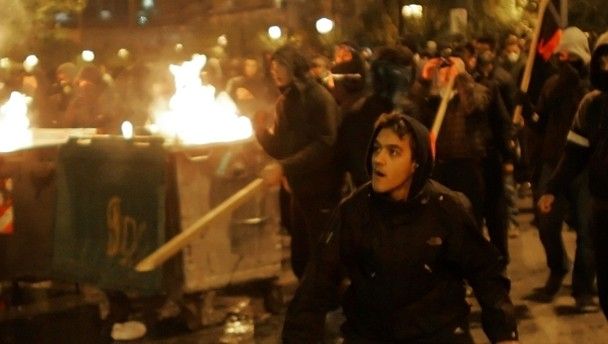
The Greeks are up in arms again after the latest set of austerity measures, but the question we’re asking is: Could Ireland be in the same situation soon?
By Denis McEvoy
The Greek Prime Minister Lucas Papademos warned on Saturday that his country would be plunged into ‘uncontrolled chaos’ if the national parliament voted no to the austerity measures, but he was wrong. There were going to be protests either way.
The situation may be unfolding on the far side of the continent, but given the commonality between Europe’s peripheral countries, most notably Greece, Portugal and Ireland, there’s no doubt events in Athens have implications for us.
As yet, though, there have been few protests here and little or no social unrest, with only pensioners and students making any real effort. Are Irish people genetically programmed to avoid protesting like a leper at a kissing booth, or are there other reasons at play for the apparent difference between us and our Greek brethren?
Dr Thomae Kakouli-Duarte has been in Ireland since 1995 and has seen the rise and fall of the Irish economy. She lectures in Environmental Biotechnological Sciences at IT Carlow and has been head of the Hellenic Community in Ireland.
As she explained to JOE: “I thought initially that the reaction had to do mostly with the Irish psyche, but it became apparent to me on a recent visit to Greece that the austerity there is completely different to the austerity here.
“That very thing is a fundamental factor for the different reactions. I know friends and family who have €5 to spend a week; these people are considered middle class. Decent, honest, working people who are about to lose jobs and literally have €5 to spend for the weekly budget.”
Is Ireland really as bad as Greece?
It’s hard to argue that Ireland is in any way as severe an economic situation as Greece. But is it only a matter of time before we get there? According to Richard Boyd Barrett, the United Left Alliance TD, the same situation won’t be long in reaching these shores.
“The Greeks are a year ahead of the curve of austerity than here. The government story is that we’re not going to get to that terrible situation,” the Dun Laoghaire TD told us.
He warns that there’s a rocky road ahead for Ireland: “If you look at our debt and at the collapsing forecast for economic growth both in Ireland and Europe, it is almost inevitable we will need a second bailout.
“When that happens the demand for austerity will be ratcheted up by the Troika; they won’t give us a second bailout unless we intensify the austerity. That’s when we’ll see real problems.”
Dr Kakouli Duarte is adamant, however, that the situations are completely different. “Poverty is widespread in Greece, Ireland hasn’t reached that stage yet and I hope it will not reach it,” she says.
Even with the difference in our economic fortunes, she feels that the Irish and Greeks have different views on demonstrating. “This is [another reason] why we’re reacting differently. Irish people are more placid in general; they don’t have to have such political polarisation. Greeks are more political by their very nature, by their culture. And Greece has hit rock bottom at this stage.”
Strikingly, though, Dr Kakouli Duarte reckons Irish people must make their presence felt while the can still exert an influence on policy-makers. “People should protest before we reach the same point as the Greeks,” she says. “If we reach that point it will be too late and there will be riots here as well.”
The Government doing all they can to prevent social unease?
So the consensus is that mass demonstrations and rioting could, in time, be on the cards for us. Dr Michael Breen, a lecturer in the School of Law and Government at Dublin City University who takes a special interest in IMF programmes, says the Government have to handle the cuts deftly – something they’ve managed to achieve thus far.
“If you look at the way the Irish Government, with the backing of the Troika, has managed our adjustment following the crisis, they’ve actually done a good enough job in avoiding major public protests with hundreds of thousands of people out on the streets,” reckons Dr Breen.
“There hasn’t been a short, sharp shock, they’ve spread out the cuts over a number of years. They have a plan where the cuts are incremental. This doesn’t mean that they’re any less devastating to people, but they’ve neutralised what could have been a much bigger protest.”
Whether it’s thanks to the Government or the fact that we’re just not bothered enough to protest, it seems riots are being kept at a fairly safe distance for now.
However, Boyd Barrett says there’s already movement towards the public being more vocal on the austerity measures. “It’s inevitable we’ll reach a point where people can’t take anymore and will be forced to resist,” he says. “In fact I think it’s beginning to happen already. There’s been enormous turnouts at the Household Charge meetings that’s been the first opportunity people have had to say ‘No’.
“That will manifest itself in protests in the coming months. Up until now people have hoped that there’ll be a year or two of austerity and then the situation would right itself. But it’s become clear the situation isn’t getting better, it’s getting worse.”
Different strokes for different folks
The line from the Government is that ‘we’re the poster boys of Europe because we’ve followed our bailout agreement’, and perhaps that has prompted a further unwillingness to raise our heads above the parapet.
Dr Kakouli Duarte is clear in her view of what’s happened to her country – and feels that the Irish Government have not helped matters by trying to put distance between us and the Greeks.
“Greece has been completely stigmatised and demonised and wanting to ‘punish’ a nation that Europe owes a lot to down through history,” she says.
“I think that the Greeks have been demonised severely and been used as a scapegoat to justify the very flaw of this system that brought Greece to its knees. Portugal is probably next and then it would be Ireland.
“The things I hear in the news are the worst. Like Enda Kenny saying ‘Ireland is not Greece’. This is very offensive, very hurtful, and very inconsiderate because before we know it, and I hope it doesn’t, Ireland could be in exactly the same position.”
So what happens next?
Apart from sticking with our agreement with the Troika, there doesn’t seem to be a clear plan. Dr Breen thinks that nothing less than leaving the agreement would cause the Irish to take to the streets in any great numbers.
“Supposing we were to leave the EU/IMF programme and we were to close our budget deficit immediately, then I would expect we would see some serious social unrest in Ireland,” he says. “It would really be a shock to the system. We would see major social changes happening straight away.”
One thing everyone seems to agree on is that riots and mass protests are a possibility; how close they are to becoming a reality is where opinion differs.
But even that alone is a stark change since the beginning of the recession. Social unrest even being conceivable only serves to underscore the gravity of the situation in which Ireland finds itself.
LISTEN: You Must Be Jokin’ podcast – listen to the latest episode now!