With the amount of stuff going on in Dublin over the past couple of weeks, a visit by the planet’s most powerful man seemed almost run-of-the-mill. With Dublin under a now familiar lockdown for Obama’s arrival, JOE journalist Robert Carry heads for College Green in the hope of snatching a glimpse of the devilishly handsome kingpin.
The economic downturn steadily hammering the US since Barack Obama cleaned out Hillary Clinton and John McCain has left the American president looking a lot like he couldn’t ‘Change!’ a wheel. However, his recent success against Osama bin Laden, not to mention his public spanking of Donald Trump, has helped turn things around on the domestic front and the country’s 44th president is again riding high in the opinion polls.
But while he has at times been left looking somewhat toothless to those back home, many in this part of the world fondly remember the sense of optimism that saw Obama plough through all before him when he won the presidency and have no real depth of knowledge when it comes to his performance during his term.
Throw that in with the man’s innate likeability, made all the more obvious when contrasted with the gimp he took over from, and it’s easy to see why his popularity abroad has never really faded.
Sure enough, thousands of people decided to brave wild wind, random searches and a Jedward performance in the hope of getting the chance to point their eyeballs at the best looking president in US history.
With all direct routes into College Green sealed off with now familiar barriers, the flag-waving hoard milled aimlessly around the city asking confused gardaí hailing from everywhere from Ballyhaunis to Bundoran about what might be the best way to get one of the sought-after slots in front of the podium. They shuffled from one foot to the other, scratched their heads and pointed, seemingly, in whatever direction might end the line of questioning.
“There’s loads of time. Sure he’s still sculling pints in Moneygall!”
Eventually, the crowd thickened at Christchurch and a sign became just about detectable over the sea of heads. It said something about no bags being allowed. This had to be the entry point.
“The poor Queen,” said someone over my shoulder. “She must be wondering where everyone was when she was over.”
Although Gardaí in their thousands were on hand, there was little by way of an actual queue. Instead, we were formed into a gelatinous ball of people pressing towards what we hoped was the way down Dame Street and into the Green. The crowd would be still for 15 minutes before suddenly moving forward exactly two steps before coming to a halt again. This, at least, suggested people were still getting in.
It was only 2.30pm anyway and he wasn’t due to speak until 6.30pm. Loads of time.
“There’s loads of time,” said Phil Doyle, a 50-something who had made his way from Howth for the event. “Sure he’s still sculling pints in Moneygall!”
An hour in, and people were starting to get nervous. Things were made worse by the demoralising sight of punters, who had been way ahead of the rest of us, jacking it in and pushing past in the opposite direction.

Suddenly, the faint sound of a PA system banging out an unidentifiable tune off in the distance became just about audible, sending a collective groan rippling across the waiting mob. Meanwhile, a giant screen sat unplugged on the back of a truck at the front of Christchurch.
“I wonder what the story is there?” I asked a fellow waiter.
“I was asking a garda about that earlier,” said Simone Keegan, who had carted herself and her three small children all the way from Galway for the day. She was flanked by twin girls with their faces painted in the stars and stripes while a third was flaked out in a buggy. “They said it’s too dangerous to set up in this wind.”
So unless we got down Dame Street, we would be seeing nothing.
Two hours in and with frantic phone calls attempting to find out what the hold-up was, a garda came over a PA system to fill us in on the state of play.
“This is a safety announcement. Don’t push when the crowd moves forward.”
He obviously heard the collective, “Well what’s the story then?” because after a short silence he returned to give us more.
“My information is that all of you will get in.”
The crowd cheered, the mood lifted and people stopped pushing so much.
“Ah no!” said the previously cheerful Simone, pointing at the information screen.
It was now flashing an alert saying that prams or buggies would not be permitted down Dame Street. It was a sickening blow for the family that had set out at first thing from the other side of the country to catch a glimpse. With a shrug and a sad smile, she turned to push her way back through the crowd. She was followed by dozens of other disappointed mothers in a similar situation.
Three hours in and things were looking grim. The crowd was still making its way down in small increments, but the bottom of Dame Street wasn’t even visible yet. A conversation between a group of Dublin girls in their late teens had been going on in front of me for some time and three hours in, it was starting to grate.
One of the faction had apparently spent last summer in the US, and had returned home with a shiny new Californian accent. But rather than ridiculing her like they should have, her friends appeared to be picking up her twang.
“Sure everyone knows Lucan is like Ireland’s America,” said one loathsome, perma-tanned individual.
There was so much wrong with that sentence I almost cried. And they were by no means alone. There were, no doubt, wannabe Americans scattered liberally among the crowd. Kids whose goals involved going to America to be famous and older people who would vote us in as a US state in a heartbeat.
With the guts of the performances well over and the big man about to take to the stage, I was almost within touching distance of the barrier. However, my headphones were telling me that he and Enda would take to the stage at any minute. Then, another ripple went through the crowd. Full. They weren’t letting any more people down the road.
So, after four-plus hours standing in a queue to nowhere, we finally got to see the US President – on telly.
The good news was that the authorities had cast aside their previous health and safety concerns and rigged up the big screen on the road behind us. It had remained lowered and turned off for the performances, but they would click it on, briefly, just for the speeches. It was something.
So, after four-plus hours standing in a queue to nowhere, we finally got to see the US President – on telly.
I had been looking forward to it. I read his books, Dreams from My Father and The Audacity of Hope a couple of years ago. I was struck by how honest he had come across. Few people with electoral ambitions would talk about smoking weed, snorting coke and hanging around with a crack head during their formative years. He also came across of having a real positivity and clarity of purpose – something a lot of Irish people would benefit from being slapped over the head with.
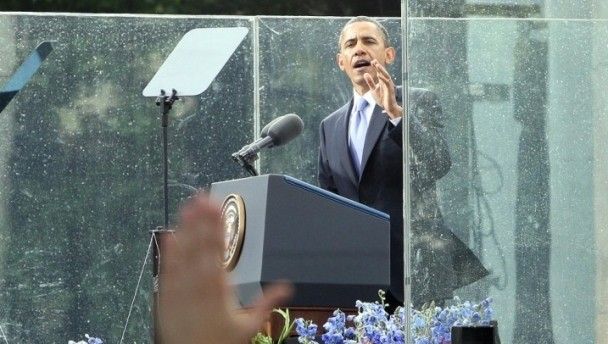
Once a worryingly animated Enda was finished begging Irish Americans to come over and give us their money, Obama took to the stage. Those gathered around me chose to ignore the fact that a telly can’t hear you by erupting into applause.
Cringe
Obama’s speech didn’t disappoint. He shrugged off the cringe factor brought about by the attempts to claim him as one of our own by speaking about how a green twinge to the blood wasn’t important – all Americans were connected to the Irish because of the share of the load we took in the creation of a most powerful nation the world has ever known.
But while many in the crowd had long ago ditched any sense of pride in their own country and had instead turned out to drool over and cheer for the leader of the one they would probably prefer to be part of, Obama was all about talking Ireland up.
He ran through the horror of famine, emigration, repression and war – and our capacity to endure and overcome. He acknowledged that we had problems now, but pointed out that when set against the things we’ve surmounted in the years past, they seemed to him almost inconsequential. While many of our own had come to doubt this country and her people, he certainly hadn’t.
There seems to be something about the Irish psyche that aches for validation from figures abroad and in a way it’s a shame that we needed to hear all this from a foreign president before it could be taken to heart. Nonetheless, many of those who queued to admire an American will no doubt have come away with a new pride in their own.
LISTEN: You Must Be Jokin’ podcast – listen to the latest episode now!