In a few short weeks he’s gone from unconsidered outsider to the top of the opinion polls. JOE talks to presidential candidate Sean Gallagher about political apathy, St Stephen’s Green’s ducks and instruction manuals.
What are the staples for business success? A certain ruthlessness, maybe. Ego, definitely. A lack of empathy, quite possibly. It’s not stretching it to suggest you’d need all three to be cherry-picked for Dragons’ Den, to sit for the television cameras, clipboard in hand, as potential entrepreneurs climb the stairs to pitch their ideas for chimney-stack wind-turbines or a new, improved type of wheelbarrow.
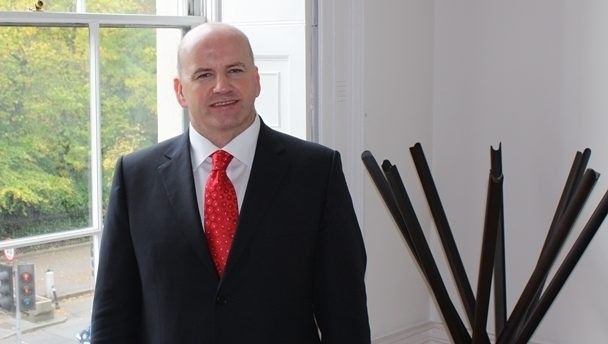
But as fire-breathing Den protagonists on either side of the Irish Sea go, you get the feeling Sean Gallagher is one of the nicer ones. I’d never met him before I climbed the steps of his presidential campaign base on St Stephen’s Green, but I felt I knew him fairly well. He’s no Bill Clinton, say, but he does offer a bit more of that intangible – charisma, for want of a better word – than the rest of the less-than-magnificent seven who make up the list of candidates for the Irish presidential election on Thursday week.
Things have definitely come a long way since rumours of his interest in running for Aras an Uachtarain first surfaced in early summer – the opinion polls have shown a steady surge in his popularity over the past few weeks. It’s the way of things in post-bailout, politically reactionary 2011 Ireland. Convince people you’ve a bit of integrity and you stand a decent chance.
Before Gallagher arrives for our rendezvous, I spy a puddle of coffee on his desk and, on the floor, a stray Pringle (sour cream & onion rather than naff pullover variety). He’s clearly not all gloss and polish, but in a world where the PR spin, the carefully-constructed image, usually wins out, there’s something refreshing about that.
I put it to him, as a successful businessman (or at least he’s been presented as such to the Irish people, given his prominent role on Dragons’ Den) and with that rising profile in the world of television, that running for the presidency is the biggest risk he’s ever taken.
He responds categorically and without hesitation. “No, this is not a risk. It’s not a risk because I believe in what I’m talking about. I believe there’s a time for a set of skills and a type of president.”
And in the Ireland of 2011, he feels, he’s best placed to carry on the flame espoused by his immediate predecessors. Or better placed than the other six candidates at any rate. “Fourteen years ago the type of president we needed was Mary McAleese,” he says, “because of the background she came from in the North and because of her personality, her value system, what she believed in. It was a time when the peace process was at a crucial juncture and she brought all her life experience to help build bridges and build peace. Mary Robinson before that was the right person to move Ireland to a more modern agenda, to address issues of social inclusion.
“I think now the real issue for this country is unemployment. Almost half a million people are unemployed. No job to go to, no sense of dignity in terms of work and no way of providing for themselves financially, independently. That’s the challenge facing the country now. Massive unemployment. Young people being sucked out of their communities, over to Australia and Canada. And that’s fine for many of the young people, who will hopefully gain lots of experience and come back. What it’s not great for is their parents, rearing them, as they tell me, for the plane. Lots of them will find partners and settle in these countries and they’ll see their grandchildren every five or six years if they’re lucky. And that’s not what their view or their plan for the future was.”
Every one of us has a song to sing, and the biggest challenge is that we don’t want to die with that song still in us
But why the presidency? The country already has a Department of Jobs and Enterprise and a Minister, Richard Bruton, responsible for it. Would not Dáil Eireann, where the real legislative issues are discussed and decisions taken, be a better place to attempt to bring those changes into effect?
“Do you think you can get things done as a back bench TD?” he responds. “Ninety per cent of what a TD does is constituency work. How does that change society, and generate enterprise? I have been working in every single part of this country over the last three years, talking at schools and colleges and universities, to Chambers of Commerce, to Enterprise Boards, groups representing the unemployed.
“For me it’s about a message of positivity. What’s killing Ireland at the moment is the doom and gloom. That creates fear. That leads to paralysis. It’s really about believing in yourself and having confidence. The value system I have didn’t come from enterprise. It came from community, from youth work. All you need to do is remind people of their potential, remind them to have the confidence to step out and sing their song. Because every one of us has a song to sing, and the biggest challenge is that we don’t want to die with that song still in us.”
Gallagher’s opponents – who are sure to grow in voice and number over the next ten days given his new-found place at the top of the opinion polls – point to his close links to Fianna Fáil. He worked alongside Dr Rory O’Hanlon during his time as Minister for Health in the Fianna Fáil Government of the late 1980s and was still a member of Fianna Fáil’s National Executive as recently as the beginning of the year.
Given the general hatred with which many casual voters now view Fianna Fáil, some political sketch writers have suggested such a background is worse than having been an active member of the Provisional IRA. Other commentators say that Gallagher’s popularity is indicative of just how incurable the Fianna Fáil virus is – it just mutates and survives. If there is a stick to beat him with, it’s Fianna Fáil, but he insists he’s disenchanted with the entire political system.
“I became disillusioned,” he says, “with what I saw as political parties fighting over who was going to be in power when I was out on the ground working with ordinary people who were so disconnected with what was happening at the macro level. They were struggling to find jobs, struggling to pay their mortgage. Their kids were emigrating, small businesses were struggling and couldn’t get access to capital. That’s the reality. I stepped in and worked with as many groups as I could over the last two years and that’s when the light-bulb went off: if I could do this work as an individual what could I not do as President? People need hope and leadership and confidence. And that’s what I’m about. I’ve no interest in the negativity of party political squabbling. That does not serve Ireland.”
Fianna Fáil, still trying to piece things together after their implosion at the General Election in February, opted against sanctioning any candidate in the presidential campaign – although there are many who would argue that Gallagher is the proxy FF candidate. Has he had much support from his old colleagues in the party?
“I know lots of people in Fianna Fáil, and there’s good people there,” he says. “But there’s also good people in Fine Gael, and Labour, and Sinn Féin. I get support from all parties and none. My message is not party-political.
“People don’t see the presidency as party-political. You will have the die-hards who will vote Fianna Fáil, or Fine Gael, or Labour or Sinn Fein, but the big issue in the presidential election is that it’s not really party-political. It’s not just about the individual person and who they are. It’s very much about the message and what they’re trying to do.”
That message, he says, is about representing a confident and upbeat Ireland, an Ireland far removed from the suffocating gloom of recent times.
“I ask people, ‘What is it that you want in a president?’” he says, “and the first thing a lot of them tell me is, ‘We want the president to look right, to project the right image of Ireland.’ And that’s about being young and dynamic and with traditional values, but modern. Mary Robinson and Mary McAleese represented that, and I hope that I will represent that.”
My biggest fear is that the readers of JOE.ie, those people in their 20s and 30s and 40s, will not come out to vote. That they’ll have seen the political parties and their Punch & Judy type politics, swapping insults. That they’ll be turned off
One intriguing aspect of the presidential campaign was the moment that Gallagher opted to free up County Councils who had previously expressed their support for him, in order to allow other Independent candidates such as Dana and David Norris the chance to make the ballot paper. It was the type of altruistic gesture that usually has no place in politics at any level, an certainly not in an Ireland where gombeen, parish pump politics has long been the norm. But really, wasn’t it also a bit naïve?
“Not at all,” he says. “If the people of Ireland wanted to vote for Dana or David Norris, why would I want to block that? That’s not democracy. That would be a throwback to the old, strategic, cute-hoor type of politics. I want a new type of politics, that’s honest, that has integrity. This is not about Sean Gallagher getting a job, it’s about Sean Gallagher wanting to do a job for the people of Ireland. The people of Ireland will decide, and it’s only fair that they have the widest choice possible.
“My biggest fear is that the readers of JOE.ie, those people in their 20s and 30s and 40s, will not come out to vote. That they’ll have seen the political parties and their Punch & Judy type politics, swapping insults. That they’ll see it descend into a rerun of the last General Election, a party political faction fight, and that they’ll be turned off and won’t come out to vote. And therefore I say to young people all the time – this is your future, you need to fight for it. I have one gene that drives me – that we all shape our own future. And the first thing you need to do is come out and have your voice heard.
“The office of the President in the last 20 years has been new, fresh, redefining, active and energetic. I don’t want it to go back to being a retirement home for politicians. I don’t believe the office of the President is an office for the tired voices of politics.”
Away from the presumably frantic, hither-and-thither and morning-till-night schedule of waging a presidential election, what does he do to tune out at the end of the day?
“Well I started my morning this morning, in Stephen’s Green right across the road. Close to nature. Seeing the trees, the colour of the leaves, the water, the ducks, the birds singing. That grounds me. Every day I try to do that. Walking and exercise. I love the gym, I love keeping fit. I do judo and karate. And I just love being around people and socialising.
“I follow the GAA fairly closely too. It’s something that’s really important to me, because it’s a real example of how an organisation has held entire communities together. The whole voluntary commitment of people and communities. How it’s trained young people, not just in sport but in organisation, in communication. It’s the very best of everything that’s Irish. I don’t get many opportunities to get to Croke Park to cheer for Cavan but recently I’ve had a couple of chances, for the Cavan ladies in the junior final and the U21 footballers against Galway a few months ago.”
The business success that catapulted him into the minds of the producers of Dragons’ Den came with Smarthomes, the company he co-founded in 2002 and which specialises in effective cabling for television, broadband, home entertainment, music and lighting systems for homes. Given that background, it’s a bit surprising, perhaps, that he doesn’t consider himself very tech-savvy.
“Honestly? I give the manuals for everything technical to my wife Trish,” he says. “For me, it has to be easy. I like things that just work and are intuitive. I suppose that’s why I like things like the iPhone and iPad. I don’t get into the bones of things, I like to hit buttons and they just work…”
If things continue to go the way they’re going, one of the next buttons he hits could well be on the remote control for Aras an Uachtarain’s gates.
LISTEN: You Must Be Jokin’ podcast – listen to the latest episode now!