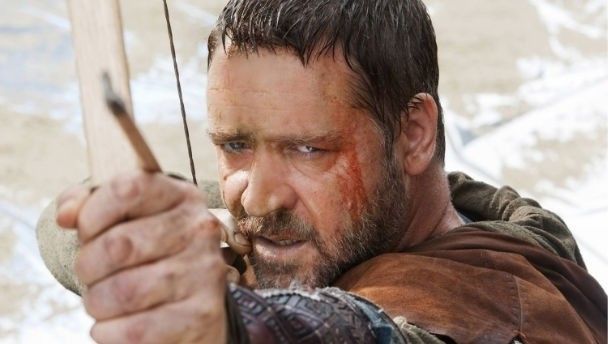
Ridley Scott’s eagerly awaited summer blockbuster, Robin Hood, opens in cinemas this Friday, May 14.
The latest adaptation of the legendary archer and his band of merry men stars Cate Blanchett, Matthew MacFadyen, William Hurt and of course, Russell Crowe in the lead role, who will be teaming up with Scott for a fifth time.
The pair have previously collaborated on famous flicks such as Body of Lies, American Gangster and Gladiator, which earned a spate of Academy awards in 2000, including Best Picture and a Best actor gong for Crowe.
JOE caught up with Scott and Crowe ahead of the film’s release where they talk about confusion surrounding the script, living up to Gladiator, Scott’s methods as a director and also his next project, a prequel to the 1979 hit, Aliens.
JOE: OK, so it was originally supposed to be titled Nottingham and we understand there were delays with the script. Just what happened exactly?
Ridley Scott (RS):Â What you are about to hear is totally normal and very every day. It happens almost on every project.
Russell Crowe (RC): If you look at the two and a half years between when we were first given the idea and the last day of shooting… I don’t know, people have tried to pump it up like it was falling apart and this was going wrong and that was going wrong, the reality is we took a normal responsible period of time to develop a story into a feature film that was shootable within a confined period of time.
JOE: But why all the confusion…
RC: There was nothing extreme about it. I mean, some of the things that were printed, we simply couldn’t answer the question at the time, you know? Okay, so are you going to play more than one character? Well, at the central part of “Robin Hood†one of the things is disguise. So I take on somebody else’s persona, right?  So I can’t answer no to that question, right? But I cannot fully explain the reality of that because that is giving away one of the fun bits of the plot.
So by not being able to answer it fully, you then leave this massive ground for interpretation. So that was happening to both of us. We were trying to answer the questions the best we could at the time and people were just running with the answer and creating something completely different out of it, which wasn’t what we said or what we intended or what was meant.
But yeah, I think you’ve got to take the time period it needs for you to get on top of it. You don’t want to be starting a film without knowing what you want to do, you know? So we just took that time.
JOE: Then there were delays with the shooting…
RC: A certain series of dates was put forward; it was like, you know, this is going to be a very bleak landscape if we are going to shoot in England starting in January. We had shot a part of “Gladiator†in England in January, you know? You can’t do your first shot until 9:30 in the morning and you are done by 2:30 in the afternoon.
Also, it wasn’t easy trying to get that amount of artillery and horses and stuff in place, when you are dealing with a foot and half of mud. You know, we knew that January is not a great time to be shooting, like, epic battles in England. So, we had to wait a little bit.
JOE: Robin Hood is somewhat similar in style to Gladiator. Is there a pressure there to live up to that standard?
RC: Obviously, once you have had a film like “Gladiator†that’s in your background; everyone is going to hold everything else you do after that. I don’t think at all that we ever tried to functionally live up to that. But we do apply the same methodology no matter what is going on. We are going to get up every day and our aim is that before this day is done, we are going to have done something special.

Robin Hood sees Crowe and Scott working together for the fifth time
JOE: Ridley, other actors have spoken about your methods in relation to your use of a number of cameras. You two must be used to each other at this stage?
RS: He (Russell) is just an expert in every fucking camera, he goes drmmm, drmmm, and knows exactly where the ninth camera is…and with an actor say like, Bill Hurt, saying, “I don’t think he caught me…â€
RC: He is talking specifically about a conversation that I had with William at the end of one day. He was very morose and sitting in his trailer and I was, you know…the merry men were sitting around having a beer together and I said, “Come join us,†you know.
He was like, ‘Naw, I can’t…I just don’t understand what is going on. I am out there doing my thing and not once did Ridley cover me in a close-up and I don’t understand. I mean isn’t this an important part of the story?â€Â He is like, “I am not trying to overstate my contribution here…but I just thought… “I am like, “Bill, we have five cameras going, mate. We had five cameras in four takes and between each take he is going to change the lens and change the way a particular camera movesâ€.
“I absolutely guarantee you that he has got more close-ups than you can shake a stick atâ€. And he is like, ‘That’s how he works it…that is how he works?â€Â And I said, “Did he interrupt you? Did he stop you from doing anything? No. When you’re not doing what he wants…that’s when he will come and talk to you.â€
JOE: Russell, did you have similar experiences with other directors?
RC: I first had that experience prior to working with Ridley, with Michael Mann and working with Al Pacino, and Michael just decided that he was going to run two cameras on everything, you know? Because I like to work in the first three takes and Al kind of uses the first thirty to warm-up. (Laughs)
So, you know, Michael just decided he is going to get everything as it happens. So that’s also the way that I work with Ridley…when I am on another film and somebody’s back is to a single camera or whatever, I still make sure that the energy is high off-camera.
So you don’t have this thing where I drop down quite often, will have chats with younger actors who believe that their job only starts when they are on camera and it’s like, ‘no, actually you have to work on the other side of the camera at the same time.’
RS: There is nothing worse than saying to actors, “We will be ready in forty-five minutes,†which is going to be an hour, and he goes back to the trailer going, ‘Fuck!’ When you just got going, you don’t want to stop.
JOE: So the finished product is now ready to go, but we hear you did test screenings on this film. How did you both feel about that process?
RS: Horrible. Well, you think differently.
RC: He hates it, but I said, “You got to do it, man. You got to do it. I know it’s hard and I know that you’re going to end up…â€Â But actually firmly enough I felt that it gave you another burst of energy, after people’s opinions.
RS: Yeah it did, because one thing is for sure when you do what I do one thing is for sure…nothing is for sure. Whatever you think, you don’t know everything and you can go to…the value of a screening is that when you think, “that really works,†and then you go to a screening and then a third of the audience says something that you knew was in the back of your mind, which was kind of needling away and as soon as they say it…fuck I’ve got to deal with that. So all you are doing is getting an endorsement of that is the problem. So you got to deal with it.
JOE: Finally, Ridley, you’re pretty busy at the moment?
RS: Oh you mean, Alien. Yeah, yeah we are doing that now; we’re on the fourth draft. Pretty good.
JOE: The original is a timeless piece and still looks well today. Do you think you can retain the qualities of the original while also giving it a more modern feel?
RS: Yeah, I think it will work, don’t you? That (the original) is twenty-nine years ago. But now, to say, “Do you want to re-cut it at the time of filming?â€Â Not really. Things move faster today, yeah…but I had no technology at all and no digital technology, at all. So, even the ones that followed, have tech, like, um digital rails and tracking and computers…I had no computers at all in ‘Alien’. ‘Alien’ was literally all physical.
So even the spaceship, which would be about as big as this table, you would hang it from a wire and the camera would slowly push up. I was the operator. I would slowly push underneath and try to keep it as steady as possible with a fan and a lot of dry ice going at it to give it some sense of movement. That was it. It’s pretty good, actually. Exactly right.
Â