By Jonny Stapleton
They say Kilkenny is the strangest and rarest destination for a Gaelic football medal. However, whilst the Cats certainly are not renowned for their prowess with the bigger of the two GAA balls it seems places with even less football pedigree and tradition are providing proud homes for Gaelic football trophies.
Ireland’s national sport has begun to travel the world with the same ease and success as our writers, music and even our national day. It seems GAA is as welcome in a number of countries across the globe as our beer-thirsty tourists are in respective Irish bars.
Points are kicked and pints drunk in places as far off as Bangkok, Buenos Aries and Beijing. GAA associations have been established in Asia, England, South America and North America. Indeed The Asian county board is now fully affiliated with Croke Park and has been able to establish an Asian Gaelic games competition held annually throughout the continent.
The spread of the GAA throughout the world has some people predicting the All Ireland series will soon become a World series, which unlike baseball’s equivalent will have teams from around the globe. A packed Croke Park could one day bear witness to Dublin versus Jakarta Dragonflies or Tyrone against Shanghai Saints and Sirens.
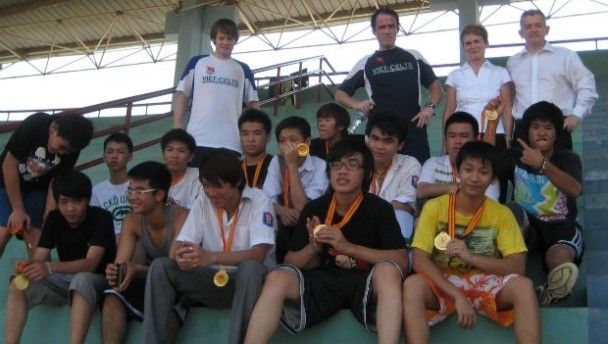
Yet another new chapter of international GAA was started recently as the world’s newest Gaelic football medal was contested in Xuan La Stadium, Vietnam, as VAS Hanoi defeated Hanoi Academy by a scoreline of 3-3 to 0-1 to collect the inaugural All Vietnam Schools Cup.
Mary Prendergast and Bob Patterson of the Irish Embassy presented medals to both teams. And to underline the indigenous nature of the event, the Man of the Match was not an expat O’Shea, Sherlock or O’Connor but none other than Nguyá»…n Äức Thắng.

VAS Hanoi defeated local rivals Hanoi Academy collect the inaugural All Vietnam Schools Cup
This decider may not be as historic as the 1947 All Ireland final-competed in New York but it is a first for GAA and will help the game gain a further international foothold. It came about thanks to the work of Viet Celts coaches David Cunningham and Jim Kiernan who teach and train kids in the respective schools.
The mission statement of Viet Celts, who are Vietnam’s GAA club, is to become the most multi-racial Gaelic football club in the world. In fact with players hailing from Ireland, England, Scotland, Vietnam, France, Australia, Ecuador, America and Uganda they could challenge Chelsea in any multi-cultural league table. But the most interesting thing about the final was that all contestants were 15-year-old Vietnamese children who have been introduced to the game for the first time.
Jim Kiernan, of Viet Clets and VAS Hanoi, explains how the venture came about: “In July 2008, I started working in Vietnam Australia School in Hanoi . VAS is a high school with about 350 Vietnamese children aged 12 to 17. By September I was asked to teach a sport as part of my duties. Coming from a GAA background, I decided on Gaelic football.
“Two boys from year 8, Phạm Tuấn Phong and Nguyễn Duy Hung got all their friends to come down to play. The fact that the boys were all good friends made the training very enjoyable. With the support of then vice-principal Leonie Brewer from Australia and Bevan Marshall from New Zealand, who now fills that role, it went from strength to strength.
“They love the speed and robust tackling of the game. For the first year and a half, the boys had been training twice a week on a Tuesday and a Friday and approached it with a level of enthusiasm which belied the fact that they were relative newcomers to the sport. But the single most important development from the point of view of the All Vietnam Schools Cup was when David Cunningham decided to introduce Gaelic football in his school Hanoi Academy.â€
With two school teams from the same city playing the game it was only inevitable they would meet in a derby decider. VAS were quiet literally Vietnamese GAA superstars having appeared on BBC Radio and been guests of honour at the Irish Embassy on St Patrick’s Day. They lived up to the favourites’ tag and despite a strong challenge from Hanoi Academy collected the rarest medal in GAA.
“They walked into the school yard at 3pm with the medals dangling around their neck like they had just beaten Kerry in the All-Ireland Final. I had shown them Kerry on DVD often enough,†says Kiernan.
VAS captain Nguyá»…n Duy Hung also had his say: “I am pleased that VAS decided to introduce Gaelic football and that the Viet Celts are trying to get the sport established in Vietnam,†he said. “But for me the most pleasing thing of all is that my team (VAS) won the championship this year and are now the Vietnam Champions. I became interested in Gaelic football because it is fun, more interesting than soccer – it is a more powerful and faster game. I also like the tackling and strategy of the game.â€
Retaining that trophy may prove a little difficult next year. It seems Gaelic football’s popularity is expanding in Vietnam at the same rate as Ricky Hatton‘s waste line. Viet Celts Chairman Jim Kiernan is predicting that investment in youth will ensure a bright future for the sport in the South East Asian football stronghold.
“Another school, UNIS Hanoi, has recently introduced Gaelic football as part of its introduction to other sports,†he says. “It is hoped that this might expand into fielding at least a 9-a-side next year. I’m going to keep together a Viet Celts U16 team. The Viet Celts have been developing very close ties with the local AFL team, Vietnam Swans, and they’ve really taken to the game of Gaelic football. A lot of them teach in a school called Hanoi International School (HIS) and they are interested in introducing Gaelic football as well as Australian Rules next year. Therefore we might have five teams playing the competition next year which is great for the future.â€
Â