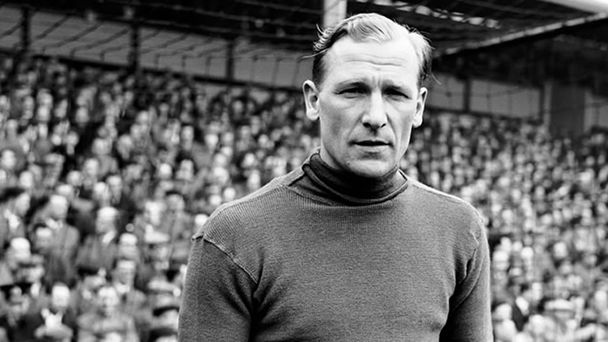
Last week the world of football lost a real icon of the game as Bert Trautmann passed away aged 89 years old. He is a man who will be forever remembered for his bravery.
The Manchester City goalkeeper is best known as the player who played on in the 1956 FA Cup Final with a broken neck, but his life story alone, never mind the fact he became something of a legend at Maine Road, set Trautmann apart from most others.
Born in Bremen in 1923, Trautmann was a keen sportsman from an early age, combining this with his involvement in Jungvolk, a pre-cursor to Hitler Youth. Working as a motor mechanic, he joined the Luftwaffe in 1941 as a radio operator. The following year he was part of an Eastern Front attack, but the offensive on Soviet Union was a failed one, and Trautmann was just one of 300 men from the 1,000 originally in the party that returned alive and he received five medals for his contribution.
By 1944 Trautmann had escaped capture from both the Russians and the French Resistance, but he was captured by the British and transferred to a camp in Essex, one of only 90 men of his original regiment to survive the war.
After a transfer to another prison, his passion for football was quickly apparent in organised games in prison. Trautmann played outfield, but went into goals after suffering an injury while playing centre-half and that was where his life in the sticks was born. It was also around this time the name Bert stuck, with the locals going for a more Anglicised version of Bernhard.
With the closure of the POW camp, Trautmann declined to return home, setting up a life for himself in Lancashire, working on a farm and togging out for non-league side St. Helen’s.
He was soon forging quite a reputation at that level and with a number of clubs showing an interest, he chose to sign for Manchester City in October 1949 as an amateur before soon turning professional. He also became the first sportsman in Britain to wear Adidas, thanks to his friendship with Adolf Dassler.
His early career saw him suffer abuse due to his Nazi links, but over a career spanning 15 years at City he would write himself into the folklore at the club, appearing 508 times in blue. Undoubtedly his most well-known moment came in the 1956 FA Cup Final, where he won his only medal during his time with the club.
Leading 3-1 with just 25 minutes left against Birmingham City, Trautmann, diving at an incoming ball, was knocked out in a collision with Birmingham’s Peter Murphy in which he was hit in the neck by Murphy’s right knee. No substitutes were permitted in those days, so Trautmann, dazed and unsteady on his feet, carried on. For the remaining 15 minutes he defended his net, making a crucial interception to deny Murphy once more.

Sustaining the head injury in the 1956 FA Cup Final
Three days later an x-ray revealed he had dislocated five vertebrae, and missed a large chunk of the following season because of the injury, though he admitted in interviews in recent years that it rankled that the injury was the reason the majority of fans remembered him.
In 1964, he ended his career with a testimonial where he captained a special joint Manchester City and Manchester United XI that included Bobby Charlton and Denis Law, against an England team that included Tom Finney and Stanley Matthews.
Trautmann would have a number of management roles after beginning life in the dugout at Stockport County, including taking charge of Burma and Pakistan.
Awarded an OBE in 2004 for his work in Anglo-German relations and inducted into the National Football’s Museum Hall of Fame the following year, Trautmann was a footballing story like few others.