JOE wonders why animals are such good actors, and considers the career of five of the most famous television animals.
By Conor Hogan
Did you ever look a squirrel in the face, and wonder what he’s thinking? Has its large eyes ever pierced through your soul? If your answer is no, then, why not? They aren’t as different from human beings as you think. In fact, squirrels are our relatives, as are chipmunks, groundhogs, prairie dogs and marmots.
They are distant relatives, of course. They aren’t going to wonder why you haven’t called them, or get mad with you for forgetting their birthday – yet they are still your relatives. And it’s not just rodents; all current life on earth has a universal common ancestor from 3.9 billion years ago. In a way, therefore, swatting a fly is a little bit like swatting your cousin, and eating a smokey bacon burger is a little bit like eating your own grandparents.
As such, animals have similar abilities to humans. WC Fields once said, “Never work with children or animals.â€Â He said this not because he believed animals hard to work with (though they can occasionally wander into the wrong shot or take dumps in the middle of the set) but because they often upstaged him.
This isn’t something to be embarrassed about, however, as all living creatures have evolved with an ability to act, with the possible exception of Twilight’s Kristen Stewart. The ability to lie, pretend and find a motivation has enabled us all to survive for so long on this planet while 99.9999% of all animals who have ever lived are now extinct.
Ronald Reagan and Clint Eastwood
As an example of the acting prowess of animals, renowned thespians Clint Eastwood and Ronald Reagan were both upstaged by primates in Every Which Way but Loose and Bedtime for Bonzo respectively. In Eastwood’s case, Manis the Orangutan, who played Clyde, was generally considered to be the Montgomery Clift of the animal kingdom.
The chimp that outshone Reagan, however, was a relatively poor actor who had to be referred to by his own name, Bonzo, to get him to do anything. The two notoriously didn’t get along; Bonzo believed that the United States should increase marginal tax rates on income from labour and capital and introduce strict regulation, while Reagan believed the opposite. Their relationship became even frostier after Bonzo voted for Reagan’s opponent, Edmund G. “Pat†Brown in the Californian Gubernatorial elections of 1967.
Animals can stand out even further in television shows. Here are some notable examples.
1. Skippy the Bush Kangaroo
The Australian show was produced between 1966 – 1968, and was famously banned in Sweden because they didn’t want to mislead children into thinking animals “could do what they really can’t.” The Swedes were right to a point, as Skippy was less like lassie, and more like McGyver. In reality, Kangaroos cannot untie ropes, open letters, or operate the radio. They can, however, box. The dexterity of Skippy was faked using manually operated artificial kangaroo arms.
Skippy was played by between nine and 14 different Kangaroos, throughout the run of the show, the most featured one being a pet owned by the son of the Head Ranger of the real Waratah National Park, in Ku-ring-gai Chase National Park in northern Sydney.
2. Bamboo Harvester (Mr. Ed)
The talking horse in the American sitcom, Mr. Ed, which ran between 1961 – 1966 (the show not the horse), was played by a Palomino called Bamboo Harvester. He couldn’t actually talk, of course, though remarkably he did make the mouth movements himself. A rumour was started that the makers of the show applied peanut butter to his lips, but while they originally used strings to move his lips open and closed originally, the fantastic gelding eventually learned to do the task himself.
Two years after the show was cancelled, Bamboo Harvester kicked the bucket. Well actually, somebody else kicked it for him, as he was euthanised. The 19-year-old had arthritis and kidney problems at the time.
3. Moose the dog (Eddie from Frasier)
Eddie, the dog from TV’s Frasier, was more than just an animal in a television show; he was a character in his own right. Of all the animals ever to feature in the medium, he was undoubtedly the most human, in the way he interacted with the cast. His scenes with Kelsey Grammar were especially enjoyable, in which he would stare incessantly at Frasier, much to the radio psychiatrist’s annoyance.
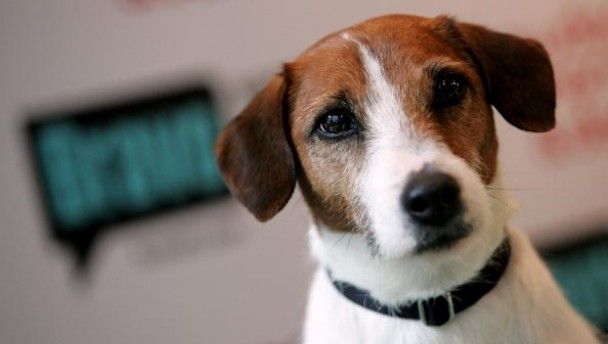
Eddie was originally played by a Jack Russell called Moose, before being replaced by his son Enzo (pictured)Â for the final three seasons. The two of them were later in the film My Dog Skip, where they played father and son. At his peak, Moose received more fan mail than the rest of the cast of Frasier, and even had his own autobiography, My Life as a Dog, ghostwritten by Brian Hargrove, husband of Frasier actor David Hyde Pierce. “He’s like a robot,” fellow Frasier actor John Mahoney told Animal Press magazine in 1994. “A consummate professional who works hard learning his tricks.” Moose died in 2006, aged 115 dog years.
4. Katie the monkey (Marcel from Friends)
Katie played Marcel, Ross’ pet capuchin monkey, in Friends. And though she played a male capuchin, as you can tell from your name she was in fact a female monkey. How’s that for Felicity Huffman style versatility? Her trainer, Nerissa Pulizer, once said of her “If Marcel were human, she’d be Meryl Streep.”
As good an actor as Katie was, she was volatile to work with, and never developed a rapport with David Schwimmer, who played Ross. Schwimmer eventually went behind Katie’s back and got the producers of the show to write Marcel out of it. Katie’s other credits include Outbreak and the Paul Verhoeven award-winning classic Showgirls.
5. Animal (from The Muppet Show)
Everybody’s favourite muppet has to be the anarchic drummer Animal, though what kind of animal he is isn’t particularly clear. He has three styles of drumming; loud, louder and loudest, and has to be constantly reminded not to eat his drums.