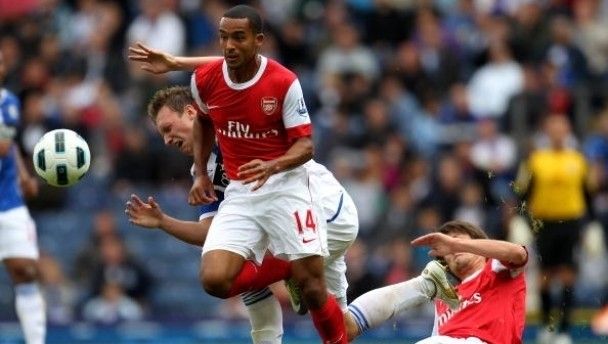

It could be that Walcott prefers the pressure of proving critics wrong than the pressure of performing for admirers who expect miracles, writes Ken Early.
Â
As Theo Walcott storms to the top of the Premier League scoring charts, a debate rages over whether or not he has a “footballing brain”. On Match of the Day last week, Alan Hansen credited Walcott with some brilliant instinctive moves, but complained “when he’s got time to think about things he never, ever picks out the right ball.” With grim finality, Hansen declared: “if you’ve not got a footballing brain, you cannot acquire one. You can’t coach a footballing brain.”
By Match of the Day standards this was sensational. Could it be that the BBC experts, stung by the widespread criticism of their boring, complacent punditary during the World Cup, have decided this season that they’re taking no prisoners? Whatever the reason, anything that causes Hansen to abandon his usual strings of abstract nouns (pace, power, passion, desire) and start doing his job properly by offering some actual analysis is probably to be welcomed.
But what of the effect on Walcott? Will he now be haunted by the fear that no matter how desperately he works to improve, he is a hard-wired mediocrity who can never hope to become truly outstanding? How realistic is Hansen’s view?
Multiple intelligences
Certainly his credo of “you either have it or you don’t” swims against the tide in the pop psychology market, currently dominated by books about how genius is really the cumulative effects of thousands of hours of practise. According to this (more hopeful?) view, Walcott just needs to work for many hours on improving his footballing brain and it will eventually respond.
But what is a footballing brain anyway? Hansen never really gives a clear definition. From his comments on Walcott’s brainless hat-trick against Blackpool, it is plain that the footballing brain is in charge of choosing the right option in on-field situations. That definitely can be learned, and the study of how is called “tactics”. Hansen must have been talking about something more basic than that.
Unfortunately, the footballing brain as such remains woefully undermapped in the existing scientific literature. Maybe its shadow can be glimpsed in Howard Gardner’s hypothesis of multiple intelligences – itself largely untested and of dubious reputation.
Gardner wrote up a list of seven different types of intelligence that everyone has to greater or lesser degrees: “linguistic”, “musical”, “logical-mathematical” and so on. The two that perhaps together constitute footballing intelligence are “bodily-kinesthetic” – the skilful control of bodily movements; and “spatial” – the ability to visualise & understand how objects in two- or three-dimensional space relate to each other.
Spatial intelligence
Hansen would admit that Walcott’s bodily-kinesthetic intelligence is off the scale – even if his first touch could be better, there is probably not a quicker, more agile player in the league. It’s the spatial component of the footballing brain that lets him down. Can that be improved?
Nobody has yet discovered a surefire method of improving spatial intelligence (some suggest video games might work, and endless hours of Pro Evo don’t seem to have done Lionel Messi any harm). But we do know that it gets better with age. The University of Washington psychologist K. Warner Schaie has been running a longitudinal study of cognitive performance since 1956. His team has found that middle-aged subjects outperform younger ones on measures of spatial orientation. This won’t come as any surprise to people who watch a lot of football and have seen players like Dennis Bergkamp, Teddy Sheringham or Ryan Giggs keep improving into their mid-30s.

Alan Hansen and Teddy Sheringham debate turtleneck etiquette
 Walcott should take particular heart from the career arc of Giggs. Alex Ferguson said Giggs as a 13-year old was “as relaxed and natural on the park as a dog chasing a piece of silver paper in the wind.” As the choice of image suggests, what stood out about the young Giggs was his pace and grace of movement, not his brains. 21 professional seasons have turned the silver paper-chasing dog into the silver fox, who can dominate Premier League midfields while moving at a fraction of his former speed.
Admittedly Walcott’s footballing brain can’t have improved massively over the last three months, so why is he suddenly playing so much better? Maybe the reason is that a player to whom a lot has come easy has recently suffered some setbacks: from the World Cup at 17 to rejection and ridicule. (In this respect the uptick in his performance mirrors that of Hansen on MOTD). It could be that Walcott prefers the pressure of proving critics wrong than the pressure of performing for admirers who expect miracles. It could be that this polite boy needs to feel a little angry to unlock his very best form.
In the longer term, a footballing brain should sprout within his skull given work, patience and several seasons of experience, though Hansen deems it impossible. Walcott might do better to heed not Hansen but Nansen – Fridtjof Nansen, the great Norwegian polar explorer. “The difficult is what takes a little time; the impossible is what takes a little longer.” He’ll get there in the end. In the meantime let’s hope Hansen stays angry.
Ken Early is chief football correspondent for Newstalk 106-108FM. He will write a regular column for JOE.ie throughout the Premier League season.