By Shane Breslin & Conor Hogan
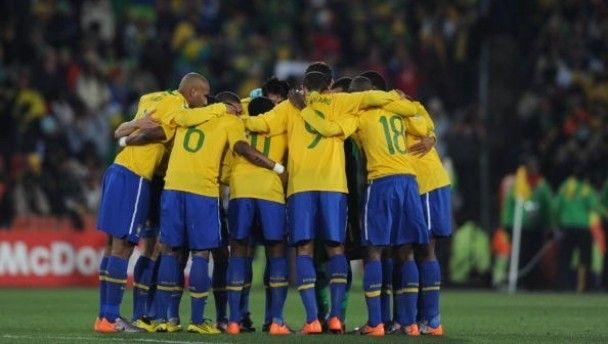
1. Boring Brazil are typical Brazil.
Say the words ‘Brazilian football’ to someone and more than likely they’ll visualise some mythical all-out-attack, fluid joga bonito, samba soccer type thing that only really exists in people’s dreams.
They might think of Carlos Alberto‘s perfect goal from the ‘70 World Cup final or Tele Santana‘s bonkers Brazilian team from ‘82, which featured Socrates and Falcao but which lost 3-2 to Italy in the second round group stage when a draw would have been enough to progress.
In the 39 World Cup matches Brazil have played since ‘82, however, they have conceded a mere 24 goals (0.68 goals a game). To put that into perspective, ‘boring Germany’ have conceded 33 in that time.
Brazil have also kept an incredible 21 clean sheets and on only five occasions have they conceded more than one goal in any match. It is clear that success for Brazil in recent times has been built on their strong defence.
Their current team is no exception, centre backs Juan and Lucio are both absolute rocks, while in Julio Cesar they have arguably the best goalkeeper in the world right now. They conceded a mere eleven goals in 18 qualification matches, and when the quality of the opposition has been hiked up in this tournament – against Portugal and Chile – they haven’t conceded. We wouldn’t be entirely surprised if they kept the ball out of the net for the rest of the tournament.
Brazil kept clean sheets in the semi-final and final in both their wins in ‘94 and ‘02. For the former, they bored their way to the final, and even won the tournament on penalties after a 0-0. Matches like their 3-2 quarter-final victory over Holland in ’94 have tended to be exceptions rather than the rule.
Nobody can argue that Brazil’s change of style hasn’t worked. Between their wins in ‘70 and ‘94, Brazil didn’t make a single final. Since then, they’ve made it to three of the last four finals. Their current team looks like it could make that four out of five.
2. A defensive 4-2-3-1 formation is likely to win the tournament.
There’s a definite argument that anyone with a love of beautiful football should be shouting their throat hoarse for either Germany or Argentina for the remainder of this tournament. The fact that they have played the most entertaining football is not just down to the quality of their forward players. No, it owes plenty to the commitment managers Jogi Loew and Diego Maradona have made to attacking football, at the expense of one or both holding midfielders.
Both sides play in a dazzling 4-3-3. Germany’s attacking triumvirate of Thomas Muller, Miroslav Klose and Lukas Podolski is so attack-minded that when you throw the brilliantly forward-thinking Mesut Ozil into the mix, and think that neither Bastian Schweinsteiger nor Sami Khedira have exactly been doing a Dieter Eilts in front of the back four, it should be no surprise that they’re so attractive to watch. Argentina are every bit as committed to playing in their opponents’ half, with Angel Di Maria and Maxi Rodriguez almost out-and-out wingers behind Carlos Tevez, Lionel Messi and Gonzalo Higuain.
All that means Javier Mascherano is possibly the most vital player in the Argentine set-up, particularly as they’ve looked uncertain at the back where Martin DeMichelis is an accident waiting to happen.
It’s frustrating that one of these sides will be going out at the quarter-final stage but whichever of them is left standing come Saturday evening there must be considerable doubts about their ability to see it out against stouter opponents in the semi-finals and final.
Each of Brazil, Spain and Holland play with two holding midfielders, which offers the double benefit of protecting the back four and winning more possession to give to the attacking players. Holland have a rock-solid pair in Nigel de Jong and Mark van Bommel, Brazil have Gilberto Silva and one of Felipe Melo and Ramires, Spain have Xabi Alonso and Sergio Busquets. Even fancied outsiders such as Uruguay know all about the benefits of two destructively creative midfielders, with Egidio Arevalo and Diego Perez playing a crucial role in their successful campaign to date.
So the message is clear: if you love entertaining football, Argentina or Germany is the team you want to win. Anything else and it’s a victory for pragmatism over romance.
3. Slovakia are going to be tough opponents for Ireland.
The Slovaks had a soft run to the finals from a group which even Northern Ireland held a challenging position until the final couple of months of qualifying. To the casual observer, the fact that Poland and the Czech Republic were also among the also-rans may suggest that it was a strong section, but both the Poles and Czechs are in the midst of rebuilding processes which look some way short of completion just yet.
Slovenia were the other side who advanced from the group, eventually ending Russia’s interest at the play-off stage, but the Slovenians’ limitations were painfully clear at this tournament.
A Euro 2012 draw in which Russia and Slovakia are the top seeds was welcomed by Irish pundits and fans alike and when the Slovaks limped to an opening draw with little New Zealand at this World Cup, Irish fans were rubbing their hands at the prospect of a handy passage to at least a play-off place in the forthcoming qualifiers.
However, that should be revised now. Whereas Ireland were unable to overcome Italy either on home turf or against ten men for virtually an entire match in Bari, Slovakia did just that in the final group match last week.
It was a thrilling encounter, arguably the most entertaining of the World Cup so far, and promised that whatever else Slovakia may be, impotent in front of goal they certainly are not. Robert Vittek has ended the tournament with four goals from four games, a tally which has him as joint leading goalscorer, at least until Gonzalo Higuain or some other player from one of the tournament’s leading contenders manages to get past him.
Marek Hamsik has been marked out as one of the best young players in Italy’s Serie A for a couple of years now and there will have been many Italians wishing he was wearing blue rather than white the other day. And there are other danger-men: Miroslav Stoch is on the books of Chelsea and while he has yet to make the breakthrough at Stamford Bridge, he has shown enough in this tournament to suggest his touch and movement will cause problems for an Irish side lacking great mobility in midfield and central defence.
Even in Steve Staunton’s nightmare term as manager, Ireland took four points from two games against Slovakia, and it should have been six but for a last-minute equaliser in Bratislava. However, the Slovaks are a different proposition now and should be underestimated at our peril.
Â