With FIFA making examples of the two officials involved in controversial refereeing incidents, JOE asks: ‘Who would want to be a referee?’
By Conor Hogan
In 2004, Swiss referee Urs Meier had to go into hiding after receiving death threats from angry England fans. His crime was to disallow a Sol Campbell goal in the quarter finals of the European Championships. It’s not easy being a referee. Who in their right mind would want to be one?
During the first few days of the World Cup, commentators and analysts were marvelling at the quality of refereeing at the World Cup. Then a series of dodgy decisions changed all that. The United States had a perfectly good goal disallowed against Slovenia. Germany’s Miroslav Klose and Brazil’s Kaka picked up unjust red cards in group matches against Serbia and the Ivory Coast.
The worst two decisions of all occurred this Sunday in second round matches, when Frank Lampard had a perfectly good goal ruled out (despite the ball bouncing yards over the line) and Carlos Tevez scored against Mexico despite being extremely offside.
FIFA’s response to these mistakes was to send the two offending officials, Roberto Rosetti and Jorge Larrionda, home in disgrace. Rosetti’s departure was especially embarrassing, as he had been the favourite to ref the final before the tournament started. How much can we really blame the referees though?
Human beings make errors. It’s inevitable. For instance, I just typed ‘enevitable’ only to be reminded by spell checker that it was wrong. It’s not that I don’t know how to spell that word. Ninety-nine times out of a hundred I would spell it correctly. I just made an mistake. (There, I did it again)
FIFA aren’t doing anything to help the officials to make less mistakes, in any way, shape or form. They are continually unwavering and obstinate in the wake of criticism, and refuse to enter into the debate on video technology. They say that the reason for not allowing such technology is because they want the rules to be the same at all levels, whether people are playing in the Premier League, Airtricity League, or Tipperary South District League third division.
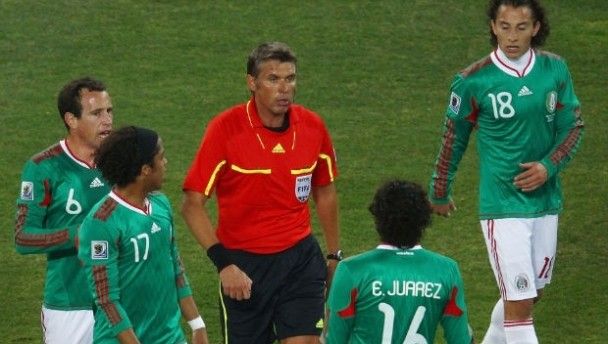
That might sound somewhat admirable, but it is absolutely absurd. If something is already there, it makes no sense not to use it. In the Mexico v Argentina match, Rosetti saw that his offside decision was wrong on the big screen. He couldn’t disallow the goal, however, because of FIFA’s ban on using technology.
He was surrounded by angry Mexican players, and the distressed look on his face said it all. He had no choice but to let an unfair goal stand. If he hadn’t, he would certainly have been sent home for disobeying FIFA instructions. FIFA seem to like to make scapegoats out of referees, because it takes the attention off them.
FIFA argue that video technology would slow down the game. All you need is a fourth official to look at an incident on a TV screen and to tell the referee his opinion on an ear piece. It would take about 30 seconds. In fact, the arguments went on so long at the Mexico match, that in that instance, it would have saved time.